

Thai food is one of the most written-about cuisines in the world, which also means it is one of the most misrepresented. The version most visitors encounter — the pad thai at the airport, the green curry at the resort, the spring rolls on the tourist menu — is a curated, internationally calibrated version of the food that Thai people actually eat. It is not bad. It is also not the point.
This guide is not a complete inventory of Thai dishes. It is a deliberately short list of the ones that genuinely reward seeking out, with specific information about where to find them properly made and what the tourist version has done to obscure them. Geography matters here more than most food guides acknowledge: Thailand is not a single cuisine but a collection of regional food cultures that barely overlap.
This is a quick recap of what we have decided to cover in this Thailand food guide. There’s more, way more, and Thai food is also the reason why we keep coming back and we keep falling in love with Thailand and its culture.
| Dish | Region | Where to Find the Best Version | Miss It If… |
| Khao Soi | North | Chiang Mai — Khao Soi Khun Yai or Lam Duan on Faham Rd | You’re only going south |
| Sai Ua | North | Any morning market in Chiang Mai or Chiang Rai | You don’t eat pork |
| Som Tam | Everywhere | Isaan-style stalls, northeast villages, Bangkok street | You can’t handle real spice |
| Boat Noodles | Bangkok | Victory Monument area, Ayutthaya floating market | You want a light meal — it’s intense |
| Khao Man Gai | Everywhere | Dedicated shophouses open from 6am. Bangkok’s Pratunam | You expect complexity — it’s deliberately simple |
| Tom Kha Gai | Everywhere | Any non-tourist Thai restaurant. Not resort menus. | You only know the hotel version — try first |
| Massaman Curry | South | Muslim-owned restaurants in the south, Bangkok’s Yaowarat | You avoid rich, slow-cooked food |
| Pad See Ew | Everywhere | Wok stalls at any fresh market, lunch hour | You’ve already committed to pad thai — get this instead |
| Mango Sticky Rice | Everywhere (seasonal) | April–June only for quality. Warorot Market, Chiang Mai | Mangoes are out of season — it’s not the same dish |
| Roti (southern) | South | Ao Nang, Krabi Town, Koh Lanta — Muslim street vendors | You’re not going south |
Before the Dishes: Where You Eat Matters as Much as What You Order
The venue hierarchy in Thai food runs roughly as follows, from best to worst for authentic quality:
| Venue Type | What It Delivers | Price Signal | Honest Assessment |
| Morning market stalls (6–10am) | The most local food in any Thai city. Dishes cooked for a Thai breakfast clientele. | Lowest — 30–80 THB per dish | The best food in Thailand is at this level. Most tourists never reach it. |
| Shophouse restaurants (no English sign) | One or two dishes, made all day, by people who have made nothing else for twenty years. | Low — 50–120 THB | The single most reliable food decision you can make in Thailand. |
| Night market and walking street stalls | Variable — some excellent, some tourist-facing. Follow the crowd, not the sign. | Low–medium — 60–150 THB | Quality depends entirely on who is eating there. Find the Thai queue. |
| Mid-range Thai restaurant (English menu) | Broader selection, consistent, cleaner environment. Food calibrated for mixed audience. | Medium — 120–300 THB | Fine. Not where the interesting food is. |
| Hotel restaurant / resort Thai food | Internationally adapted. Less spice, less fermented flavour, more familiar textures. | High — 300–800 THB | The furthest point from real Thai food. Eat here when nothing else is open. |
The most useful question you can ask anywhere in Thailand: point at what a nearby Thai person is eating and say ‘an nan’ (that one). You will get the dish that person ordered, at the price they paid, with no tourist calibration applied.
The Dishes
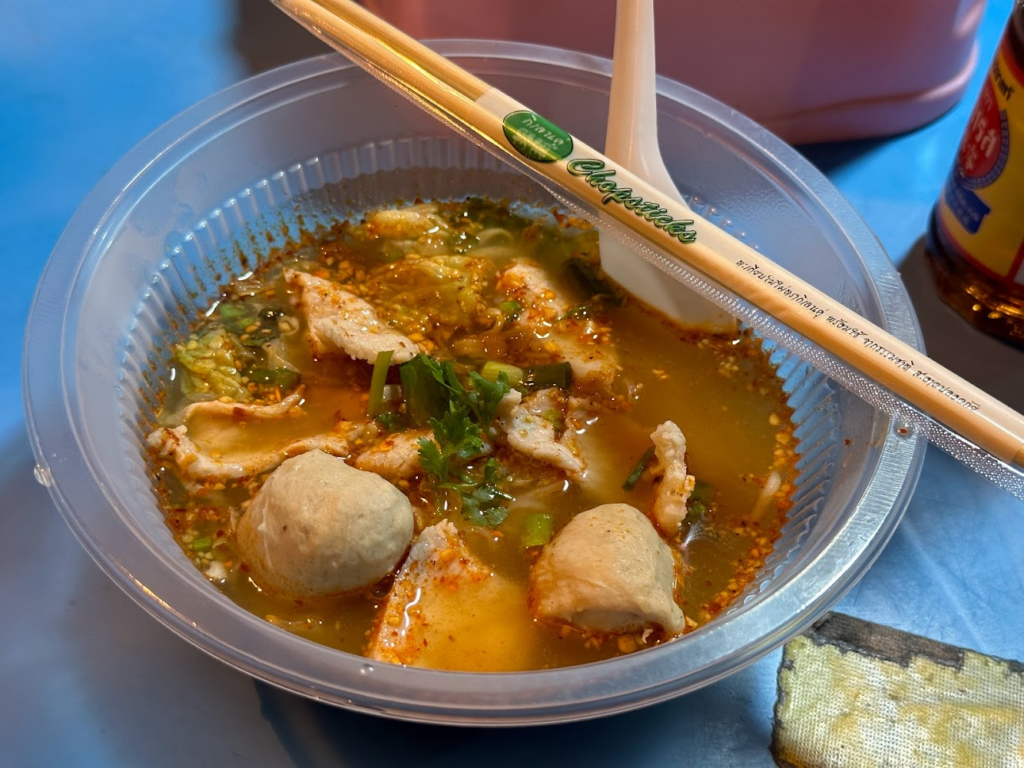
Khao Soi — The North’s Defining Dish
Khao soi is egg noodles served in a coconut-curry broth, topped with a nest of crispy fried noodles, and accompanied by pickled mustard greens, shallots, lime, and chilli paste. It belongs specifically to the Lanna culture of Northern Thailand and exists in nothing like the same form anywhere further south. Every shop makes it differently — the broth ranges from light and delicate to intensely rich, the protein is usually chicken, beef, or pork.
The best khao soi in Thailand is on Faham Road in Chiang Mai, about 10 minutes east of the Old City. Khao Soi Khun Yai and Khao Soi Lam Duan are adjacent shophouses that have been serving the same recipe for decades to the same mix of Thai workers and informed visitors. Both sell out by 1–2pm and close for the day.
What to avoid: khao soi served at restaurants that also do pad thai, massaman, and twenty other dishes. Khao soi requires a specific broth that takes hours. Restaurants spreading attention across a large menu are not making the broth correctly.
Order khao soi before noon. Ask for ‘ped’ (spicy) if you want the real heat level. Stir the condiments in as you eat — the pickled mustard greens cut through the richness in a way that changes the dish completely as you get to the bottom of the bowl.
Sai Ua — Northern Pork Sausage That Travels Badly
Sai ua is a coarse-ground pork sausage seasoned with lemongrass, galangal, kaffir lime leaf, shallots, dried chilli, and shrimp paste — grilled over charcoal until the casing blisters and the herbs inside become fragrant. It is eaten with sticky rice and raw vegetables, and it is one of the most aromatic things you will encounter in Thailand.
It is also one of the most geography-dependent dishes in Thai food. Sai ua sold outside Northern Thailand — in Bangkok supermarkets, at tourist markets anywhere south of Chiang Rai — is a pale, often flavourless version of the original. The herbs that define it lose potency when the sausage travels. Find it at morning markets in Chiang Mai and Chiang Rai, grilled fresh, and eat it within 20 minutes of the grill.
Som Tam — Papaya Salad, But Not the Version You Think You Know
Som tam is made everywhere in Thailand but it originated in the northeastern Isaan region and the Isaan version — made with fermented fish sauce (pla ra), raw crab (poo), or both — is a completely different experience from the tourist-facing som tam Thai, which uses dried shrimp and fish sauce.
The tourist version is not wrong. It is genuinely good. But if you order som tam at a proper Isaan stall and say nothing, you will get the real version: funkier, more complex, often more sour, sometimes containing raw blue crab that still moves. The heat is structural, not decorative.
The varieties worth understanding: Som tam Thai (fish sauce, dried shrimp, peanuts — the tourist default). Som tam poo (raw crab, pla ra fermented fish — the Isaan version). Som tam pu pla ra (both — the most pungent and complex). Specify which one you want, or specify ‘mai sai pla ra’ (no fermented fish) if you want to stay in safer territory.
If you order som tam at an Isaan market stall without specifying, you may receive raw crab and fermented fish in a quantity that surprises you. This is not a mistake — it is what the dish is. Know what you’re ordering.
Boat Noodles — Bangkok’s less known Bowl
Boat noodles (kuay tiao ruea) were historically sold from boats in the canals of central Thailand — small portions of intensely dark, rich broth built on pork or beef with blood, herbs, and five-spice. The canal-boat serving format meant each portion was tiny; you ordered three or four at a time. The serving size persists today even in land-based restaurants.
The broth is the point: dark, thick, complex in a way that most Thai soups are not. It is not a dish you encounter at tourist restaurants because it is labour-intensive to make properly and the appearance (nearly black from the blood and dark soy) is challenging for a tourist-facing menu.
Bangkok’s Victory Monument area has a concentration of dedicated boat noodle shops — small, lunchtime-only, often with queues of office workers. Ayutthaya also has a surviving floating boat noodle market that is worth visiting for the context as much as the food.
Khao Man Gai — The Thai Dish Nobody Talks About and Everybody Should Eat
Poached chicken — skin-on, pulled at exactly the moment it stops being pink — served over rice cooked in the same chicken broth, with a small bowl of the broth on the side, sliced cucumber, and a sauce made from fermented yellow beans, ginger, garlic, and chilli. That is the entire dish. It is extraordinarily precise.
Khao man gai is eaten primarily at breakfast and lunch. The shops that do it well open at 6am and sell out by early afternoon — they make one thing and they make it until it is gone. The bird matters: restaurants using free-range or locally raised chicken produce a different texture and flavour from the factory chicken that most tourist restaurants source.
Bangkok’s Pratunam area has some of the most cited khao man gai vendors in the city. In Chiang Mai, look for dedicated shophouses with the whole birds hanging in the window. The hanging birds are the signal: this shop does nothing else.
Khao man gai is the best test of a Thai restaurant’s ingredient sourcing. When the dish has only four components, every one of them has to be right. A bad khao man gai tells you more about a restaurant than a mediocre pad thai does.
Tom Kha Gai — What It Is When It’s Made Properly
Coconut milk soup with galangal, lemongrass, kaffir lime leaves, mushrooms, and chicken — the Thai name translates literally as ‘boiled galangal chicken.’ The defining ingredient is not the coconut milk but the galangal: fresh galangal has an almost medicinal, piney quality that dried or powdered galangal completely loses. A properly made tom kha gai has a broth that is both rich and sharp, coconut-sweet at the front and galangal-hot at the back.
The hotel and resort version is a mild coconut soup that is pleasant and bears a family resemblance to the original. The real version has a sourness (from the lime juice and lime leaves added off the heat) and a galangal bite that the tourist version removes in the interest of accessibility. Order it at any mid-range or street-level Thai restaurant where you can see the kitchen. Ask for ‘ped’ if you want the heat that balances the richness.
Massaman Curry — The South’s Most Complex Curry
Massaman is a southern Thai curry with roots in the Muslim communities that have traded and settled along Thailand’s southern coasts for centuries — the name derives from ‘Mussulman’ (Muslim), and the spice profile reflects Persian and Indian influence: cinnamon, cardamom, cloves, star anise, alongside the Thai base of lemongrass, galangal, and chilli. It is the richest, most complex curry in the Thai repertoire and the least fiery — warmth rather than heat.
It is also the curry most commonly ruined by tourist-facing restaurants, which reduce the paste’s complexity in the interest of consistency and add excessive coconut milk sweetness. The dish at its best — slow-cooked beef or lamb with whole spices, potato, and roasted peanuts, in a broth that has been building for hours — is almost unrecognisable from the watery version served in most resort restaurants.
Find the real version at Muslim-owned restaurants in the south (Krabi Town, Ao Nang’s back streets, Hat Yai) or in Bangkok’s Yaowarat (Chinatown) area, where southern Thai cooking has a historical presence.
Pad See Ew — Order This Instead of Pad Thai
Pad see ew is wide rice noodles stir-fried in a wok over very high heat with dark soy sauce, egg, Chinese broccoli (gai lan), and your choice of protein. The dish requires genuine wok fire — the ‘wok hei,’ the breath of the wok, produced only at temperatures home stoves cannot reach — and the best versions come from wok stalls at lunch markets where the cook is firing the wok continuously and the temperature never drops.
It is almost never on tourist restaurant menus, which is precisely the recommendation. It is a dish that Thai people eat several times a week. It costs 60–80 THB at a market stall. It takes 3 minutes to cook when done right. The noodles should have slight char marks, the egg should be barely set, the Chinese broccoli should still have bite.
Why not pad thai? Pad thai is genuinely Thai — it was promoted by the government in the 1940s as a national dish — but it has been so thoroughly adapted for international palates that most tourist versions share little with the versions Thai people eat. Pad thai at a market stall cooked for a Thai customer is different from pad thai at a restaurant on Khao San Road. Pad see ew has not been through the same adaptation cycle.
Pad thai on a tourist menu is not the same dish as pad thai at a market stall made for a Thai lunch crowd. The tamarind balance, the egg texture, the dried shrimp intensity, and the noodle char are all different. If you want to try pad thai, find a stall where it is the only thing being made.
Mango Sticky Rice — Seasonal, and the Season Matters
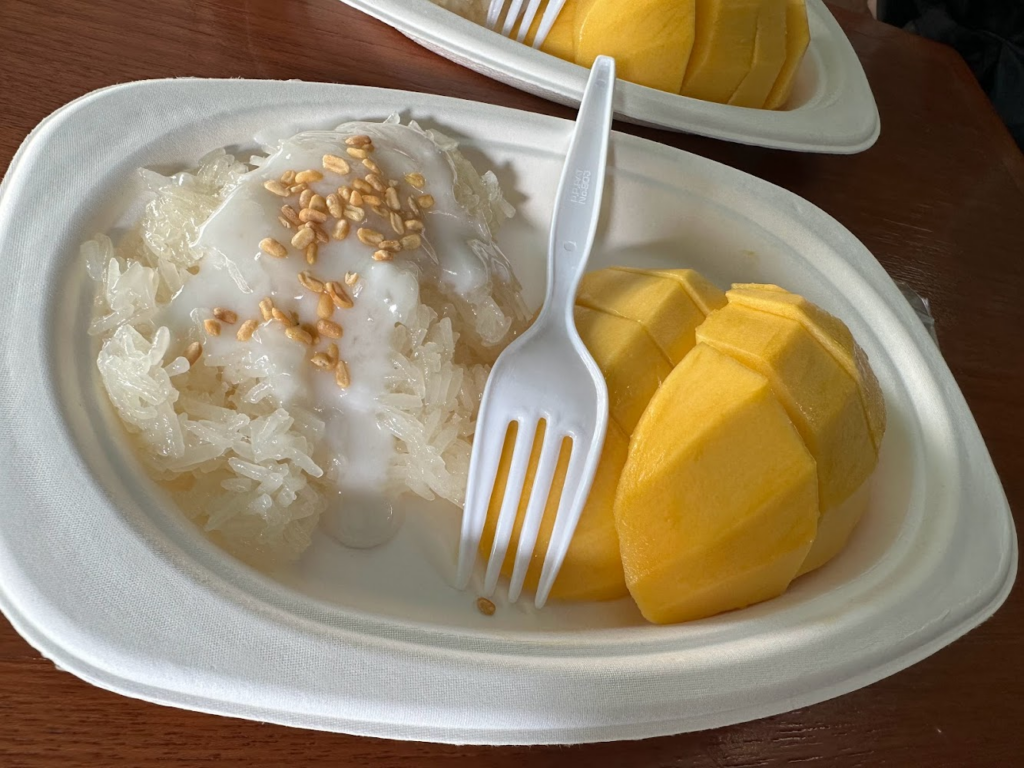
Glutinous rice steamed in coconut milk and sugar, served warm alongside cold sliced mango with a coconut cream drizzle. The dish is the sum of two components, and one of them — the mango — is irreducibly seasonal. The mangoes that make khao niao mamuang extraordinary are the Nam Dok Mai and Mahachanok varieties, which peak from April to June. Outside that window, the mangoes available are either unripe, imported, or inferior varieties that lack the honey-floral sweetness the dish requires.
A mango sticky rice made with a good Nam Dok Mai mango in May is one of the best things you can eat in Thailand. The same dish in December uses a mango that has been in cold storage or flown in at cost, and the gap in quality is enormous. Tourist restaurants serve it year-round regardless of this reality.
Warorot Market in Chiang Mai and the Chatuchak weekend market in Bangkok both have excellent seasonal mango sticky rice vendors. Look for stalls where the mango is cut to order and the sticky rice is kept warm, not sitting in a refrigerated display case.
The coconut cream on top should be lightly salted. The salt is essential — it is what makes the sweetness of the mango and rice make sense rather than collapse into cloying. If the coconut cream is not salted, the vendor has simplified the recipe for tourists.
Southern Roti — Street Food With a History
The roti of southern Thailand is a thin flatbread of Indian-Muslim origin, cooked on a flat iron griddle. It arrives in two fundamentally different forms. The savoury version is served with a bowl of curry for dipping — massaman or a yellow curry made at the same stall. The sweet version is folded around banana and egg, drizzled with condensed milk and sugar, and eaten hot off the griddle. Both are correct. Both are exceptional.
Roti vendors in southern Thailand — Krabi Town, Ao Nang, Koh Lanta, Hat Yai — are typically Muslim-owned and operate from small carts or street stalls, often in the early morning and evening. The cook folds and stretches the dough with a technique that thins it to near-translucency before hitting the oiled griddle. The result has crispy edges and soft interior layers. It is nothing like Indian roti, and the comparison misleads people into underestimating it.
What Tourist Restaurants Have Done to Thai Food
Understanding the adaptations that have been made to Thai food for international consumption helps you identify when you are getting the real version and when you are not. The changes are not sinister; they are rational responses to market feedback but they are significant.
| Original Element | Tourist Adaptation | Why It Matters |
| Fermented fish (pla ra, kapi) | Reduced or eliminated — strong smell, challenging flavour | The funk is structural to dishes like som tam. Without it, the dish is missing its bass note. |
| Galangal (fresh) | Replaced with dried or powdered galangal, or reduced | Fresh galangal’s piney, medicinal heat cannot be replicated. Tom kha without it is mild coconut soup. |
| Chilli levels | Halved or quartered for tourist-default orders | Thai spice calibrated for foreigners is not the dish. Say ‘ped Thai’ (Thai spicy) to override. |
| Wok temperature | Home stoves and semi-commercial kitchens can’t reach wok hei temperature | Pad see ew and pad thai require charring that lower temperatures cannot produce. Market stalls with live-fire woks are the only reliable source. |
| Palm sugar vs white sugar | Palm sugar swapped for white sugar in many tourist kitchens | Palm sugar adds a caramel-molasses depth. The swap flattens curries and sauces. |
| Msg and seasoning powder | Used extensively in tourist restaurants as a shortcut | Not a health concern at food quantities, but a signal that the base stocks and pastes are not being made from scratch. |
thai Dishes to Skip (or at Least to Calibrate Expectations For)
Tom Yum Goong (Prawn Tom Yum) — at Tourist Restaurants
Tom yum is a genuinely great soup when made with quality stock and fresh aromatics — lemongrass, galangal, kaffir lime, fresh chilli. At tourist restaurants, it is almost universally made with instant seasoning paste, bouillon cube stock, and farmed prawns that have been frozen. The result is sour and hot but hollow. Find it at a shophouse or market stall where you can see the whole aromatics going into the pot, or skip it until you find a version that justifies its reputation.
Thai Green Curry — Outside Thailand
We are including this because visitors who have eaten Thai green curry in their home country arrive expecting the dish they know and are surprised by how different the Thai version is. Abroad: coconut-heavy, mild, often sweet. In Thailand: the paste is more prominent, the basil (Thai holy basil, not sweet basil) is sharper, the fish sauce is stronger, the coconut milk is used more sparingly. Both are called green curry. They are different dishes.
Spring Rolls on a Tourist Menu
Spring rolls exist in Thai cuisine but they are not a significant or interesting part of it. They appear on tourist menus because they are recognisable and easy to produce in quantity. Ordering them at a Thai restaurant is not wrong — it is just using your eating capacity on the least interesting thing available. The same applies to prawn crackers, satay skewers as a starter, and anything described on a tourist menu as ‘suitable for all tastes.’
THAI food: Frequently Asked Questions
Khao soi, if you are going to Northern Thailand. It is the only major Thai dish that has no equivalent elsewhere in the country and no widely available international version — meaning the only place to try it properly is Chiang Mai. Som tam, if you eat everywhere and want to understand how Thai food actually works at street level. It is the country’s most democratically eaten dish, from royal kitchens to roadside stalls.
Yes, for the vast majority of dishes from the vast majority of stalls that operate in daylight hours in any Thai city or tourist area. The two genuine risk factors: raw or undercooked animal products (raw crab in som tam poo, raw pork in some northern larb styles — ask about these specifically), and food that has been sitting out in heat for hours at low-traffic stalls. Food cooked to order in front of you, served hot, from a stall with visible turnover is safe. The ‘follow the crowd’ principle is not just about food quality — it is also a reliable hygiene indicator.
Chiang Mai for Northern Thai cuisine — no other city has the density and quality of khao soi, sai ua, and northern market food. Bangkok for range and ambition — the city has every regional Thai cuisine, plus some of the best Chinese-Thai and Muslim-Thai cooking in the country. The south (Krabi Town, Hat Yai) for southern food specifically — the roti, massaman, and fresh seafood in southern Thai preparations are only properly eaten at the source.
Thai food is built on four flavours in balance: spicy, sour, salty, and sweet. No single dish is purely one of these — the complexity comes from how they play against each other. The sour element comes from lime, tamarind, or fermented fish. The salt from fish sauce or shrimp paste. The sweet from palm sugar or coconut milk. The heat from fresh or dried chilli. A good Thai dish shifts between these four elements as you eat it — you might taste the lime first, then the fish sauce, then the chilli builds. When a dish is flat or one-dimensional, one of those four elements is missing or suppressed.
With effort and explicit communication. Thai cooking uses fish sauce, shrimp paste, and dried shrimp as foundational seasonings in almost everything — including dishes that contain no visible seafood. Asking for ‘jay’ (the Thai term for the strict Buddhist vegetarian diet that excludes all animal products) reliably produces a meat-free and seafood-seasoning-free version of most dishes, because it is a recognised cooking mode with its own established tradition. ‘Mangsawirat’ (vegetarian) is a slightly looser request. Tofu stalls and pure vegetarian restaurants (jay restaurants are usually yellow-signed) exist in most Thai cities and are reliable.