

Few islands in Southeast Asia generate more debate than Koh Phi Phi.
The photos look extraordinary: bright turquoise water, white sand and huge limestone cliffs rising almost vertically from the sea.
Those photos are real.
The question is whether the experience around them lives up to what you imagine.
When we arrived in Phi Phi, our first reaction was not paradise. It was noise, crowds, pollution and an extraordinary amount of tourism squeezed into a very small place. Tonsai felt more like a tourism machine than the tropical island we had been sold.
But then you get into the water.
And that is where Phi Phi becomes much harder to dismiss.
Our verdict: Koh Phi Phi is worth visiting for the sea, snorkelling, diving and limestone scenery. I would not choose it for peace, authentic local life or a relaxed multi-day island stay.
That distinction is the key to enjoying it.
Is Koh Phi Phi Worth Visiting?

Yes — if you go for the things Phi Phi genuinely does exceptionally well.
The water around the islands is beautiful, the limestone landscape is extraordinary and the underwater experience can justify putting up with a lot of what happens on land.
I would go to Phi Phi if:
- snorkelling or diving matters to you;
- you want to see the famous Andaman limestone scenery;
- you are combining several islands;
- nightlife and a busy atmosphere do not bother you;
- you are happy to stay away from Tonsai if you want quiet.
I would reconsider it if your image of a Thai island is an empty beach, a peaceful village and evenings spent listening to the sea.
For that, I would choose Koh Lanta.
The mistake is not going to Phi Phi.
The mistake is going there expecting it to be something it no longer is.
Why Go to Koh Phi Phi: The Water Really Is That Good
Strip away the crowds and commercialisation and the sea around Phi Phi is still genuinely impressive.
The colour is not Photoshop.
Around Phi Phi Don and the surrounding islands you find excellent snorkelling, clear water and some of the best-known dive sites in this part of the Andaman Sea.
Thailand’s tourism authority specifically highlights diving and snorkelling as two of Phi Phi’s major attractions and notes the rich marine life around the islands.
Bida Nok and Bida Nai, south of Phi Phi Don, are particularly well known among divers.
If underwater experiences are one of the main reasons you are travelling in southern Thailand, Phi Phi makes considerably more sense than it does purely as a beach destination.
The sea is the island’s strongest argument.
Why You Might Not Like Koh Phi Phi
The problem is what happens once everybody gets out of the water.
Tonsai Village occupies a narrow strip of flat land between Tonsai Bay and Loh Dalum Bay and absorbs an enormous amount of visitor activity into a very small area.
Restaurants, bars, dive shops, hostels, tour offices and souvenir stores sit almost on top of one another.
It works.
But it does not feel remotely relaxed.
Thailand’s tourism authority openly describes Phi Phi as having vibrant nightlife, with dozens of bars and restaurants around Tonsai and a busy maze of businesses through the village.
At night, parts of Phi Phi are loud.
During the day, the main settlement becomes busy with people arriving from ferries and organised tours.
So if you go looking for an untouched Thai island community, you are going to be disappointed.
That does not make Phi Phi inherently bad.
It just makes it important to understand what you are booking.
Maya Bay: Is It Worth Visiting?
Maya Bay is the image most people associate with Phi Phi.
It became internationally famous after appearing in The Beach in 2000 and eventually became so heavily visited that Thai authorities closed it completely in 2018 to allow the ecosystem to recover.
It reopened in 2022 under much stricter rules.
Today, boats do not land directly on Maya Bay’s beach. Visitors arrive through Loh Samah on the opposite side of Phi Phi Leh and walk to the bay via a boardwalk.
Swimming in Maya Bay itself remains prohibited under the conservation rules.
And the bay now closes every year from 1 August to 30 September, reopening on 1 October. The 2026 season followed that same schedule.
So the Maya Bay experience today is very different from the photographs many travellers still have in mind.
You are visiting a protected viewpoint and beach rather than spending the afternoon swimming in an isolated tropical bay.
What Time Is Maya Bay Least Crowded?
This is where a lot of travel advice becomes unrealistic.
You will often read that you simply need to take an early-morning tour and you will have Maya Bay to yourself.
Do not plan around that assumption.
Maya Bay currently operates with controlled entry, timed visits and visitor limits. Current 2026 guidance lists opening hours of roughly 07:00–18:00, with visits managed in timed rounds.
The earliest visits generally give you the best chance of seeing the beach before the heaviest day-trip traffic builds, but early does not mean empty.
A sensible way to think about the day is:
Early morning
Usually your best chance of lower visitor numbers.
But multiple tour operators sell early departures, so you are unlikely to have the bay to yourself.
Late morning to early afternoon
This is the period I would expect to be busiest because organised trips from Phuket, Krabi and Phi Phi Don overlap.
Later afternoon
Crowds may ease as mainland day trips begin working their way back towards Phuket and Krabi, although conditions vary by day and season.
The important point is:
Visit Maya Bay because you want to see it, not because somebody sold you an “exclusive” empty-beach fantasy.
The days when thousands of visitors could simply arrive, swim and anchor boats inside the bay are gone — and that is probably a very good thing.
Is Maya Bay Overrated?
For us, yes. We skipped it.
That does not mean Maya Bay is ugly. Quite the opposite.
The cliffs, sand and water are genuinely beautiful. But beauty is not the same thing as experience.
If seeing one of Thailand’s most famous beaches matters to you, go. Just understand that you are visiting a controlled, highly popular attraction where swimming is prohibited and your time is limited.
I would not organise an entire Phi Phi trip around it.
And if I had to choose between spending more time looking at Maya Bay and spending more time in the water elsewhere around Phi Phi, I would choose the water.
Pileh Lagoon Is the Phi Phi Leh Stop I Prefer
Maya Bay gets the headlines. Pileh Lagoon is the place that better represents what makes Phi Phi extraordinary to me.
It sits inside Phi Phi Leh, surrounded by vertical limestone walls and intensely coloured water.
Most Phi Phi Leh boat trips include both areas, so you do not necessarily have to choose one or the other.
But if I were thinking about where I actually wanted to spend my boat-trip time, Pileh would be higher on my list.
The problem, again, is timing.
It is popular too. Go early enough to avoid the densest concentration of boats if your tour allows it.
Should You Stay on Koh Phi Phi or Visit on a Day Trip?
Stay overnight if you want to understand Phi Phi beyond Maya Bay and the daytime crowds.
A day trip makes sense if your only goals are:
- seeing Maya Bay;
- doing some snorkelling;
- photographing the limestone scenery;
- returning to Phuket or Krabi the same evening.
But you will experience Phi Phi at its busiest.
Staying at least one night gives you something day-trippers do not get: time.
Once mainland tours begin leaving, Phi Phi feels different. You can go to a quieter beach, stay for sunset, have dinner without thinking about your return ferry and explore again the following morning.
There are also current year-round ferry connections between Phi Phi and both Phuket and Krabi, so it remains straightforward to use Phi Phi as one stop within a wider Andaman itinerary rather than a standalone holiday.
For most travellers, I think one night is enough. Two nights makes sense if you want to dive or spend substantial time on the quieter beaches.
The Best Beaches on Koh Phi Phi
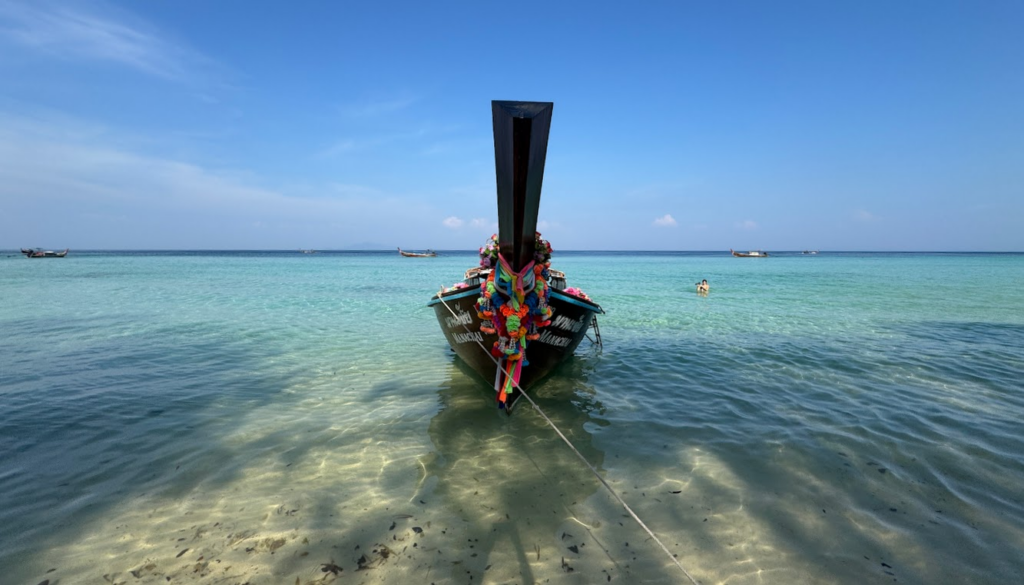
The beaches that make me understand Phi Phi’s reputation are not necessarily the places where everybody arrives.
The best strategy is to get away from Tonsai.
Loh Ba Kao Bay — Best for a Quieter Stay
Loh Ba Kao Bay sits on the northeast side of Phi Phi Don and feels dramatically removed from Tonsai.
The beach is wide, the water is shallow and the entire area is considerably quieter.
If I wanted to stay overnight on Phi Phi and cared about sleep, this is the area I would consider first.
You sacrifice some convenience.
That is precisely why it works.
Staying here means you can visit the busier parts of Phi Phi when you want to without having to sleep in the middle of them.
Long Beach — Best Balance of Access and Beach Time
Long Beach sits southeast of Tonsai and is close enough to reach relatively easily while still feeling substantially calmer than the main village.
You can reach it by longtail boat or on foot via the trail from Tonsai.
This is a good option if you want to stay within relatively easy reach of the main settlement but still have a proper beach outside your door.
The water is also good for snorkelling.
For many first-time visitors, Long Beach is probably the easiest compromise.
Maya Bay — Best for the Famous View
Maya Bay is not somewhere I would choose for beach time because beach time is no longer really what the experience is about.
Swimming is prohibited, visits are controlled and crowds are part of the experience.
Go because you want to see the landscape made famous by The Beach.
Do not go because you expect a quiet day on the sand.
Pileh Lagoon — Best for the Water
For pure scenery on Phi Phi Leh, this is my choice.
The limestone walls and water create exactly the experience people imagine when they picture the Phi Phi Islands.
You need a boat to reach it.
And yes, there will usually be other boats.
It is still worth seeing.
Tonsai Bay — Best for Arriving and Leaving
Tonsai Bay is practical.
The ferry arrives here, the village is here and almost everything on Phi Phi Don connects through it.
That does not make it the beach I would choose for swimming or relaxing.
Use Tonsai as your transport and logistics hub. Then leave it.
Tonsai Village: What It Is Actually Like
Tonsai has almost everything a visitor needs. Restaurants, cafés, diving operators, convenience stores, bars, accommodation and travel agencies are all packed into a small area.
The food is better than you might expect from somewhere so heavily tourist-oriented. You can still find decent Thai food and good seafood if you move beyond the most obvious tourist-facing restaurants.
But I would not describe Tonsai as an authentic Thai village. The atmosphere is commercial because tourism is what sustains much of the settlement.
If that bothers you, stay elsewhere on the island.
If you are backpacking and want to meet people, drink and have everything within walking distance, you may love it.
Is the Phi Phi Viewpoint Worth It?
Yes. If there is one land-based activity I would make time for, it is the viewpoint above Tonsai. From above, you get the classic view of Phi Phi Don’s narrow centre with Tonsai Bay on one side and Loh Dalum Bay on the other.
It also helps you understand the geography of the island in a way you cannot from ground level. Go early or towards late afternoon rather than climbing in the strongest midday heat.
Who Should Visit Koh Phi Phi?
Phi Phi works particularly well for:
Divers and snorkellers
This is where the island is strongest.
Island-hoppers
Phi Phi works well as part of a route through Phuket, Krabi and Koh Lanta rather than necessarily as your final destination.
Backpackers and people who enjoy nightlife
If you like energy and a social atmosphere, Tonsai delivers it.
Travellers who want spectacular scenery
The combination of cliffs and turquoise water is undeniably impressive.
Who Should Skip Koh Phi Phi?
I would think twice if you are:
Looking for quiet
You can find quieter pockets, but quiet is not what defines the island.
Looking for local culture
Koh Lanta or mainland Krabi give you more opportunity to experience ordinary local life.
Travelling primarily for long, peaceful beach days
Again, I would choose Koh Lanta.
Very sensitive to noise
Avoid Tonsai and Loh Dalum in particular. Where you sleep will completely change how you feel about Phi Phi.
Koh Phi Phi vs Koh Lanta
These islands make an interesting comparison because they are geographically close but almost opposite experiences.
Choose Phi Phi if you want:
- dramatic scenery;
- snorkelling and diving;
- nightlife;
- a short high-energy island stop.
Choose Koh Lanta if you want:
- longer beach stays;
- less crowding;
- a stronger sense of local community;
- easier slow travel;
- somewhere you can comfortably stay four or five nights.
If you have time, do both.
Current ferry services connect Phi Phi and Koh Lanta, with journey times varying by operator and vessel.
I would personally visit Phi Phi first and Koh Lanta afterwards.
The sequence gets progressively calmer.
Koh Phi Phi vs Krabi
Krabi is the better base if you want more flexibility.
Stay around Ao Nang or Railay and you can combine beaches, limestone scenery and multiple island trips without living inside the intensity of Phi Phi.
Phi Phi is better if you specifically want to experience the islands themselves after the day-trip boats leave.
So the question is less:
Which one is prettier?
and more:
Do you want Phi Phi to be the trip, or something you visit during the trip?
How to Get to Koh Phi Phi
There is no airport on Phi Phi.
You arrive by boat.
From Phuket
Most services leave from Rassada Pier.
Current schedules show multiple daily ferry and speedboat options between Phuket and Tonsai Pier, with crossing times varying substantially depending on vessel and service.
From Krabi
Krabi also has multiple daily connections to Phi Phi, including ferry and speedboat services.
Current schedules show year-round sailings, although weather can affect departures.
From Koh Lanta
Phi Phi and Koh Lanta are straightforward to combine.
Current schedules list several services on the route, with fast crossings taking around 30 minutes and conventional ferries closer to an hour.
Whatever route you use, check the actual timetable for your dates rather than assuming old ferry times are still valid.
How Do You Get Around Koh Phi Phi?
You walk. That is one of the strangest adjustments if you arrive after travelling around larger Thai islands.
The central area of Phi Phi Don is compact and pedestrianised.
For beaches that are further away, longtail boats effectively become taxis.
This makes where you stay particularly important.
A cheap hotel in the wrong part of the island may mean either walking further than expected or repeatedly paying for longtail transfers.
When Is the Best Time to Visit Koh Phi Phi?
Thailand’s tourism authority recommends November to April, when rainfall is generally lower and conditions are more favourable for island travel.
December to February usually brings the biggest crowds alongside some of the most reliable weather.
November, March and April can be useful compromises if you want good conditions without travelling exactly at Christmas and New Year.
Remember that Maya Bay has its own closure schedule and is closed annually from 1 August through 30 September.
If Maya Bay is important to your trip, factor that into your dates.
How Long Should You Stay on Koh Phi Phi?
One night is enough for most travellers.
That gives you time to:
- arrive without rushing;
- spend time on a quieter beach;
- snorkel or take a boat trip;
- see the viewpoint;
- experience the island after some day visitors have left.
Stay two nights if diving is a priority or if you are deliberately staying somewhere quiet such as Loh Ba Kao.
I would not automatically book four or five nights here.
For that kind of slower island stay, I prefer Koh Lanta.
Final Verdict: Is Koh Phi Phi Worth It?
Koh Phi Phi is both better and worse than its reputation. The landscape really is spectacular. The water really can look exactly like the photographs. And if you snorkel or dive, the sea around the islands is the strongest argument for coming.
But the crowds, noise and commercialisation are equally real. Trying to pretend otherwise does not help anybody plan a better trip.
So would I visit? Yes. But I would not go expecting a peaceful tropical paradise.
I would stay one night, avoid sleeping in the loudest parts of Tonsai, spend as much time as possible in or around the water and treat Maya Bay as one stop rather than the reason for the entire trip.
And then I would take the ferry to Koh Lanta. Phi Phi is worth seeing. You just need to know which version of it is actually worth your time.