

Thailand is one of the most well-trodden destinations in the world, and with that comes an enormous amount of tourism infrastructure that has very little to do with authentic experience. Many of the excursions marketed most aggressively at visitors — the ones that fill the hotel lobby leaflet racks and Khao San Road tour desks — are either ethically problematic, deeply staged, or simply not very good.
This guide focuses on excursions that are worth your time, your money, and your conscience: day trips and half-day activities that deliver something real, educational, beautiful, or memorable without contributing to industries that harm animals or manufacture culture for consumption. We started to question the standard tourist circuit once I realised how often the most popular excursions prioritised volume over experience. Since then, we have tended to look for trips that feel less rushed, less crowded, and more connected to the landscape, the people and the rhythm of the place.
At a Glance: Thailand Excursions by Region
| Bangkok base | Ayutthaya, Kanchanaburi, Khao Yai National Park, Amphawa canal boat (not the floating market) |
| Chiang Mai base | Chiang Rai temples, Doi Inthanon, Doi Suthep, Mae Hong Son, cooking class, village trekking |
| Krabi / Phuket base | Phang Nga Bay kayak, Koh Hong, Similan Islands diving, Khao Sok National Park |
| Koh Samui base | Ang Thong Marine Park, Koh Nang Yuan, snorkelling Koh Tao, full moon preparation |
| Best for history | Ayutthaya (day trip from Bangkok) — UNESCO World Heritage, 14th–18th century ruins |
| Best for nature | Khao Sok National Park — 160-million-year-old rainforest, lake, gibbons, hornbills |
| Best for water | Phang Nga Bay by kayak — sea caves, mangroves, James Bond island without the main-boat crowds |
| Most underrated | Kanchanaburi — WWII history, Death Railway, River Kwai, jungle waterfalls, almost no crowds |
Excursions to Avoid in Thailand and Why
Before the list of what to do, it is worth being direct about what not to do. These are the most widely marketed excursions in Thailand. They appear in guidebooks, on hotel concierge lists, and all over social media. They are also, without exception, either ethically harmful, deeply performative, or both.
Elephant Sanctuaries and Camps
This one requires nuance, because the marketing around it is sophisticated. Most facilities in Thailand that call themselves ‘sanctuaries’ or ‘ethical elephant experiences’ are not sanctuaries in any meaningful sense. They are tourist camps using welfare-adjacent language to charge premium prices for the same basic activity: close human contact with elephants that are kept in conditions that would not be possible if the animals were genuinely wild or free-ranging.
Legitimate elephant sanctuaries — the handful that actually exist, mostly in Northern Thailand — do not offer elephant rides, elephant bathing sessions, painting demonstrations, or trekking. Elephants in the wild do not bathe tourists. That behaviour is trained, and training elephants requires methods that welfare-conscious visitors would find deeply uncomfortable if they saw them.
If an ‘elephant sanctuary’ allows you to ride, bathe alongside, or closely handle elephants, it is not a sanctuary. The marketing term is almost universally misused in Thai tourism.
The kindest thing a visitor can do for Thailand’s remaining wild and captive elephant population is not participate in any direct-contact experience, regardless of how it is described.
Floating Markets
Most of Thailand’s famous floating markets — Damnoen Saduak in particular, and to a large degree Amphawa — have become performance tourism. The boats are there because tourists expect boats. The vendors are selling to tourists, not to other locals. The ‘market’ that existed as a genuine commercial waterway for Thai communities largely ceased to function as such when the roads arrived, and what replaced it is a stage set.
Damnoen Saduak, one hour from Bangkok and the most photographed of all, is almost entirely theatrical. Rows of identical goods, boats that circle for photographs, tourist-facing food. Amphawa is more pleasant and has better food, but it too is now primarily a domestic tourism attraction rather than a living market.
If you are visiting a floating market to see how Thai people actually live and trade, you will be disappointed. You are visiting a tourist attraction themed around a historical activity. Adjust expectations accordingly — or skip it.
Tiger Selfies and Tiger Shows
Tigers in Thai tourist facilities are sedated, chained, or both. The animals used for selfie encounters spend their lives in conditions incompatible with any form of natural behaviour. The sedation practices used to make adult tigers handleable — which operators deny, and which investigators have repeatedly documented — cause long-term harm. There is no version of a tiger selfie experience in Thailand that is ethical.
Any facility where a tourist can sit next to, hold, or pose with a tiger is causing harm to that animal. Full stop. This includes venues that describe themselves as ‘rescue centres’ or ‘tiger temples’.
Animal Shows (Monkeys, Crocodiles, Snakes)
Monkey shows, crocodile shows, and snake-handling performances are common in tourist areas across Thailand. In every case, the animals involved are kept in conditions that cause stress and often physical harm, and the behaviours performed are the result of training methods incompatible with animal welfare. Crocodile ‘head in the mouth’ acts, monkey bicycle performances, and snake charming all fall into this category.
These shows persist because tourists attend them. Not attending is the only effective response.
With that context established here is what is actually worth doing.
The Best Excursions in Thailand: By Category
History and Culture
Ayutthaya — Bangkok Day Trip (★★★★★)
Ayutthaya was the capital of the Kingdom of Siam from 1350 to 1767 and at its peak was one of the largest cities in the world, with a population of around one million people. The Burmese sacked it in 1767, and what remains are the ruins of that city — temples, prangs (towers), and Buddha heads, many in states of photogenic decay.
It is 80km north of Bangkok, reachable by train in 1.5 hours from Hua Lamphong Station (around 15 THB — one of the best-value journeys in Thailand), by minivan (around 2 hours), or by the popular but slower river cruise route. Once there, the ruins are spread across a central island and best explored by bicycle or tuk-tuk. A full day is sufficient; a half day is possible but rushed.
The site is not manicured or reconstructed — it reads as a genuine archaeological landscape rather than a theme park. Wat Mahathat, with its famous Buddha head entwined in tree roots, is the most photographed; Wat Phra Si Sanphet and Wat Yai Chai Mongkhon are less visited and arguably more impressive.
Take the 6:30am train from Bangkok. You arrive before the heat builds, beat the tour groups, and have the ruins in golden morning light. The afternoon train back gives you a full day.
Kanchanaburi — The Most Overlooked Day Trip from Bangkok (★★★★)
Kanchanaburi, 130km west of Bangkok, is almost entirely absent from the standard tourist circuit despite being one of the most historically significant destinations in the country. The town sits at the confluence of the Kwai Noi and Kwai Yai rivers and was the location of the Death Railway, built by Allied prisoners of war and Asian forced labourers under Japanese occupation during World War II.
The Bridge on the River Kwai is here — smaller than most people expect, and more moving for that reason. The JEATH War Museum and the Kanchanaburi War Cemetery are both sobering and excellently maintained. Beyond the history, the surrounding landscape opens into jungle: Erawan National Park, 65km north, has seven-tiered waterfalls and pools of extraordinary clarity. Both history and nature are possible in a single long day trip.
The town itself has almost no tourist infrastructure relative to its significance. You are much more likely to be sitting next to Thai tourists here than international ones, which changes the atmosphere entirely.
The State Railway of Thailand runs a special tourist train to Kanchanaburi on weekends, travelling part of the original Death Railway route along the cliff above the river. It is slow, crowded, and genuinely memorable.
Chiang Rai Temples — Day Trip from Chiang Mai (★★★★)
Chiang Rai is 200km north of Chiang Mai and most visitors see it as a day trip, which is enough for the three temples that have made it famous in recent years. Wat Rong Khun (the White Temple) was designed by Thai artist Chalermchai Kositpipat and is still under construction — an ongoing artwork rather than a historical site. The all-white exterior inlaid with mirror pieces is strange and spectacular in equal measure.
Wat Rong Suea Ten (the Blue Temple, completed 2016) is less famous but arguably more beautiful inside — deep indigo walls, gold Buddha statues, and almost none of the crowds that descend on the White Temple by 10am. Baan Dam (the Black House), the life’s work of National Artist Thawan Duchanee, is a compound of dark-wood buildings filled with animal bones, skins, and sculpture — intense, unusual, and unlike anything else in Thailand.
Go to the White Temple at opening (8am) and it is a different place to the 10am version. The Blue Temple attracts far fewer visitors even at midday — save it for when the crowds have found Wat Rong Khun.
Sukhothai Historical Park — If You Are Passing Through (★★★★)
Sukhothai, the first capital of the Thai kingdom (founded around 1238), is 427km north of Bangkok and 300km south of Chiang Mai — more naturally a stop between the two than a dedicated day trip. But for travellers making a slow journey north, the historical park is one of Thailand’s most rewarding archaeological sites: 193 ruins across a large zone, best explored by bicycle, with far fewer visitors than Ayutthaya.
The central zone is the main attraction — Wat Mahathat (different from Ayutthaya’s), the Royal Palace, and several beautifully proportioned lotus-bud chedis. The pace here is genuinely relaxed. Hire a bicycle from the park entrance for around 50 THB and spend four to five hours at your own speed.
Nature and Wildlife (Ethical)
Khao Sok National Park — The Excursion Most People Wish They Had Done (★★★★★)
Khao Sok is Thailand’s largest area of virgin forest — 160 million years old, predating the Amazon rainforest by 100 million years. Located in Surat Thani province in southern Thailand (roughly equidistant between Phuket and Koh Samui), it is the most biodiverse region in the country: gibbons, hornbills, tapirs, elephants in the wild, and the world’s largest flower, Rafflesia kerrii, which blooms unpredictably in the forest.
The centrepiece is Cheow Lan Lake, a reservoir created by a dam in 1987 — 165 square kilometres of water surrounded by sheer karst limestone peaks rising 960 metres. Floating bungalows on the lake allow overnight stays that are as close to genuinely remote as it is possible to get on a booked excursion. The dawn on the lake — mist, gibbons calling across the water, the sun hitting the cliff faces — is a specific kind of experience that Thailand’s beach and temple circuit does not produce.
Khao Sok works better as an overnight trip than a day trip. A single night on the floating bungalows changes the quality of the experience entirely. Day tours from Phuket or Khao Lak reach the lake but give you only a few hours there.
Phang Nga Bay by Kayak — Not the Big Tour Boat Version (★★★★★)
Phang Nga Bay, the body of water between Phuket and Krabi filled with karst limestone islands, is genuinely spectacular. The problem is the way most people experience it: standing on the deck of a large tour boat circling the same four or five islands with several hundred other tourists. James Bond Island (Khao Phing Kan) is the famous stop — it is fine, photogenic, and completely surrounded by tour boat traffic by 10am.
The kayak version is a different excursion. Small group sea kayak tours, departing from Phang Nga Bay or Ao Nang, take you through sea caves, mangrove tunnels, and hongs (enclosed lagoons inside hollow rock formations) that are inaccessible to larger vessels. The silence inside a hong — water dripping from the roof, birds nesting in the limestone — is one of the genuinely unusual sensory experiences in Thai tourism.
John Gray’s Sea Canoe is the longest-running operator, having pioneered the hong kayaking format in Phang Nga Bay in 1989. Small-group operators from Ao Nang offer the same access at lower prices. Avoid any tour that uses motorised boats to enter the caves — the wake damages the cave walls.
The large boat ‘James Bond Island tour’ is the default sold at every hotel desk in Phuket. It is the most crowded, least interesting way to see Phang Nga Bay. Book the kayak version even if it costs more.
Doi Inthanon National Park — Chiang Mai’s Best Day Trip (★★★★)
Thailand’s highest peak (2,565m) sits 70km southwest of Chiang Mai in a national park that covers waterfalls, highland forest, hill tribe villages, and — near the summit — cloud forest and conditions that feel nothing like Thailand at sea level. The temperature at the summit drops to 5–10°C in winter (December–February), and the birdlife in the upper forest includes species found nowhere else in the country.
The park’s twin chedis (Naphamethanidon and Naphaphonphumisiri, built to honour the King and Queen) are impressive in their highland setting. The Wachirathan Waterfall, about 21km into the park, is the most powerful fall in Northern Thailand. The Karen and Hmong villages in the park’s valleys offer an insight into Thailand’s highland communities that is harder to access anywhere closer to Chiang Mai.
Rent a motorbike and drive Doi Inthanon yourself rather than taking a tour — the road to the summit is excellent, and stopping at waterfalls and viewpoints on your own schedule is a significantly better experience than a minivan tour with fixed stops.
Gibbon and Wildlife Watching — Khao Yai and Doi Inthanon (★★★★)
Khao Yai National Park, 200km northeast of Bangkok, is UNESCO-listed and one of the best places in Southeast Asia to see gibbons in the wild. Early morning walks with park rangers reliably produce gibbon sightings, hornbills, elephants (less reliably), and the soundscape of primary forest — without any animal confinement or training. The wildlife is genuinely wild, which means it behaves like wildlife: unpredictably, at distance, and on its own terms.
This is what an ethical wildlife experience looks like: an animal doing what animals do, with no human intervention in its behaviour. Khao Yai has good infrastructure, well-maintained trails, and licensed guide operators. The 3-hour drive from Bangkok makes it a long day trip or an easy overnight.
Water, Snorkelling and Diving
Similan Islands — Thailand’s Best Snorkelling and Diving (★★★★★)
The Similan Islands, 70km off the coast of Phang Nga province, are consistently ranked among the top ten dive sites in the world. The water clarity runs to 30+ metres, the coral coverage is exceptional relative to other Thai sites, and the marine life — reef sharks, leopard sharks, manta rays (seasonal), sea turtles, enormous schools of barracuda — is the most diverse in Thai waters.
The islands are only accessible from November to May (the marine park closes seasonally to allow reef recovery). Day trips depart from Khao Lak, about 2 hours by speedboat. Liveaboard dive trips (2–3 nights) are the best way to reach the best dive sites, which are more exposed and further from the islands than day-trip operators typically reach.
For snorkellers: the sites accessible from the islands themselves, particularly around Islands 4 and 8, have excellent shallow water coral that does not require diving equipment to appreciate.
Khao Lak is the best base for Similan day trips — it is 30 minutes closer to the islands than Phuket and the departure infrastructure is less crowded. Similan liveaboard trips should be booked 2–3 months in advance in peak season.
Ang Thong Marine Park — From Koh Samui (★★★★)
Ang Thong, an archipelago of 42 islands 30km west of Koh Samui, is a national marine park that does not permit private development. The result is an unusually preserved seascape — steep jungle-covered islands, turquoise interior lagoons, and limestone outcrops rising from flat water. The interior saltwater lake on Mae Koh island (reached by a 400-step staircase) is the visual centrepiece and the inspiration for the fictional beach in Alex Garland’s novel.
Day trips from Koh Samui take around 1.5 hours to reach. Snorkelling here is decent without being exceptional — the interest is more geological than underwater. Sea kayaking around the island perimeter is the best way to access the caves and rocky inlets that the tour boats pass without stopping.
Koh Nang Yuan — Day Trip from Koh Tao (★★★★)
Three small islands connected by a natural sand bar, sitting directly off the coast of Koh Tao. The three-peak view from the summit viewpoint (15-minute climb) is one of the most reproduced photographs in the Gulf of Thailand. The snorkelling around the rock outcropping between the islands has excellent visibility and consistent reef shark sightings in shallow water.
A 100 THB entry fee applies and plastic bags are prohibited on the island — one of the few Thai tourist sites with active environmental enforcement. Day trips from Koh Samui combine Koh Tao and Koh Nang Yuan.
Food, Cooking and Local Life
Thai Cooking Class — Chiang Mai (★★★★★)
Chiang Mai is the best city in Thailand for a cooking class, and a Thai cooking class is one of the most transferable experiences available on any Thai itinerary — the techniques and dishes you learn in the morning are ones you can replicate at home for years. The best classes include a market visit to Warorot Market or the Muang Mai produce market to source ingredients, followed by four to six dishes cooked and eaten in a garden kitchen setting.
Northern Thai cuisine differs significantly from central Thai — khao soi (coconut curry noodle soup) is the headline dish unique to the region, and larb moo (minced pork salad with toasted rice powder) is a standard. Classes focused on Northern Thai rather than generic ‘Thai food’ teach you something specific to the region rather than a Bangkok hotel version of pad thai.
Class sizes matter: groups of eight or fewer mean you actually cook rather than watching a demonstration. The 4-hour morning format (starting 8–9am) is better than the half-day version — most of the experiential value is in the market and the first two hours of cooking, and the quality of attention drops as groups get tired.
Book a class that visits the market before cooking, not one that pre-sources ingredients. The market component — understanding what fresh galangal looks like, how to choose a good kaffir lime — is half the education.
Night Market Food Tour — Bangkok or Chiang Mai (★★★★)
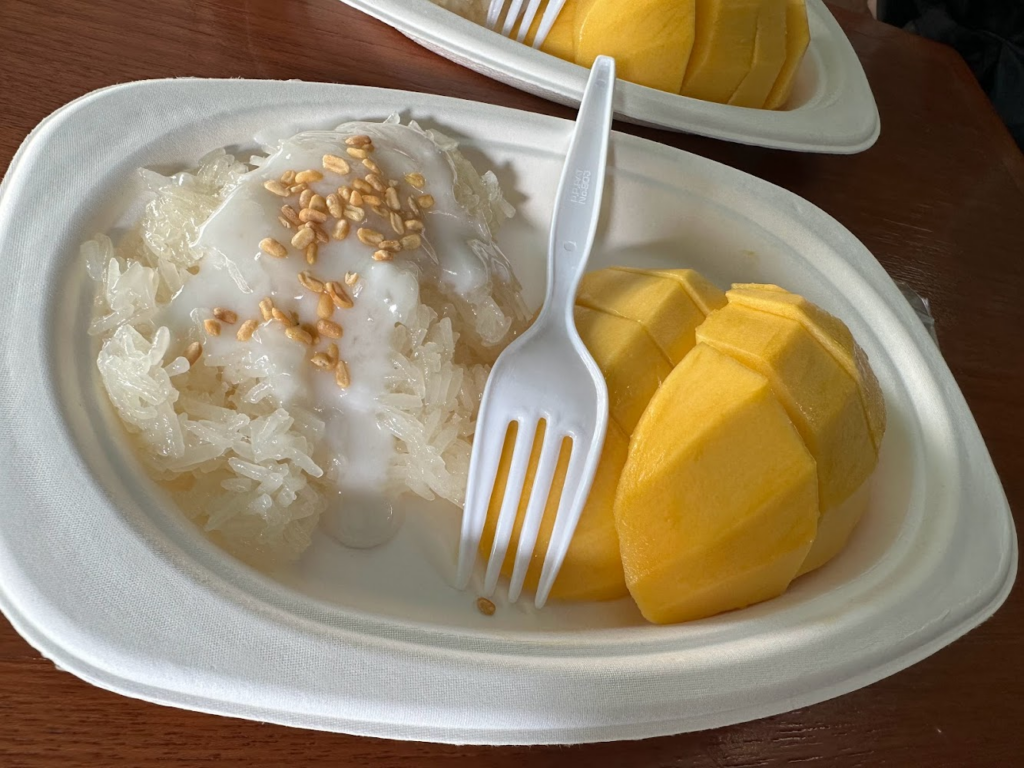
A guided street food tour through a night market is a better introduction to Thai food than any restaurant dinner. A knowledgeable guide moves you past the dishes that cater to foreigners (pad thai, spring rolls) and into the ones that Thais actually eat on weeknights — boat noodles, kanom krok (coconut pancakes cooked in cast iron), mango sticky rice in the right sequence, blood tofu soup, crispy pork fat over rice.
In Bangkok, the Or Tor Kor Market near Chatuchak and the Yaowarat (Chinatown) strip are the two strongest food environments for this format. In Chiang Mai, the Saturday and Sunday walking streets offer a broader mix but require a guide to navigate meaningfully. Self-guided food walks are possible with research; guided tours add the context and the language to move off the tourist track.
Chiang Mai Monk Chat — Wat Suan Dok (★★★)
Wat Suan Dok, one of Chiang Mai’s major temples, runs a ‘Monk Chat’ programme on Monday, Wednesday, and Friday evenings (5–7pm) in which visiting monks practise English conversation with foreign visitors. It is informal, free, and genuinely reciprocal — the monks improve their English and answer questions about Buddhism and monastery life; visitors leave with a more substantive understanding of Thai religious culture than any temple visit alone can provide.
There is nothing performative about it. You sit in the temple grounds and talk. It is one of the few tourist-facing programmes in Thailand that functions as an actual cultural exchange rather than a staged interaction.
Trekking and Village Visits
Hill Tribe Village Trekking — Chiang Mai and Mae Hong Son (★★★ with caveats)
Northern Thailand has a significant highland population — Karen, Akha, Hmong, Lisu, and other communities living in villages in the mountains around Chiang Mai and Mae Hong Son. Village trekking — multi-day walks staying overnight in villages — was one of the formative activities of early Thai backpacker tourism and remains a genuinely interesting experience when done well.
The caveats are real. Some village ‘treks’ have become staged loops with communities that depend almost entirely on tourism income and whose daily life has been adapted for visitor consumption. The ‘Long Neck Karen’ villages near Chiang Rai, where women in Kayan dress wear brass neck rings for photo opportunities, are the clearest example of a community locked into a tourism dynamic that removes agency.
The better version: multi-day treks with small groups (4 or fewer), operators who pay communities directly and have long-term relationships with specific villages, routes that take you away from the Chiang Mai day-trip radius, and itineraries that include actual walking rather than shuttle vehicles. Agencies in Chiang Mai’s Nimman area that focus on sustainable trekking are worth researching before booking.
Avoid any trek that visits ‘Long Neck Karen’ villages marketed as a cultural experience. The brass ring practice in tourist-facing villages is maintained for visitor consumption and income dependency, not cultural continuity.
Mae Hong Son Loop — Motorbike (★★★★★)
The Mae Hong Son loop is a 600km circular mountain route from Chiang Mai that passes through some of the most remote and geographically dramatic terrain in mainland Thailand — mountain passes, Pai Valley, the Shan border town of Mae Hong Son, and back via a different route. It takes 3–5 days on a motorbike.
It is not strictly a single excursion — it is a route. But for travellers with motorbike experience, it is the single most rewarding thing you can do in Northern Thailand. The mountain passes between Pai and Mae Hong Son involve more than 1,700 curves in roughly 100km. The valley scenery is extraordinary. Traffic is minimal. Towns along the route are small, genuine, and almost entirely domestic tourism or expat communities rather than international tourist infrastructure.
Rent a proper motorcycle (not a scooter) in Chiang Mai for the loop — the mountain roads require engine capacity and braking ability that 125cc automatic scooters cannot reliably provide. An international driving licence is legally required.
Quick Reference: Best Excursions in thailand by Base
| Base City | Top Excursion | Runner Up | Half-Day Option |
| Bangkok | Ayutthaya day trip (train, 1.5 hrs) | Kanchanaburi (Death Railway, Erawan Falls) | Night market food tour, Chinatown |
| Chiang Mai | Doi Inthanon (waterfalls, summit, birds) | Chiang Rai temples (White, Blue, Black House) | Thai cooking class with market visit |
| Phuket | Phang Nga Bay kayak (hong lagoons) | Similan Islands diving/snorkelling | Khao Sok day trip (better overnight) |
| Krabi / Ao Nang | Koh Hong island (emerald lagoon) | Phang Nga Bay kayak (from Ao Nang) | Tiger Cave Temple climb (early morning) |
| Koh Samui | Ang Thong Marine Park (kayak) | Koh Tao + Koh Nang Yuan snorkel combo | Koh Samui cooking class |
| Koh Tao | Scuba diving — beginner to advanced | Koh Nang Yuan viewpoint + snorkel | Night dive (advanced, seasonal) |
Excursions in Thailand: Frequently Asked Questions
Ayutthaya, without question. It is accessible, historically significant, visually arresting, and reachable by a 15 THB train from Hua Lamphong. A full day gives you time to do it properly. Kanchanaburi is the second-best choice and significantly less crowded — better for history-focused travellers.
Yes, particularly the lake section with the floating bungalows. It requires effort to reach (roughly 2 hours from Khao Lak, 3.5 hours from Phuket), but it delivers a specific kind of experience — remote jungle, wildlife, silence — that the beach islands cannot. An overnight stay is strongly recommended over a day trip.
Khao Yai National Park for mammals and birds (gibbons, hornbills, wild elephants at distance). Similan Islands for marine life. Khao Sok for birdlife and gibbons. The common thread: genuinely wild animals in national park settings, with no direct human-animal interaction. Any excursion that requires an animal to perform, be handled, or be in close contact with tourists involves some form of training, which invariably involves practices incompatible with animal welfare.
Yes, if you go efficiently. The White Temple is extraordinary and unlike any other religious site in Thailand — it demands a visit. The Blue Temple is less famous and more beautiful inside. Combine with Baan Dam and the Golden Triangle for a full day. Go to the White Temple at opening (8am) — by 10am it is very crowded.
Among the most valuable things you can do on a Thai trip, particularly if you cook at home. The techniques — making curry paste from scratch, proper wok temperature, balancing the four Thai flavours — are directly transferable. Chiang Mai has the highest concentration of good-quality classes. Choose one that starts at the market, keeps groups small, and focuses on regional Northern Thai dishes rather than a generic ‘Thai food’ menu.