

Asking where to find the best pastel de nata in Lisbon sounds like a simple question. It is not. Pastéis de nata are not a specialist dessert that Portuguese people save for particular occasions. They are part of everyday life and a source of national pride. You find them in historic confectioneries, neighbourhood cafés, shopping centres, supermarkets, motorway service stations and small pastelarias that will never appear in an international travel guide.
This makes creating a definitive ranking almost impossible. Some of the best pastéis de nata we have eaten came from ordinary local cafés we entered for a quick coffee. They had no polished branding, open pastry kitchen or queue outside. They simply received or made a fresh batch at the right moment.
Freshness matters enormously. So do personal preferences.
Some people want a thin, brittle shell that explodes into flakes. Others prefer pastry with more structure. Some like the custard loose and creamy; others prefer it firmly set. The balance between sweetness, egg, butter, salt and caramelisation changes from one bakery to the next.
Once you start eating pastéis de nata regularly, you begin to notice those differences.
It is similar to pizza in Italy. At first, you recognise only that one is good and another is disappointing. After enough experience, you start noticing the dough, cooking, texture, balance and small details that distinguish one style from another.
The same happens with pastéis de nata. That is why this is not a scientific ranking or an attempt to declare one permanent winner.
These are seven Lisbon-area pastéis we know, enjoy and would confidently recommend but you should not stop with them.
Try as many as possible. The best pastel de nata from your trip may be the one you eat warm at a small café near your accommodation, surrounded by people who have been ordering it with their morning coffee for years.
Do you want to know how to visit Lisbon without being overwhelmed and based on local recommendations? Our Lisbon local guide covers this and more, helping you to make an informed decision on what to do, what to skip and what you miss if you focus on the things everyone recommends, especially one-time travelers to Lisbon.
What Makes a Good Pastel de Nata?
A pastel de nata has only two main elements: laminated pastry and baked custard. That apparent simplicity is exactly why the differences become so noticeable once you start trying them regularly.
The pastry may be thin and brittle, more buttery, slightly salty or firm enough to hold its shape. The custard can be loose and creamy or distinctly set, delicate or strongly egg-forward, lightly baked or deeply caramelised.
There is no single correct version. What matters is whether the pastry and filling balance each other and whether the pastel is fresh.
Take the first bite without cinnamon or powdered sugar. Notice whether the pastry cracks cleanly, whether the layers remain distinct and how the texture contrasts with the custard.
Temperature matters too. Most pastéis are at their best warm, when the shell is crisp and the filling soft. But that is not an absolute rule: Confeitaria Glória deliberately serves a firmer version cold, and its temperature is part of what makes it distinctive.
After enough pastéis, you stop judging them only as good or bad. You begin to recognise different styles—and eventually work out which one you prefer.
7 Best Pastéis de Nata in Lisbon
These seven are not listed from best to worst. They represent different versions of the pastel de nata and different reasons to stop: history, consistency, texture, atmosphere or simply the pleasure of finding a very good pastel in a traditional Lisbon café.
1. Pastéis de Belém: The One You Need to Try Once
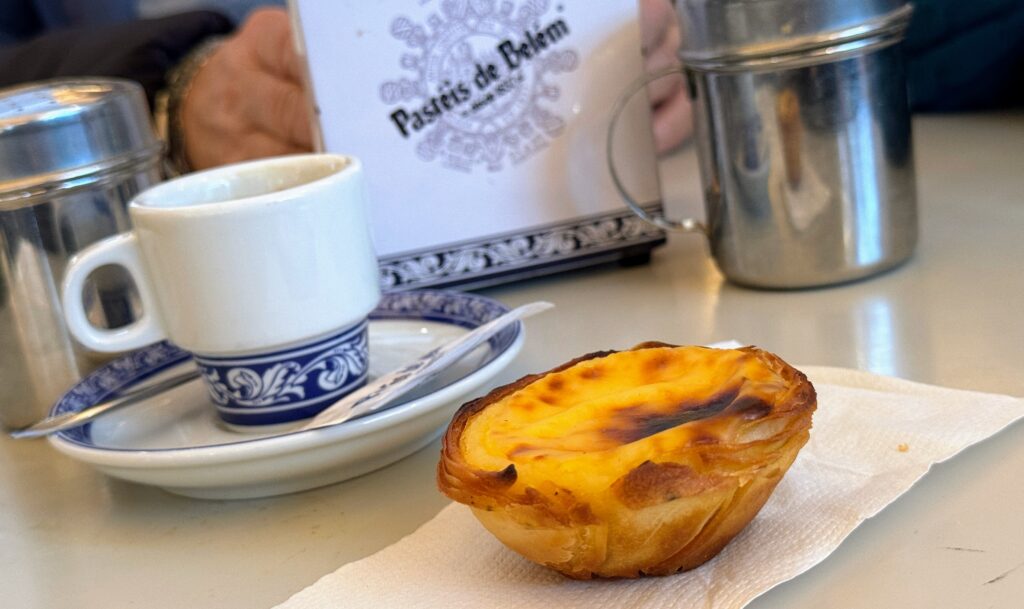
Pastéis de Belém is the unavoidable starting point. The bakery has produced its pastries beside the Jerónimos Monastery since 1837, using a recipe that remains closely guarded. Only this business can call its product a Pastel de Belém; everywhere else, the pastry belongs to the broader family of pastéis de nata.
This is more than a technical distinction. The pastry is particularly brittle and flaky, while the custard is less uniformly sweet than many modern versions. There is a slightly savoury quality to the balance that becomes more noticeable when you compare it directly with Manteigaria or Aloma.
The queue outside can look discouraging, but it often moves quickly. Many visitors join the takeaway line without realising how large the interior is. When possible, sit inside and eat the pastéis immediately rather than carrying a box around Belém for hours.
Are they definitively the best in Lisbon? Not for everyone.
Are they a tourist trap? We do not think so. The historical connection is real, the production remains specific to this location and the pastéis are genuinely distinctive.
- Go for: The original experience and a direct comparison with modern Lisbon pastéis.
- Our advice: Eat them there while they are fresh. Do not judge them after transporting a box across the city.
2. Manteigaria: The Reliable Modern Benchmark
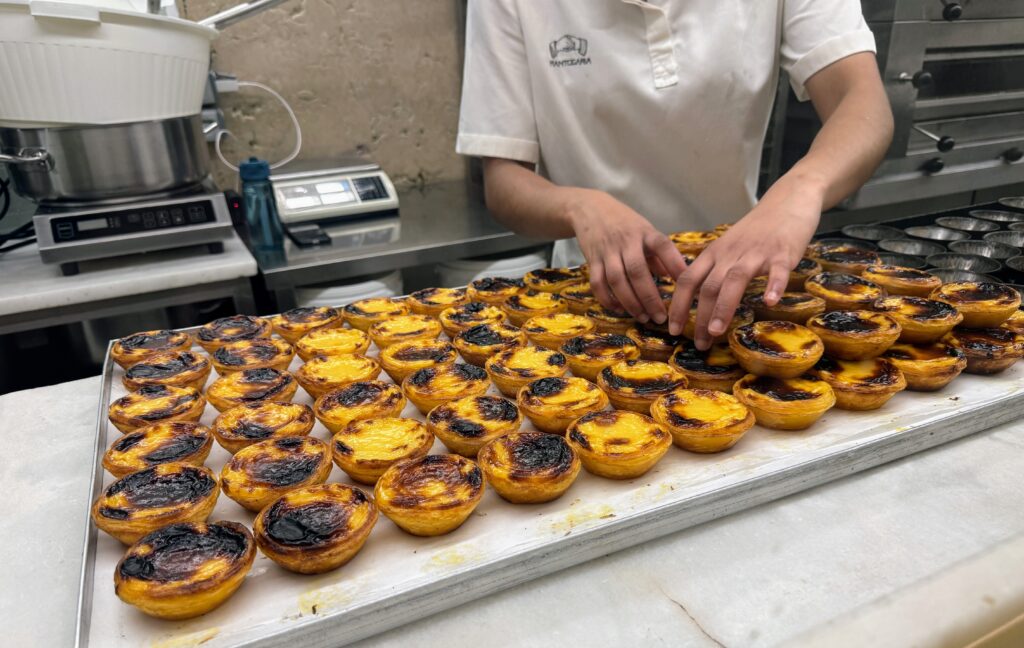
Manteigaria is probably the easiest pastel de nata to use as a benchmark. Its shops specialise in pastéis de nata, with production taking place throughout the day. At several locations, you can watch the bakers prepare the pastry behind glass and hear a bell announce a fresh batch.
The pastry is crisp but generally more structurally stable than Pastéis de Belém. The custard is smooth, creamy and relatively sweet, with a deeply baked top.
Its greatest strength is consistency.
Manteigaria now has numerous Lisbon locations, including Chiado, Alvalade, Belém, Campo de Ourique, Saldanha, Príncipe Real and Rossio. The company continues to emphasise pastéis made on-site and served fresh.
Expansion can make a business feel less special, but accessibility is not a flaw when the product remains good.
You do not need to cross Lisbon specifically for Manteigaria. You will probably pass one naturally, and that makes it an excellent first reference point.
- Go for: A consistently crisp, creamy pastel served warm.
- Our advice: Try one early in the trip. It will help you recognise how other versions differ.
3. Aloma: The Award-Winning Lisbon Classic
Aloma began in Campo de Ourique in 1943 and has built much of its reputation around its pastel de nata.
It has repeatedly performed well in Lisbon’s annual pastel de nata competition, including first-place awards in 2012, 2013, 2015, 2024, 2025, and 2026. Competition results do not settle the question of personal taste, but repeated recognition says something about technical consistency.
Aloma’s pastel has a well-defined pastry shell and a smooth custard that feels balanced rather than excessively sweet. It is an easy version to like, but it has enough character to remain recognisable beside its competitors.
The original Campo de Ourique shop is the most meaningful place to try it, although Aloma now has several Lisbon locations.
- Go for: One of Lisbon’s most consistently awarded traditional pastéis.
- Our advice: Combine the Campo de Ourique location with a visit to the neighbourhood rather than treating it as a rushed pastry stop.
4. Confeitaria Glória: The One That Breaks the Rules
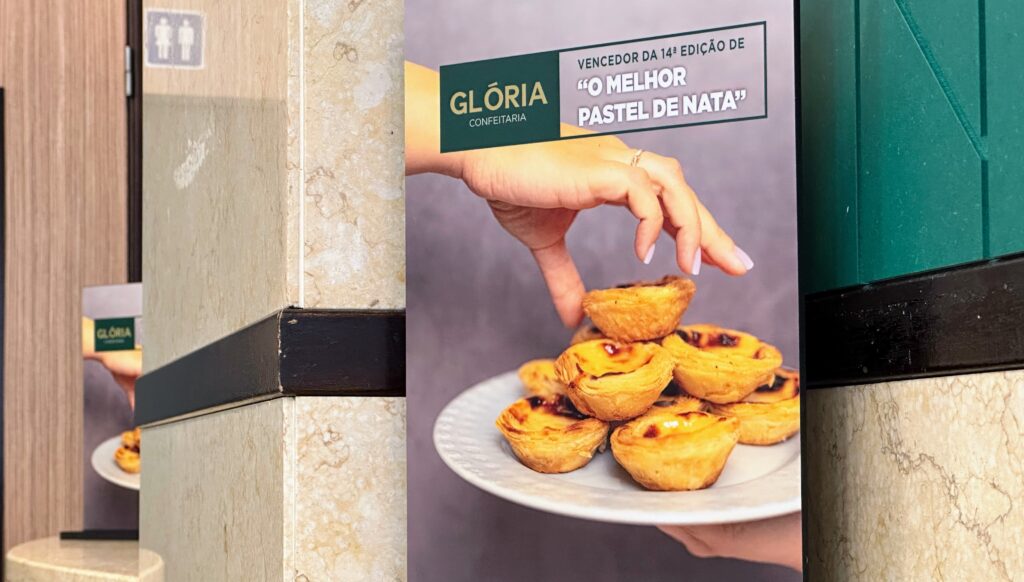
Confeitaria Glória requires more commitment. It is in Amadora, outside Lisbon’s historic centre, and it is unlikely to fit naturally into a first-time sightseeing route. But its pastel de nata deserves attention precisely because it challenges several assumptions about what a great pastel should be.
Confeitaria Glória won the official Best Pastel de Nata competition in 2023.
Its version is unusual.The custard is firm rather than flowing. The pastry is distinctly flaky, with a slightly salty edge that counters the sweetness. Most surprisingly, it is served cold.
We usually recommend eating pastéis de nata warm. Glória is the exception. The cold temperature reinforces the firmness of the custard and makes the contrast with the salty pastry more obvious. It feels like a deliberate style rather than a pastel that has simply been left on the counter for too long.
This may not be the version every visitor prefers, but it is one of the most useful for understanding how different two pastéis de nata can be.
- Go for: A distinctive, award-winning interpretation that tastes unlike the central Lisbon standard.
- Our advice: Do not travel to Amadora expecting a warm, creamy Manteigaria-style pastel. Its difference is the reason to go.
5. Portela: The Neighbourhood Pastelaria Choice
Portela represents another important part of Lisbon’s pastel de nata culture: the established neighbourhood pastelaria. It is not built around one globally marketed product. People visit for coffee, bread, cakes, savoury snacks and the ordinary routines of a Portuguese café.
A pastel de nata does not need a theatrical open kitchen or specialist shop to be good. In places such as Portela, it belongs to a much larger pastry counter and is eaten as part of everyday life rather than as a culinary pilgrimage.
The version we recommend has a good balance between flaky pastry and traditional custard without trying to distinguish itself through an exaggerated characteristic.
- Go for: A reliable pastel within the atmosphere of a conventional Lisbon pastelaria.
- Our advice: Sit down, order it with a coffee and experience it as a normal part of the day—not only as another item on a tasting list.
6. Versailles: The One to Eat in a Proper Lisbon Café
Pastelaria Versailles has served Lisbon since 1922 and remains one of the city’s most recognisable historic cafés. Its Art Nouveau-inspired interior, long display counters and formal service make it a destination beyond any single pastry.
Its pastel de nata belongs within that wider experience.This is not a specialist nata factory. Versailles produces a broad range of Portuguese and European-style pastries, and part of the pleasure is seeing the pastel de nata alongside the rest of Lisbon’s traditional confectionery culture.
Come here when you want to sit rather than eat standing at a counter.
The pastel is traditional and satisfying, but the setting contributes to why we include it. A list focused only on blind tasting would miss the fact that where and how you eat something can affect how you remember it.
- Go for: A pastel de nata inside one of Lisbon’s classic café interiors.
- Our advice: Do not order only the pastel. Look at the counter and try another Portuguese pastry as well.
7. Confeitaria Nacional: The Historic-Centre Classic
Confeitaria Nacional opened in 1829, making it older than Pastéis de Belém. Its pastel de nata recipe appears in the original recipe book of founder Balthazar Castanheiro, and the confectionery still serves it at its historic Praça da Figueira location.
The pastel is not necessarily the most technically dramatic on this list.
That is not why we include it. Confeitaria Nacional connects the pastel de nata with Lisbon’s broader confectionery tradition. Long before the city filled with single-product nata shops, historic pastelarias produced it alongside bolo-rei, conventual sweets, savoury pastries and elaborate cakes.
It is also exceptionally convenient. Most first-time visitors will pass through Rossio or Praça da Figueira, making this an easy place to stop without restructuring the day.
The interior can become busy and service may feel more traditional than polished, but that is part of visiting an old Lisbon institution rather than a modern pastry concept.
- Go for: History, central location and the atmosphere of a traditional confectionery.
- Our advice: Go upstairs when seating is available and treat it as a café stop, not simply a takeaway counter.
So Where Is the Best Pastel de Nata in Lisbon?
We do not think the question has one permanent answer.
- Pastéis de Belém offers the most historically specific version.
- Manteigaria is the easiest modern benchmark.
- Aloma has the strongest record in Lisbon’s formal competition.
- Glória is the most distinctive.
- Versailles and Confeitaria Nacional place the pastry inside Lisbon’s historic café culture.
- Portela represents the neighbourhood pastelaria, where the best pastel may depend less on fame than on whether you arrive just after a fresh batch.
Our own favourite can change depending on the day, the location and the version we feel like eating. That is what happens when you stop treating every pastel de nata as the same pastry.
Try Pastéis de Nata in lisbon Beyond This List
Use this guide as a starting point, not a closed ranking. When you enter a busy neighbourhood café and see a fresh tray arrive, order one.
When the person beside you asks for a pastel with their coffee, consider doing the same.
When you pass a pastelaria that has been serving the same area for decades but has no presence in international travel guides, go inside.
Some will be ordinary. A few may be disappointing.
Others will make you wonder why people cross Lisbon and stand in long queues when something this good was waiting in an anonymous glass display near their accommodation.
Portugal does not have only seven excellent pastéis de nata. That abundance is the point.
Pastel de nata is singular.
Pastéis de nata is plural.
One pastel. Two pastéis.
Pastéis de Belém refers specifically to those made by the historic bakery in Belém. The name is reserved for that business; similar pastries produced elsewhere are pastéis de nata.
Pastéis de nata are strongly associated with Lisbon and Belém, but today they are made and eaten throughout Portugal. You will find excellent versions in Porto, the Algarve, the islands and small towns across the country. Lisbon has the greatest concentration of famous producers, but it does not own every good pastel de nata.
Most pastéis are best warm or at least freshly baked because the pastry remains crisp and the custard soft. That is not an absolute rule. Confeitaria Glória deliberately serves a firmer version cold, showing that temperature can be part of the intended style rather than simply a question of freshness.
Yes, particularly on a first visit. The queue often moves faster than it appears, and the bakery has extensive indoor seating. The pastéis have a distinctive recipe and historical connection that cannot be reproduced by visiting another nata shop in central Lisbon.
The standard pairing is coffee, usually an espresso known in Lisbon as a bica. The bitterness balances the sweet custard and buttery pastry. Cinnamon and powdered sugar are generally available, but both are optional.
As many as you reasonably can without turning the trip into a forced tasting exercise. Try different styles in different settings: one famous, one specialist, one historic and at least one from an ordinary neighbourhood café.
By the end of the trip, you may not have discovered the objectively best pastel de nata. You will have discovered which kind you like—and that is a much more useful answer