

Lisbon is now full of specialty coffee shops. They serve single-origin beans, flat whites and filter coffee in polished spaces designed for laptops, long brunches and an increasingly international audience.
Some are excellent. But they are not the centre of Lisbon’s coffee culture.
That culture existed long before specialty coffee arrived, and it remains alive beyond the fashionable counters and English-language menus.
You find it in small cafés and pastelarias where people stop before work, drink an espresso at the counter, collect bread, meet neighbours, eat a simple lunch and return later for another coffee.
The same place may serve several generations of one family. Staff know what regular customers order. Coffee is not treated as a specialist experience requiring twenty minutes of explanation.
It is part of the structure of the day. A guide to Lisbon cafés that focuses exclusively on specialty coffee reflects the habits of international visitors, expats and coffee enthusiasts more than the way the city has traditionally used cafés.
We are not suggesting that every old café serves exceptional coffee. Many do not. But judging Lisbon’s café culture only by the origin of the beans, extraction method or quality of a flat white misses most of what makes it important.
A café can matter because of the community that surrounds it, the role it plays in the neighbourhood and the way it allows people to stop without turning that pause into an event.
The best Lisbon café may be a historic institution with chandeliers and mirrored walls. More often, it is the small pastelaria near your accommodation: slightly old-fashioned, busy from early morning and filled with people who live or work nearby.
This guide includes several historic cafés and neighbourhood institutions worth seeking out. But it is not a definitive ranking. Lisbon has too many small local cafés for that and the one you remember most may be somewhere nobody outside its neighbourhood has ever thought to recommend. Same for our guide to the best pasteis de Nata in Lisbon: our guide covers some of the ones we think are unmissable, but a complete list is impossible.
How to Order Coffee in Lisbon
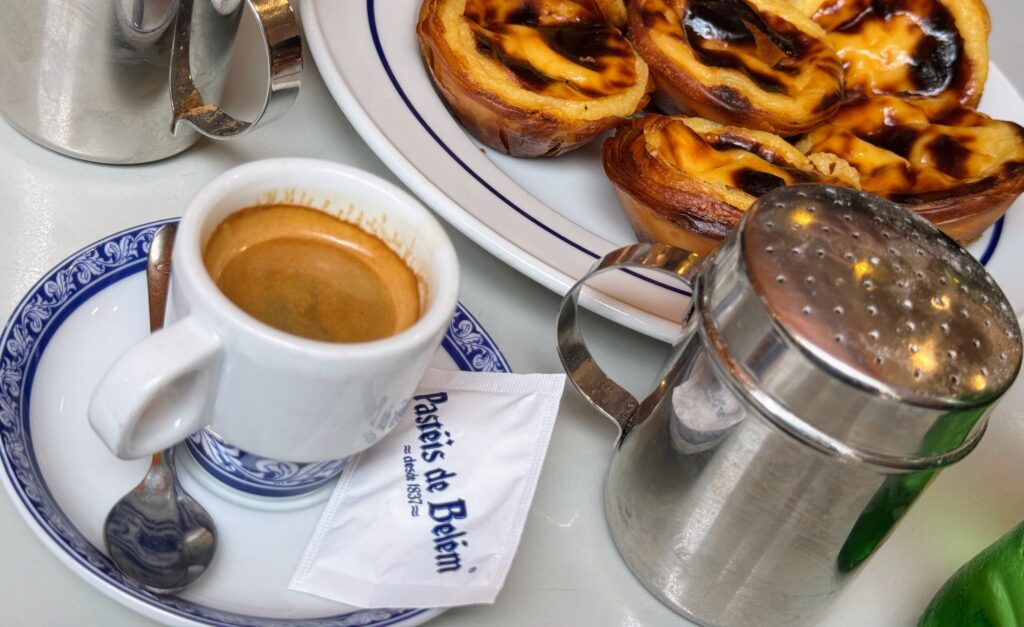
A few Portuguese terms will make ordering easier.
A bica is the Lisbon name for an espresso. Espresso remains one of Portugal’s most common everyday drinks and is traditionally consumed quickly at the counter.
A garoto is an espresso with a small amount of milk.
A meia de leite is coffee with a larger proportion of milk, usually served in a cup.
A galão contains even more milk and normally comes in a tall glass.
For breakfast, order torrada, generally thick toast served generously buttered, or a tosta mista, a toasted ham-and-cheese sandwich.
You can sit at a table, but ordering and drinking at the counter is usually quicker and more representative of how many Lisbon residents use a café.
Service may feel direct when the place is busy. That does not necessarily mean it is unfriendly. Traditional cafés are built around efficiency. Know what you want, order simply and do not expect every transaction to become a conversation about the coffee.
best Historic Lisbon Cafés Worth Visiting
Historic cafés are not automatically the best place to experience ordinary neighbourhood life.
Many now receive substantial numbers of visitors, particularly in Baixa and Chiado. But they remain part of Lisbon’s social and architectural history and deserve a place in the guide when approached with realistic expectations.
1. Confeitaria Nacional: Lisbon’s Historic Confectionery
Confeitaria Nacional has occupied its Praça da Figueira location since 1829, making it one of Lisbon’s longest-running confectioneries.
It represents the older meaning of a confeitaria: a business producing traditional pastries, elaborate cakes, savoury items and seasonal specialities rather than focusing on one famous product.
Its central position means it receives many visitors, but the pastry counter still demonstrates the breadth of Portuguese confectionery far better than a shop dedicated entirely to pastéis de nata.
Do not enter, buy one pastel and immediately leave.
Look at the full display. Try something you have not already seen recommended repeatedly online. When seating is available, go upstairs and experience it as a café rather than only a takeaway counter.
- Come for: History and the range of traditional Portuguese pastries.
- Order: Coffee and one pastry you do not already recognise.
- Keep in mind: It is in one of Lisbon’s busiest visitor areas, so the experience is not especially local during peak hours.
2. Pastelaria Versailles: Lisbon Café Culture at Full Scale
Versailles opened in 1922 and remains one of Lisbon’s most impressive traditional café interiors. Its mirrored room, chandeliers, decorative ceilings and long pastry counter preserve a grander version of the city’s café culture.
Despite the formal surroundings, it still functions as a real pastelaria and restaurant.
People visit for breakfast, lunch, cakes and coffee throughout the day. You can sit for table service or stand at the counter for something quicker.
This balance is what makes Versailles more interesting than a historic room preserved mainly for tourists.
The pastry selection is extensive. Ordering only a pastel de nata would miss much of the point.
- Come for: The interior, pastry counter and atmosphere of a traditional grand café.
- Order: Coffee, a pastry and something savoury when visiting around lunchtime.
- Keep in mind: It is more formal than a small neighbourhood café, but it remains integrated into everyday city life.
3. A Brasileira: Important, Famous and No Longer Intimate
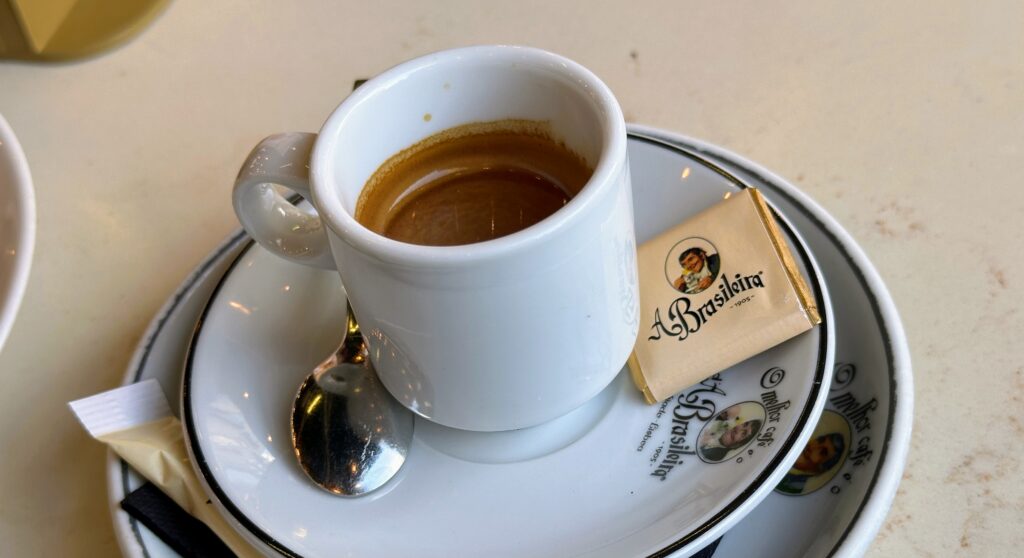
A Brasileira opened in Chiado in 1905 and became closely associated with Lisbon’s literary and intellectual history.
Its historic interior and location beside the statue of Fernando Pessoa make it one of the city’s most photographed cafés. Lisbon’s official historic-shops route recognises it as a century-old symbol of Chiado’s cultural life.
Visit it for that history.
Do not visit expecting a quiet literary café filled with writers and regulars. Chiado is one of Lisbon’s most heavily visited areas, and A Brasileira now operates within that tourism economy.
The terrace is useful for watching the street, while the interior contains more of the historic atmosphere.
For the simplest experience, drink a bica at the counter rather than building an entire morning around it.
- Come for: Architecture, cultural history and its place in the story of Chiado.
- Order: A bica at the counter.
- Keep in mind: Its fame is part of the experience and also the reason it no longer represents ordinary Lisbon café life.
Neighbourhood Pastelarias Worth Knowing
These places are included because they remain connected to their areas, not because we think visitors must cross the entire city to complete another list.
Visit them when they fit naturally into your day.
More importantly, use them to understand what to look for in the hundreds of smaller pastelarias we cannot include.
1. Pastelaria Mexicana: A Modernist Café Still Used by Its Neighbourhood
Pastelaria Mexicana is one of the most interesting cafés in Lisbon because it combines architectural significance with continued neighbourhood use.
It opened in the mid-twentieth century and later received a distinctive modernist redesign. Lisbon’s Comércio com História programme describes it as a local reference frequented by regular neighbours, nostalgic returning customers and only occasionally curious tourists.
That mixture is exactly what a historic café should preserve.
Mexicana is not simply a beautiful interior waiting to be photographed. It remains a place where people meet, eat, drink coffee and use the café throughout the day.
It also helps correct the idea that Lisbon’s historic café culture exists only in nineteenth-century rooms around Baixa and Chiado.
- Come for: Modernist design and a historic café that still belongs to its neighbourhood.
- Order: Coffee and a pastry, or stay for a simple meal.
- Neighbourhood: Areeiro.
2. O Careca: A Restelo Institution Built Around One Famous Croissant
Pastelaria Restelo opened in 1954 and became known as O Careca, a nickname inspired by one of its founders. It developed alongside Restelo and remains closely connected with the neighbourhood.
Its sweet, flaky croissants are the main reason people travel there.
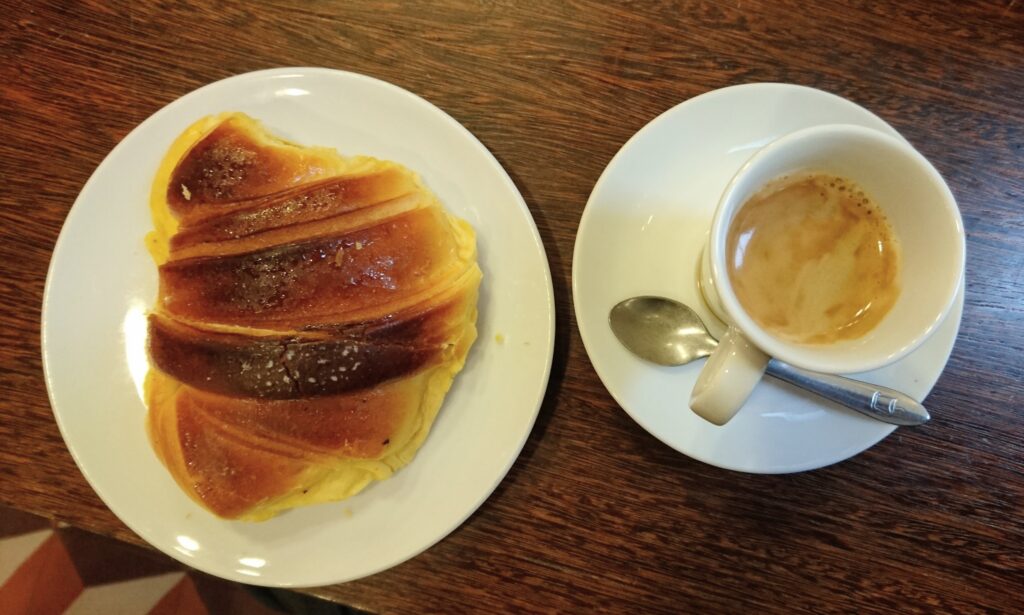
They are not French-style croissants. They are heavier, softer, generously coated with sugar and associated with childhood memories for generations of Lisbon customers.
The café’s location near a garden reinforces its role as a meeting place, particularly for families and neighbourhood residents.
O Careca is known beyond Restelo now, but it still feels tied to a specific part of Lisbon rather than designed as a generic city-centre destination. Its own history emphasises the long relationship with several generations of customers in the area.
- Come for: The famous croissant and a café with a strong neighbourhood identity.
- Order: A warm croissant with coffee.
- Neighbourhood: Restelo.
3. Califa: A Benfica Pastelaria Used Throughout the Day
Califa is the kind of large neighbourhood pastelaria many visitors never encounter when they remain between Alfama, Baixa and Chiado.
It combines a café, pastry counter and restaurant at Estrada de Benfica, functioning as an informal meeting place as well as somewhere to eat throughout the day.
The breadth is typical of substantial Portuguese pastelarias.
Customers come for coffee and pastries, but also for lunch, savoury snacks, cakes and ordinary social occasions. The business does not depend on one globally recognisable speciality.
That makes it valuable to this article.
Califa shows that Lisbon café culture is not limited to tiny espresso counters or grand historic rooms. It also lives in large neighbourhood establishments capable of serving many different routines at once.
- Come for: A traditional pastelaria-restaurant used by the surrounding community.
- Order: Coffee and a pastry, or stay for one of the simple lunch options.
- Neighbourhood: Benfica.
4. Galeto: Not Quite a Pastelaria, but Essential to the Culture
Galeto opened in 1967 and preserves a modernist snack-bar format built around long counters, quick service and a wide menu spanning coffee, toast, soup, steaks, snacks and desserts.
Portugal’s official tourism site describes it as a former temple of modernity that has retained its characteristic counters and fast, efficient service.
It is not a conventional neighbourhood pastelaria, but it belongs in the wider story of Lisbon café culture.
Galeto demonstrates how these spaces blur categories. It can function as a café, snack bar, restaurant, late meal stop and meeting point depending on the time and customer.
You do not visit solely for a technically exceptional espresso.
You visit because the space, service and rhythm explain something about twentieth-century Lisbon that a recently opened specialty café cannot recreate.
- Come for: The counters, the atmosphere and the unusual continuity of a mid-century Lisbon institution.
- Order: Coffee and toast for a quick stop, or one of the classic dishes when you are hungry.
- Neighbourhood: Saldanha.
5. Pastelaria Aloma: A Campo de Ourique Reference Beyond Its Pastel de Nata
Aloma is widely known for its award-winning pastéis de nata, but its original Campo de Ourique location also belongs to the neighbourhood’s café culture.
The business has more than seven decades of history in Campo de Ourique and remains officially recognised as one of Lisbon’s historic shops.
Visitors may arrive for the pastel de nata, but the context matters.
Campo de Ourique is a neighbourhood where people still organise daily life around local shops, cafés, schools, the market and Jardim da Parada. Aloma forms part of that network rather than operating only as a destination for pastry tourism.
It is a useful example of a place that can become famous without losing its original local function completely.
- Come for: A recognised pastel de nata in its original neighbourhood context.
- Order: A pastel de nata and coffee.
- Neighbourhood: Campo de Ourique.
How to Find a Real Neighbourhood Café in Lisbon
The best way to experience Lisbon café culture is not to travel across the city following a list. Start with the café closest to where you are staying.
Look through the door before deciding whether it is worth entering. A successful neighbourhood café usually reveals itself through activity rather than design.
You may see people drinking espresso at the counter, workers stopping for breakfast, older customers reading the newspaper, bread being collected and staff greeting regulars without needing to ask what they want.
The interior may be plain. The lighting may be harsh.
The menu may not be translated into English, and nobody may have considered whether the pastry counter looks appealing in a photograph.
None of that is a warning sign.
Look for:
- A steady flow of customers from the surrounding area
- Coffee being served quickly at the counter
- Bread, pastries and savoury snacks replenished during the day
- People eating simple breakfasts or lunches
- Customers known by name
- A menu designed to serve the neighbourhood rather than explain Portugal
- Few laptops and no expectation that one coffee buys a table for an entire afternoon
Order simply. Ask for a bica, garoto, meia de leite or galão. Add torrada, a tosta mista or whichever pastry looks freshest.
Then return another day. A café becomes part of Lisbon culture through repetition. Visiting once shows you the room. Becoming a temporary regular helps you understand what the place is for.
Traditional Café or Specialty Coffee Shop?
There is no need to choose one permanently. Lisbon’s specialty coffee shops can serve better beans, more careful extractions and drinks that traditional cafés do not attempt.
Traditional cafés offer something else. They are quicker, more integrated into neighbourhood life and less likely to treat coffee as a lifestyle identity. Their importance is social as much as culinary.
Go to a specialty café when you specifically want filter coffee, a flat white or detailed information about the beans.
Go to a traditional café when you want to understand how Lisbon stops for coffee.
The problem is not specialty coffee. The problem is allowing its current visibility to replace the older culture underneath it.
Historic Café or Neighbourhood Pastelaria?
Choose a historic café when the architecture, story and location are part of what you want to experience.
Choose a neighbourhood pastelaria when you want to observe how Lisbon actually uses cafés.
The two are not in competition. Confeitaria Nacional, Versailles and A Brasileira explain part of the city’s public and cultural history.
Mexicana, O Careca, Califa, Galeto and Aloma show different ways cafés remain integrated into the communities around them.
The mistake is visiting only the famous institutions and assuming you have understood Lisbon café culture.
The Best Lisbon Café May Never Appear in a Guide
Historic cafés deserve to be preserved and visited. They explain how coffee, politics, literature and public life once intersected in Lisbon. Places such as Versailles, Confeitaria Nacional and A Brasileira remain part of the city’s story even when tourism has changed the way they feel.
But Lisbon’s café culture does not survive only through famous rooms. It survives through the small businesses that open every morning for the people living around them.
The local pastelaria may not serve the most technically accomplished espresso in the city. It may use a familiar Portuguese coffee brand, have no English website and offer the same pastries it has sold for years.
Yet it may also know who wants their coffee short, who takes milk, who collects bread on the way home and who needs a few minutes of conversation before continuing with the day.
That is café culture too. Arguably, it is the part that matters most.
Use these recommendations to understand the different types of cafés Lisbon has.
Then stop following the list. Walk into the small place near your accommodation, order at the counter and see what happens.
The best Lisbon café is often not the one people cross the city to visit. It is the one the neighbourhood would notice if it disappeared.