

Choosing where to stay in Lisbon is not only a question of finding the prettiest neighbourhood. The area you choose determines how many hills you climb before breakfast, whether you hear music until the early morning, how easily you reach the rest of the city and whether the streets around your accommodation still function as a neighbourhood or mainly as a visitor corridor.
We live in Lisbon, and this is one of the things we notice most when people describe their trips. Two visitors can spend the same number of days here and experience almost completely different cities because one stayed in Alfama and the other in Alvalade, Campo de Ourique or Arroios.
The most photographed neighbourhood is not automatically the best base. A street that feels romantic during an afternoon walk may be inconvenient with luggage, noisy at night or disconnected from the places where you actually want to spend your time.
Far too many Lisbon’s guides group Alfama, Bairro Alto, Baixa, Belém, Cais do Sodré, Chiado, Graça, Mouraria and Príncipe Real among its principal historic neighbourhoods. That is useful for sightseeing, but it does not answer the more practical question of what staying in each place feels like and the even more practical questions: where should I stay in Lisbon?
This guide is organised around that difference.
Some neighbourhoods are excellent places to visit but poor places to sleep. Others show little of the Lisbon people arrive expecting, yet provide a much more comfortable and locally grounded stay.
There is no universally best area. There is only the area whose trade-offs suit your trip.
f you’re traveling to Lisbon, these resources may be useful both in the planning phase and if you’re already in the city:
- Our local Lisbon city guide and our advice on the best transports to use in Lisbon to avoid costly mistakes
- Our selection of the best pasteis de nata in Lisbon (spoiler: a selection is impossible and if you read the article you will immediately understand why)
- Our selection of the best traditional cafes in Lisbon (spoiler: nothing to do with specialty coffees for expats and tourists)
- Best Portuguese desserts to try when in Lisbon
- Best Portuguese foods to try in Lisbon
Baixa: The Most Convenient Lisbon and the Least Personal
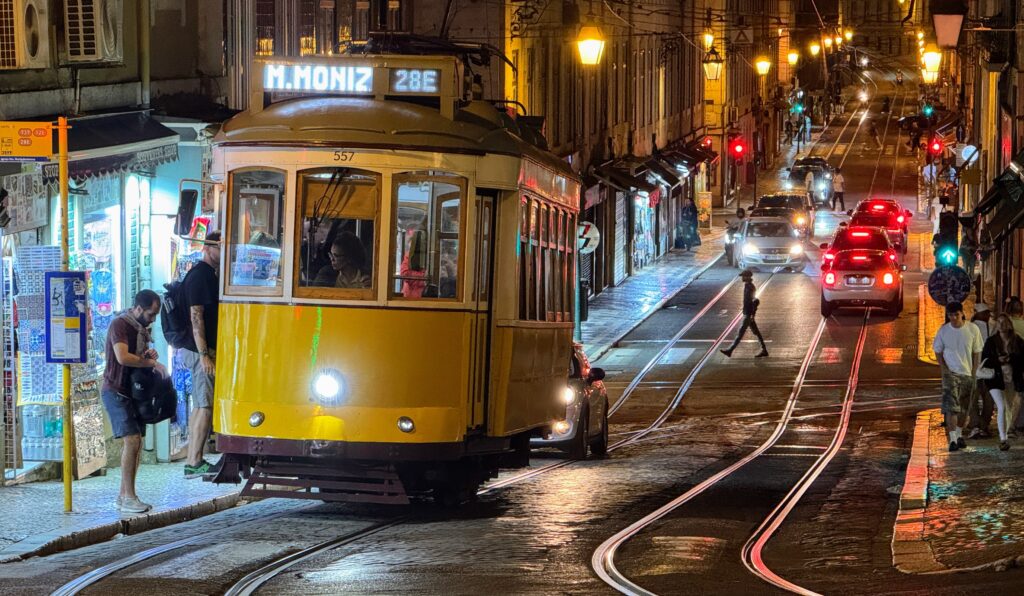
Baixa is the easiest neighbourhood for a first-time visitor to understand.
It is flat by Lisbon standards, highly central and connected to Rossio, Chiado, the riverfront and several major transport routes. Many of the city’s best-known streets and squares sit here, including Rua Augusta, Praça do Comércio and Rossio.
For a short visit, that convenience is real.
You can leave the hotel and immediately begin sightseeing. Restaurants, shops, transport and attractions are close, and returning during the day is easy.
The disadvantage is that Baixa now feels heavily oriented towards visitors. Souvenir shops, international retail, restaurant terraces and short-term accommodation occupy much of the central grid. Lisbon’s tourism authority describes it as one of the city’s best-known and most visited areas, which is precisely why it can feel less intimate than the neighbourhoods around it.
Baixa is not fake, but it is no longer the best place to understand everyday Lisbon.
- Stay here when: It is your first visit, you have limited time or you want the easiest possible base.
- Visit for: Praça do Comércio, Rossio, architecture and access to the river.
- Think twice when: You want neighbourhood life, quiet evenings or restaurants aimed primarily at repeat local customers.
- Our view: Excellent for convenience, weaker for atmosphere.
Chiado: Central, Elegant and Easy to Like
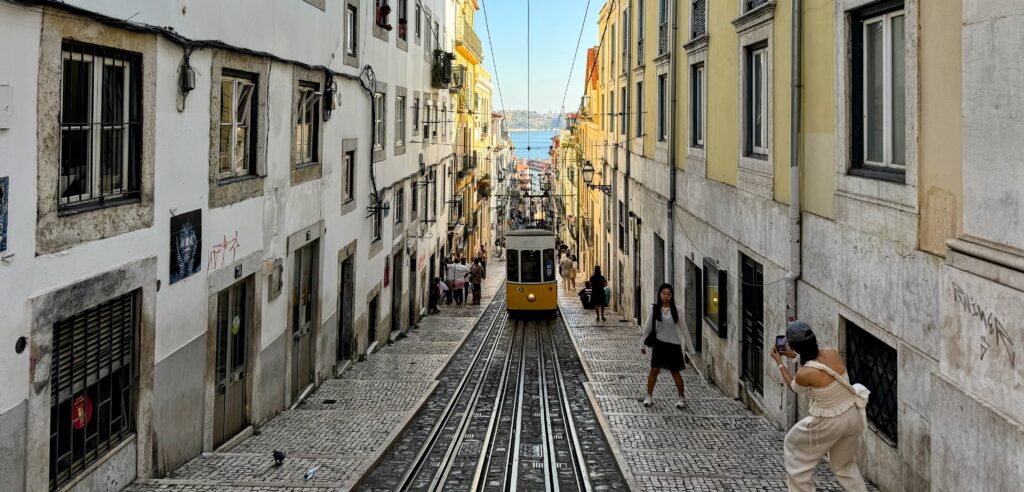
Chiado sits between Baixa, Bairro Alto and the river-facing side of central Lisbon.
It is one of the most balanced choices for travellers who want to stay centrally without being completely inside Baixa’s tourism grid. Historic shops, theatres, cafés and polished restaurants coexist with international brands and some of the city’s most expensive accommodation.
The area is lively throughout the day and well positioned for walking towards several neighbourhoods.
It is also more polished than much of Lisbon. That makes it comfortable, but it can give visitors a version of the city that feels smoother and wealthier than the whole.
- Stay here when: You want a central base with restaurants, shops and straightforward access to several parts of the city.
- Visit for: Historic cafés, shopping, theatres and the transition between Baixa and Bairro Alto.
- Think twice when: You want quiet, low-key neighbourhood life or more space for your accommodation budget.
- Our view: One of the safest all-round choices for a first visit, provided you accept that you are paying for location.
Alfama: Beautiful to Visit, Complicated to Stay In
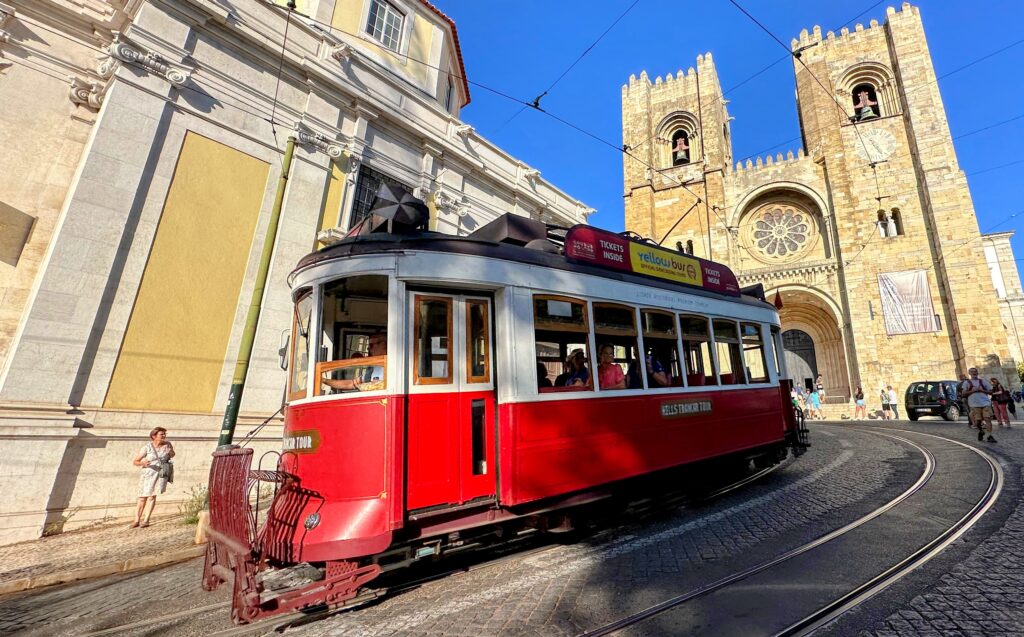
Alfama is the Lisbon many visitors imagine before arriving.
The neighbourhood climbs through narrow lanes, staircases, small squares and tiled façades below São Jorge Castle. Official tourism material openly describes its inclines as steep and demanding, and notes that much of the neighbourhood must be explored on foot.
That is part of its beauty.
It is also what accommodation photographs often fail to communicate.
A property may appear close to the river or a major landmark on the map while requiring a difficult climb over uneven paving. Cars cannot reach every street. Luggage can become a genuine problem, and older buildings may have narrow stairs, limited insulation and no lift.
Alfama has also been strongly affected by short-term accommodation. The city has long treated Alfama, Castelo and Mouraria as areas requiring specific monitoring and containment because of tourism pressure on housing.
The neighbourhood remains inhabited, but some streets feel very different during the day, when tours pass through, and at night, when many temporary visitors return to apartments.
Stay here when: Atmosphere matters more than convenience and you are comfortable with hills, stairs and older buildings.
- Visit for: Wandering, viewpoints, fado history, the cathedral and the streets below the castle.
- Think twice when: You have mobility concerns, heavy luggage, a pushchair or an early departure.
- Our view: Essential to experience, but not the automatic best place to sleep simply because it looks the most romantic.
Bairro Alto: Enjoy It at Night, Sleep Somewhere Else
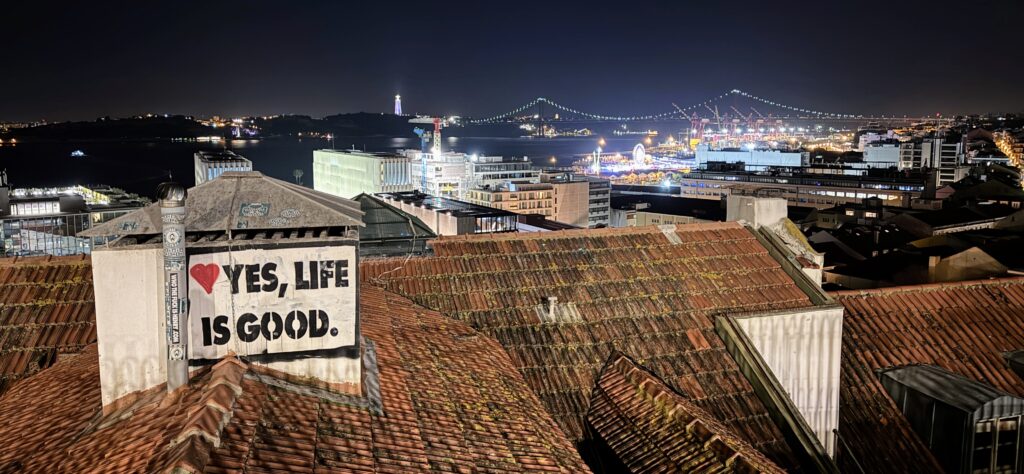
Bairro Alto is one of Lisbon’s most misunderstood accommodation choices.
During the day, its narrow streets can feel almost subdued. Shops, small restaurants and old buildings give it the appearance of a central historic neighbourhood with plenty of character.
At night, the purpose of many of those streets changes.
Bars open, people gather outside and noise continues well beyond the point when most hotel guests expect to sleep. The atmosphere is social, informal and central to Lisbon nightlife, but that does not make it a sensible base for everyone.
Noise varies street by street, and a well-insulated hotel can make a significant difference. But booking an apartment in Bairro Alto without checking the exact location is a gamble.
- Stay here when: Nightlife is one of the main reasons for the trip and sleeping early is not.
- Visit for: Bars, small restaurants and the energy of the neighbourhood after dark.
- Avoid staying here when: You are a light sleeper, travelling with young children or want calm evenings.
- Our view: One of the clearest examples of a neighbourhood that can be enjoyable to visit and frustrating to live above.
Cais do Sodré: Transport, Nightlife and Constant Movement
Cais do Sodré combines a major transport interchange with the riverfront, nightlife and easy access to central Lisbon.
It is practical for trains to Cascais, ferries across the Tagus and walking towards Baixa, Chiado and Santos. It also places you close to Time Out Market and Pink Street.
That convenience comes with activity.
The area can be busy late into the night, particularly around Rua Nova do Carvalho and the streets connecting the station with Bairro Alto. Staying directly above the nightlife corridor is very different from staying several streets away towards Santos.
- Stay here when: You plan to use the Cascais train, want nightlife nearby or prioritise transport over quiet.
- Visit for: The river, ferries, nightlife and onward travel to the coast.
- Think twice when: Your accommodation sits directly beside Pink Street or a late-night venue.
- Our view: Extremely useful, but the exact street matters more than the neighbourhood name.
Santos: Creative, Convenient and Increasingly Busy
Santos sits west of Cais do Sodré, between the river, Lapa and São Bento.
For years, it was associated with design schools, warehouses, nightlife and a slightly rougher riverside atmosphere. That version has not disappeared completely, but the neighbourhood is now far more polished.
Restaurants, brunch cafés, bars, creative businesses and renovated accommodation have transformed the area. The opening of new transport connections has also made Santos easier to use as a base rather than somewhere visitors simply pass through.
Its location is excellent.
You can walk towards Cais do Sodré and Chiado, climb towards Lapa and Estrela or continue west along the river. It also works well for travellers interested in Lisbon’s contemporary food and café scene.
The trade-off is noise and movement.
Some streets remain busy with traffic, trains and nightlife. The area around Avenida 24 de Julho feels very different from the quieter streets climbing towards Lapa. As elsewhere in Lisbon, “staying in Santos” does not tell you enough without knowing the precise address.
- Stay here when: You want restaurants, nightlife and river access within walking distance of central Lisbon.
- Visit for: Food, cafés, design, nightlife and the route between Cais do Sodré and Estrela.
- Think twice when: Your accommodation faces Avenida 24 de Julho, sits above a bar or you want a particularly traditional neighbourhood atmosphere.
- Our view: One of the best areas for visitors who want contemporary Lisbon and central convenience, provided they choose the street carefully.
Príncipe Real: Beautiful, Polished and Increasingly International
Príncipe Real is leafy, elegant and easy to enjoy.
The central garden gives the area breathing room, while surrounding streets contain restaurants, design shops, bars and some of Lisbon’s most attractive nineteenth-century buildings.
It is a strong choice for travellers who want to remain central without sleeping directly in Baixa or Bairro Alto.
The neighbourhood is also one of the clearest examples of contemporary international Lisbon. Expensive restaurants, boutiques, foreign residents and upmarket accommodation now shape much of the area.
That does not erase its character, but visitors should not confuse polish with a more authentic version of the city.
- Stay here when: You want centrality, restaurants and a stylish but calmer atmosphere.
- Visit for: The garden, shops, architecture and an evening away from the most concentrated tourist routes.
- Think twice when: You are seeking ordinary neighbourhood prices or a predominantly local social environment.
- Our view: One of Lisbon’s most pleasant areas, though increasingly representative of the city’s affluent international side.
São Bento: Central Without Feeling Like the Centre
São Bento sits between Príncipe Real, Estrela, Santos and Bairro Alto, but it does not feel entirely absorbed by any of them.
That position is its main strength.
You can walk towards Chiado and the historic centre, continue uphill to Príncipe Real or move west towards Estrela and Campo de Ourique. The neighbourhood is also well connected by buses and trams, even though it does not have its own Metro station.
São Bento has changed significantly. Antique shops, traditional cafés and residential buildings now sit beside wine bars, independent restaurants, design businesses and accommodation aimed at international visitors.
It is no longer an overlooked local pocket, but it still feels more lived-in than Baixa or Chiado.
The streets vary considerably. Some are quiet and residential, while others carry traffic or sit close enough to Bairro Alto for late-night noise to become noticeable. The hills are also easy to underestimate, particularly between São Bento and Príncipe Real.
- Stay here when: You want a central position, good restaurants and access to several neighbourhoods without sleeping directly inside the busiest tourist zone.
- Visit for: Independent restaurants, cafés, antique shops and the walk between Estrela, Príncipe Real and the centre.
- Think twice when: You need immediate Metro access, completely flat streets or a guaranteed quiet apartment without checking the exact location.
- Our view: One of the best-balanced areas for visitors who want central Lisbon without staying in its most obvious neighbourhoods.
Graça: Excellent Views, Real Life and More Tourism Than People Admit
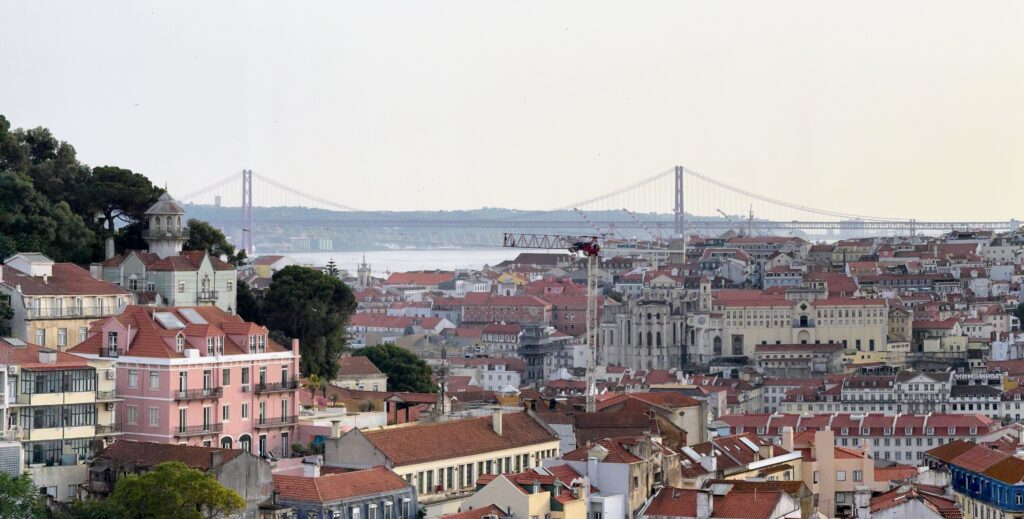
Graça sits above Alfama and Mouraria, with some of Lisbon’s most famous viewpoints nearby.
It has long combined residential streets, traditional shops, cafés and dramatic views. It remains one of the better central areas for seeing how daily life and tourism overlap.
But Graça is no longer an undiscovered local neighbourhood.
The miradouros attract large sunset crowds, tuk-tuks move constantly through parts of the area and short-term accommodation has expanded. The city itself now promotes routes beyond the historic centre partly to distribute tourism pressure more widely, which shows how established the concentration has become in central neighbourhoods.
The hills are also substantial. Graça works best for visitors who do not mind climbing or using buses and trams strategically.
- Stay here when: You want views, neighbourhood cafés and a more residential base within reach of the historic centre.
- Visit for: Miradouro da Graça, Senhora do Monte and the streets beyond the viewpoints.
- Think twice when: You want flat walking, fast Metro access or an area untouched by tourism.
- Our view: Still one of central Lisbon’s most rewarding neighbourhoods, but it is no longer a secret and it can be unpleasant. We used to live here, we kind of ran away.
Mouraria: Central, Diverse and Difficult to Reduce to One Description
Mouraria sits beside Baixa and below Graça and the castle.
It is one of Lisbon’s most culturally diverse areas, with long Portuguese, South Asian, African and other migrant histories visible in its shops, restaurants and streets.
Parts of Mouraria feel extremely central and heavily visited. Others remain more residential and less polished. The differences can occur within a few minutes’ walk.
That complexity makes blanket accommodation advice difficult.
Some streets are convenient and atmospheric. Others may feel noisy, poorly maintained or uncomfortable to travellers expecting the curated version of historic Lisbon shown in marketing materials.
This is not a neighbourhood to dismiss or romanticise.
- Stay here when: You value diversity, central access and a neighbourhood that feels less polished than Chiado or Príncipe Real.
- Visit for: Food, history and the connection between Baixa, Graça and the castle hill.
- Think twice when: You want a uniformly quiet or aesthetically polished environment.
- Our view: One of Lisbon’s most interesting areas, but choose the exact street and accommodation carefully.
Arroios and Anjos: Central Lisbon Beyond the Postcard
Arroios and Anjos offer a more contemporary, mixed version of Lisbon.
Avenida Almirante Reis runs through the area, connecting it directly to the centre by Metro. Side streets contain traditional businesses, international restaurants, bakeries, bars and residential buildings.
It is less immediately beautiful than Alfama or Chiado.
That is part of its value.
You are staying in a part of the city where people commute, shop and eat, rather than in a neighbourhood whose primary purpose is to be visited. At the same time, Arroios has changed rapidly and is increasingly filled with new cafés, accommodation and international residents.
The municipality identifies Arroios among the central parishes facing the strongest housing pressure and tighter local-accommodation controls, so it would be misleading to present it as untouched Lisbon.
- Stay here when: You want good transport, diverse food and a less postcard-driven base.
- Visit for: Restaurants, markets and the changing contemporary city.
- Think twice when: You want historic views immediately outside the hotel.
- Our view: One of the most practical areas for repeat visitors who want to see more than the historic core. Also, two of the most interesting areas when it comes to good and unique food.
Estrela and Lapa: Calm, Elegant and Better for a Slower Stay
Estrela and Lapa are residential, green and noticeably calmer than the central nightlife and sightseeing districts.
The Basilica da Estrela, Jardim da Estrela, embassies and larger residential buildings give the area a more spacious rhythm. It works well for travellers who want to return somewhere peaceful after spending the day in busier parts of Lisbon.
The compromise is transport.
There is no Metro station directly in the heart of these neighbourhoods, so buses, trams, taxis and walking become more important. Hills are still present, particularly in Lapa.
- Stay here when: Quiet, space and residential atmosphere matter more than immediate access to every attraction.
- Visit for: Jardim da Estrela, the basilica and a slower side of central Lisbon.
- Think twice when: You want to rely almost entirely on the Metro or walk home quickly from every night out.
- Our view: One of the best areas for couples, families and anyone who wants Lisbon without constant tourism outside the door.
Campo de Ourique: The Best Neighbourhood Feel, With a Transport Trade-Off
Campo de Ourique often feels like a small city inside Lisbon.
It has its own market, schools, shops, restaurants, cafés and Jardim da Parada. Residents can conduct much of daily life without leaving the neighbourhood, which gives it a coherence that many central areas have lost.
It is also relatively flat within its core, an unusual advantage in Lisbon.
The main drawback is that it does not have a Metro station. Buses, taxis and Tram 28 connect it with other areas, but returning from the historic centre is less immediate than staying in Baixa, Arroios or Alvalade.
- Stay here when: You want neighbourhood life, food and a calm base rather than monuments outside the door.
- Visit for: The market, Jardim da Parada, cafés and the rhythm of residential Lisbon.
- Think twice when: It is your first visit, you have only two days or you want to move mainly by Metro.
- Our view: One of the places we would choose for living in Lisbon (if we decided to move from our amazing neighbourhood), but not automatically the best base for a very short sightseeing trip.
Alvalade: Everyday Lisbon With Excellent Food and Transport
Alvalade is not postcard Lisbon.
Its broad avenues, mid-century residential buildings, traditional shops and local cafés show the city’s twentieth-century expansion rather than its medieval or Pombaline past. The area is still developed around traditional commerce, green spaces and shaded streets developed during Lisbon’s 1940s growth.
This is precisely why we like it. And that’s why we decided to live exactly in Alvalade.
Avenida da Igreja, Mercado de Alvalade and the surrounding streets remain part of everyday routines. The neighbourhood also has good Metro access and a growing food scene without being organised primarily around tourism.
Visitors expecting tiled alleys and castle views may initially find it ordinary. Visitors who want to understand how Lisbon residents live often find that ordinariness refreshing.
- Stay here when: You want transport, neighbourhood restaurants, bakeries and a calmer local base.
- Visit for: Food, the market and a side of Lisbon rarely included in first-time itineraries.
- Think twice when: You want to walk directly to the historic centre or see famous landmarks from your window.
- Our view: One of the best areas for repeat visitors and one of the clearest examples of Lisbon beyond tourism. We simply love living here.
Avenidas Novas and Saldanha: Practical, Central and Not Especially Romantic
Avenidas Novas and Saldanha are built around wider roads, offices, hotels, shopping centres and later urban development.
They lack the immediate visual charm of Alfama or Chiado, but they compensate with transport, modern hotels, lifts, larger rooms and easier taxi access.
This can matter more than visitors expect.
Travellers with mobility concerns, business commitments or a preference for predictable hotel infrastructure may have a much easier stay here than inside an old building on a steep historic street.
The area is still close to the Gulbenkian, Parque Eduardo VII and several Metro lines.
- Stay here when: Comfort, transport and modern accommodation matter more than historic atmosphere.
- Visit for: The Gulbenkian, shopping and practical access across the city.
- Think twice when: You want your accommodation itself to feel like part of old Lisbon.
- Our view: Underestimated as a base, particularly for families, work trips and travellers who value function.
Belém: Essential to Visit, Usually Too Far Out to Stay
Belém contains some of Lisbon’s most important monuments, including the Jerónimos Monastery, Belém Tower and the riverside cultural district.
It deserves at least half a day.
It is not usually the best base for experiencing Lisbon as a whole.
Belém sits west of the historic centre and is connected mainly by tram, bus and train rather than Metro. Evenings are quieter, and returning after dinner or nightlife elsewhere requires more planning.
Staying there can work for travellers who prefer calm, riverside walks and monumental Lisbon over neighbourhood variety.
- Stay here when: You want peace, the river and easy access to Belém’s cultural sites.
- Visit for: The monastery, museums, waterfront and pastries.
- Think twice when: It is your first visit and you want to explore several central neighbourhoods every day.
- Our view: One of Lisbon’s most important places to visit, but not one of its most versatile bases.
Parque das Nações: Easy, Modern and Almost a Different City
Parque das Nações was redeveloped for Expo 98 and offers a modern waterfront, contemporary architecture, wide pavements and strong transport connections through Oriente.
It is easier to navigate with luggage, wheelchairs and pushchairs than much of historic Lisbon. Hotels are modern, the airport is nearby and the riverfront has space rarely found in the centre.
The trade-off is atmosphere.
This is not the Lisbon of tiled façades, narrow streets and old neighbourhood cafés. It can feel like a separate modern city attached to the capital.
- Stay here when: You have an early flight, an event at FIL or Altice Arena, or need modern accessibility and transport.
- Visit for: The Oceanário, waterfront and contemporary architecture.
- Think twice when: You want to step outside and feel immediately immersed in historic Lisbon.
- Our view: Highly practical for specific trips, weak as the default choice for a first city break.
Which Lisbon Neighbourhood Should You Avoid?
We would not describe any major central neighbourhood as somewhere every visitor must avoid. The more useful question is what you should avoid for your particular stay.
- Avoid Bairro Alto when sleep matters.
- Avoid the steepest parts of Alfama, Castelo and Graça when mobility or luggage is a concern.
- Avoid staying directly beside Pink Street or the busiest Cais do Sodré bars when you want quiet.
- Avoid Belém or Parque das Nações when you want to spend most of the trip walking around central Lisbon.
- Avoid choosing Baixa because you assume central automatically means local.
Avoid booking anywhere based only on the neighbourhood name. In Lisbon, one street can be calm and the next intensely noisy, steep or crowded.
The city’s regulation of local accommodation reflects real pressure in historic and central parishes, including Santa Maria Maior, Misericórdia, São Vicente, Arroios, Estrela and others. That does not make them unsuitable for visitors, but it is a reminder that accommodation choices affect functioning residential neighbourhoods.
The Best Lisbon Neighbourhoods by Type of Trip
- For a first visit, choose Chiado, Baixa or the quieter edges of Cais do Sodré.
- For nightlife, choose Bairro Alto or Cais do Sodré—but check the exact street.
- For views and historic atmosphere, choose Graça or Alfama.
- For food and everyday Lisbon, choose Alvalade, Arroios or Campo de Ourique.
- For quiet and elegance, choose Estrela, Lapa or Príncipe Real.
- For modern comfort and transport, choose Saldanha, Avenidas Novas or Parque das Nações.
- For families, consider Estrela, Avenidas Novas, Alvalade or Campo de Ourique.
- For repeat visitors and people into local culture, Alvalade, Campo de Ourique and Arroios reveal more of the city beyond the main sightseeing corridor.
Where Would We Tell Friends to Stay in Lisbon?
As Lisbon residents, this is the question we actually ask ourselves: where would we send friends or family if they came to visit and, for once, were not staying with us?
For a first trip of three or four days, we would usually recommend Chiado, Príncipe Real, São Bento or a carefully chosen street in Santos or Cais do Sodré. They make it easy to move between different parts of Lisbon without beginning every day with a complicated journey.
São Bento is particularly good for travellers who want to be central without feeling completely surrounded by tourism. Santos works better for people who care about restaurants, cafés and contemporary city life and do not mind a busier atmosphere.
For a longer stay, we would look beyond the obvious centre. Alvalade, Estrela and Campo de Ourique offer more neighbourhood life, better reasons to spend time close to where you are staying and a version of Lisbon that does not disappear once the main sights close.
For atmosphere, Graça remains one of the most appealing choices, provided the hills and transport are not a problem.
And Alfama? We would visit it every time. We would never recommend staying there.
That is ultimately how we think people should choose a Lisbon neighbourhood: not by asking which area is the prettiest or most famous, but by asking what they want daily life during the trip to feel like.
Do you want to walk almost everywhere? Sleep quietly? Be close to nightlife? Step outside into a residential neighbourhood? Avoid steep climbs? Return easily after dinner?
The best place to stay in Lisbon is the one that makes those ordinary parts of the trip easier.
Because after the viewpoints, tiled façades and photographs, you still have to live in the neighbourhood for a few days.