

Let’s be upfront about what the Algarve is: a region built largely around international beach tourism. The cliffs are genuinely extraordinary: ochre and rust-coloured limestone carved into sea stacks, arches and grottos that look too dramatic to be real. The water is clear and the best beaches compete with anywhere in Europe. That part of the Algarve’s reputation is earned.
But much of the Algarve’s wider appeal depends on who is visiting and what they are comparing it with.
The region has been marketed for decades primarily to British and northern European holidaymakers. For many of those visitors, the combination of reliable sunshine, widespread English, inexpensive beer, familiar food, golf courses and resort convenience creates the wow factor. A meal or a round of drinks may feel cheap compared with London, Dublin, Amsterdam or Oslo even when the same price is expensive by Portuguese standards.
This helps explain why the Algarve is recommended so enthusiastically abroad and why the reality can feel underwhelming once you arrive, especially if you live in Portugal like us and know what Portugal is. Much of what surrounds the beautiful coastline has been developed to meet the expectations of international package tourism rather than to preserve or showcase Portuguese character.
In the busiest areas, the result is a landscape of resorts, British and Irish pubs, translated menus, international restaurants and all-inclusive entertainment that could exist in almost any southern European beach destination.
The Algarve was quite a disappointment for us. We went from Lisbon after hearing so much about it and arrived with high expectations, only to leave underwhelmed. We had imagined it as the kind of place where you could slow down, switch off and experience a relaxed side of Portugal. Instead, much of it felt highly commercialised and oddly disconnected from the country around it.
The food was another part of that disconnect. The Algarve is often described as an affordable destination with excellent seafood. Good seafood certainly exists, but restaurant quality is inconsistent in the main tourist areas, and prices are frequently high by Portuguese standards. What appears to be a bargain to someone comparing it with northern Europe may feel overpriced when compared with Lisbon, Porto, the Alentejo or less touristed parts of the Portuguese coast. And we say all of this because we know what Portugal is, how welcoming it is, what’s real food like in Portugal and when a place is meant to satisfy tourists more than locals.
None of this means the Algarve is not worth visiting. It means its reputation needs context.
Visit for the cliffs, beaches, kayaking, surfing and outdoor scenery. Choose your base carefully, avoid assuming that every busy restaurant serves good Portuguese food, and understand that the region’s celebrated affordability and friendliness is relative.
The Algarve can be beautiful. It is simply not always as extraordinary or authentically Portuguese as it is sold.
Is the Algarve Worth Visiting?
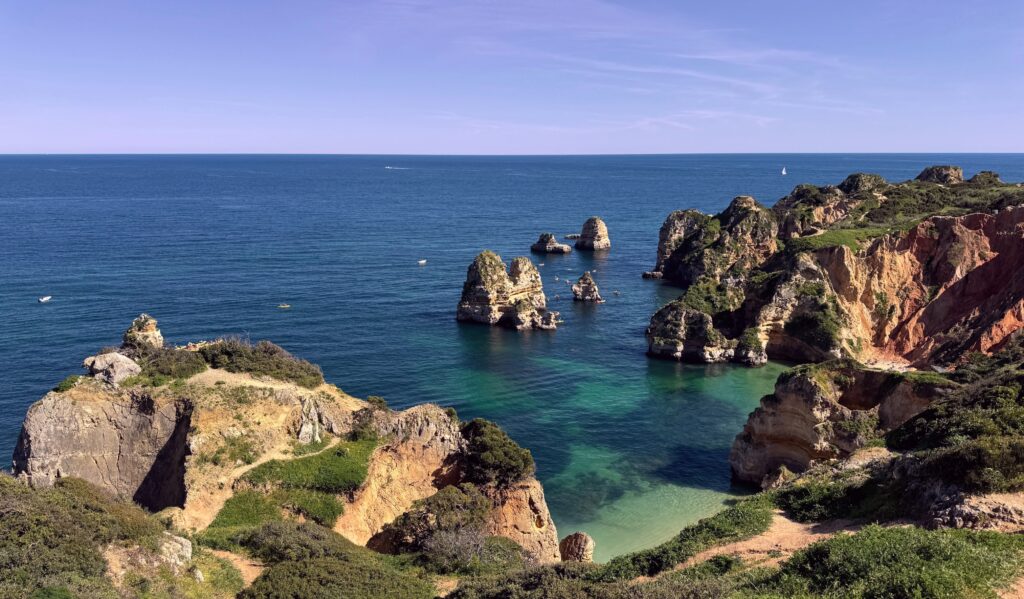
The Algarve is worth visiting for its beaches, limestone cliffs, sea caves and outdoor activities. Whether it deserves its wider reputation depends on what you expect from it.
For many international visitors, particularly those arriving from the UK and northern Europe, the Algarve offers an appealing combination: warm weather, English-speaking service, familiar food, inexpensive alcohol by their home-country standards, golf courses, nightlife and resorts that make holidays extremely easy.
That convenience is a major part of the destination’s success. But convenience is not the same as cultural depth, authenticity or good value within Portugal.
Measured against other parts of the country, the Algarve can feel expensive, heavily commercialised and extremely generic. A restaurant meal that appears cheap to a visitor from London may be poor value compared with an extremely better meal in Lisbon, Porto or the Alentejo. A busy resort town may feel exciting to someone seeking nightlife while feeling completely disconnected from Portugal to someone looking for local character.
The Algarve is therefore neither universally exceptional nor simply overrated. It is a destination that has been marketed extremely effectively to a specific type of tourist.
Come for the coastline and outdoor experiences, and it can be worth the journey. Come expecting the most authentic, culturally rich or best-value version of Portugal, and it may disappoint.
The Algarve at a Glance
- Best overall base: Lagos
- Best for cliffs and coastal scenery: Lagos and Ponta da Piedade
- Best for surfing and wild landscapes: Sagres
- Best for luxury resorts and golf: Vilamoura
- Best for a quieter, more attractive town: Tavira
- Best for nature and birdwatching: Ria Formosa
- Best place to skip: Albufeira, unless you specifically want nightlife and package tourism
- Best beaches: Praia do Camilo, Praia de Dona Ana, Meia Praia and Praia da Marinha
- Best experience: Kayaking or taking a small boat around Ponta da Piedade
- Best time to visit: May, June, September and early October
- Main airport: Faro Airport
- Recommended transport: Rental car
- Ideal trip length: Four to seven days
- Best food to try: Cataplana, grilled fish, seafood rice and amêijoas à Bulhão Pato
Where to Go in the Algarve
The Algarve stretches across the southern edge of mainland Portugal, but the experience varies considerably depending on where you stay.
The western Algarve has dramatic cliffs, Atlantic scenery and more individual character. The central Algarve contains the highest concentration of resorts, nightlife and package-holiday infrastructure. The eastern Algarve is quieter and more understated, although reaching its beaches often requires a ferry or boat.
Choosing the right area matters because the Algarve can feel like three very different destinations.
Western Algarve: Best for Cliffs and Coastal Scenery
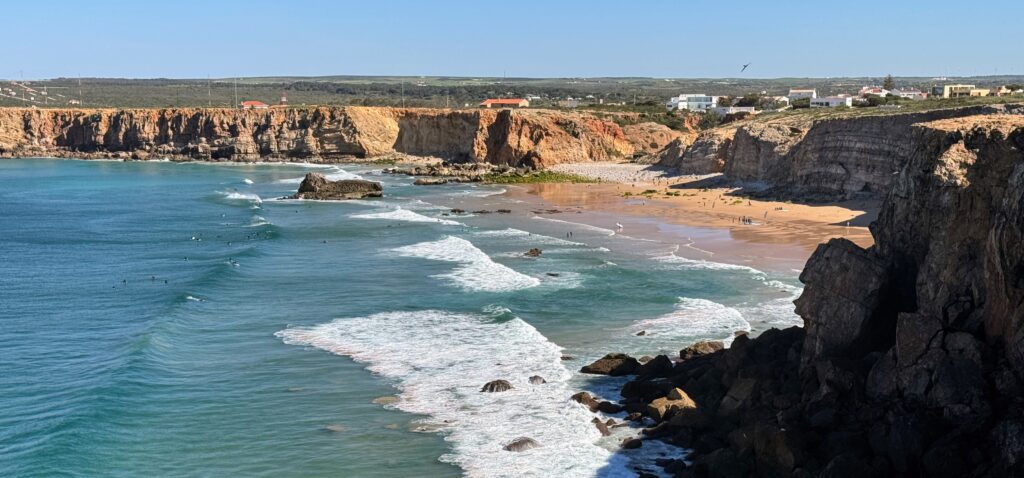
The western Algarve includes Lagos, Sagres and the coastline around Ponta da Piedade.
This is where the Algarve comes closest to matching its international reputation. The cliffs are dramatic, the landscape feels less controlled and the Atlantic coast creates a stronger sense of place than the resort developments farther east.
Choose the western Algarve for:
- Limestone cliffs and sea caves
- Kayaking and small-boat tours
- Surfing
- Coastal walking
- Smaller towns
- The most memorable scenery in the region
For most first-time visitors, this is the part of the Algarve worth prioritising.
Central Algarve: Best for Resorts, Nightlife and Golf
The central Algarve includes Portimão, Albufeira, Carvoeiro, Armação de Pêra, Vilamoura and several large resort developments.
This is the centre of the Algarve’s international tourism industry. It offers convenient hotels, restaurants, golf courses, marinas, waterparks and organised entertainment.
It is also where the region feels most generic.
In many places, the tourism infrastructure overwhelms the destination itself. Streets are designed around short-term visitors, restaurants serve broad international menus and prices are based on what overseas tourists are willing to pay rather than what represents good value locally.
Choose the central Algarve if you want:
- A resort holiday
- Nightlife
- Golf
- Family attractions
- All-inclusive accommodation
- English-speaking convenience
Do not choose it expecting a strong sense of Portuguese culture.
Eastern Algarve: Best for Quieter Towns and Nature
The eastern Algarve includes Faro, Olhão, Tavira and the Ria Formosa.
This part of the region feels flatter, calmer and more traditionally Portuguese than the central resort corridor. Instead of small beaches surrounded by cliffs, the coastline is formed by lagoons, marshes and long barrier islands.
The eastern Algarve is often more rewarding for travellers interested in towns, local atmosphere and nature. However, it is less convenient for a simple beach holiday because many beaches require ferries, boats or additional transport.
Choose the eastern Algarve for:
- Attractive historic towns
- Birdwatching
- Quiet island beaches
- Ria Formosa boat trips
- A slower pace
- A less resort-focused experience
Is Lagos the Best Place to Stay in the Algarve?
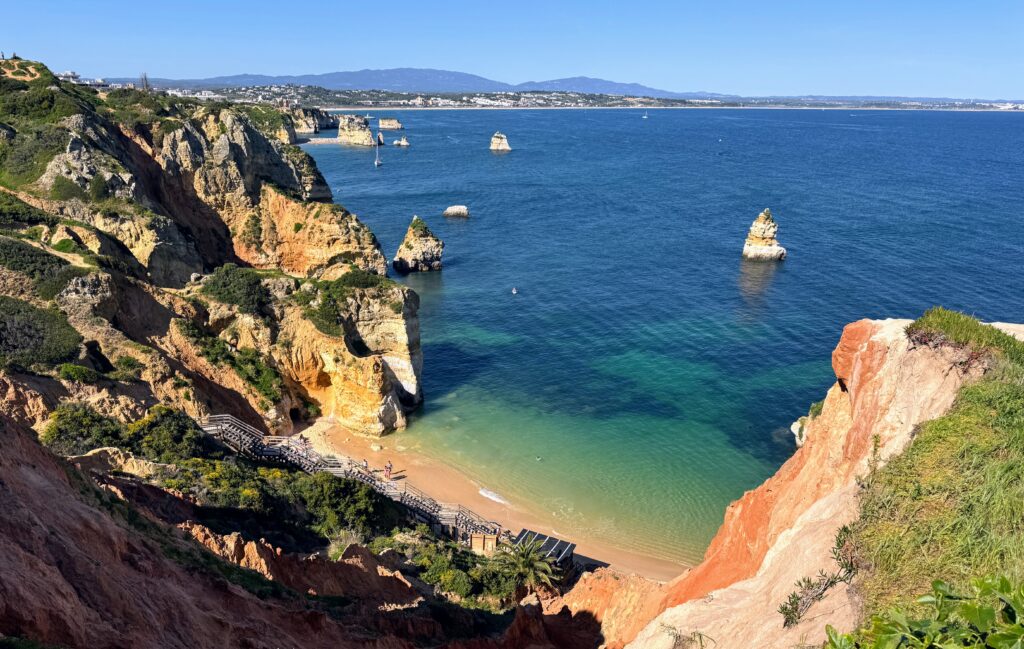
For us, Lagos is the best base in the Algarve because it combines a walkable historic centre with easy access to beaches, cliffs and Ponta da Piedade.
It is still highly touristed, particularly during summer, but it retains more character than most towns along the central coast.
The old town contains pedestrian streets, small squares, cafés, bars and independent restaurants. It feels like a place where people live, even if tourism now shapes much of its economy.
The main reason to stay in Lagos, however, is the coastline immediately outside the town.
Between Lagos and Ponta da Piedade, the limestone has been shaped into arches, sea stacks, narrow passages and hidden coves. This is the Algarve scenery people imagine before visiting—and one of the few parts of the region that genuinely delivers the expected wow factor.
What to do in Lagos
- Walk around the historic centre
- Visit Praia de Dona Ana
- Descend the staircase to Praia do Camilo
- Walk the cliff-top path towards Ponta da Piedade
- Explore the coastline by kayak or small boat
- Spend a full beach day at Meia Praia
- Use Lagos as a base for Sagres and Silves
TheFoodellers’ honest view of Lagos
Lagos is not an undiscovered Portuguese town. It has hostels, international restaurants, English-language menus and a substantial seasonal tourism industry.
However, compared with Albufeira, Praia da Rocha or Vilamoura, it offers a better balance between tourism, scenery and local character.
If you visit only one part of the Algarve, Lagos is the strongest choice.
The Best Beaches Near Lagos
1. Praia de Dona Ana – Best for: Classic Algarve cliff scenery.
Praia de Dona Ana is a small beach surrounded by the golden cliffs for which the western Algarve is famous.
It is one of the region’s most photographed beaches and is easy to reach from Lagos. It is also small and becomes extremely crowded during summer.
Visit early in the morning rather than expecting a quiet afternoon.
2. Praia do Camilo – Best for: Scenery and photography.
Praia do Camilo is reached by descending a long wooden staircase through the cliffs.
The beach is tiny, but the surrounding formations are particularly dramatic. Its limited size means that even a relatively small number of visitors can make it feel full.
3. Meia Praia – Best for: Swimming, walking and avoiding cramped coves.
Meia Praia is a long, open beach east of Lagos.
It lacks the dramatic framing of the smaller coves, but it offers considerably more space and works better for a full beach day.
4. Praia da Luz – Best for: Families and a more relaxed beach day.
Praia da Luz combines a broad beach with a small resort town west of Lagos.
It is developed for tourism but generally feels calmer than Albufeira or Praia da Rocha.
5. Ponta da Piedade – Best for: Kayaking, boat trips and cliff walks.
Ponta da Piedade is not primarily a swimming beach. It is a rocky headland composed of cliffs, arches, pillars and grottoes.
You can see the formations from the paths above, but they are more impressive when viewed from the water.
Ponta da Piedade: The Algarve Experience Worth Prioritising
Exploring Ponta da Piedade from the water is one of the best things to do in the Algarve.
Kayaks and small boats can move between the arches and enter narrow areas that larger vessels cannot reach. From water level, the scale and shape of the cliffs become much more apparent than they are from the viewpoints above.
A kayak tour provides the closest experience but requires more physical effort. A small boat is a better choice for travellers who want something easier.
Morning departures are generally preferable because the water and wind conditions tend to be calmer.
The cliff-top paths are also worthwhile and free to access. Even without joining a tour, Ponta da Piedade is one of the Algarve’s strongest attractions.
Sagres: Best for Surfing and Wild Landscapes
Sagres is the best Algarve destination for travellers who want exposed Atlantic scenery, surfing and a quieter atmosphere.
At the western edge of the region, the landscape becomes wider, windier and more dramatic. High cliffs replace sheltered coves, and the tourism infrastructure feels smaller and less polished.
Sagres itself is a modest town with surf accommodation, casual restaurants and limited nightlife. It does not offer enough variety for every traveller to spend an entire week there, but it works well for a short stay or a day trip from Lagos.
Visit Sagres for:
- Surfing
- Atlantic beaches
- Cliff scenery
- Fortaleza de Sagres
- Cabo de São Vicente
- A quieter alternative to the resort coast
Sagres feels more distinctive than much of the central Algarve because the landscape, rather than the tourism infrastructure, remains the main attraction.
Vilamoura: Best for Luxury, Golf and Marina Life
Vilamoura is the best Algarve base for luxury hotels, golf, sailing and a polished international resort experience.
The town is centred around a large marina surrounded by hotels, holiday apartments, bars and restaurants. It is clean, convenient and designed to make holidays easy.
Vilamoura is very good at what it does. The issue is that what it does has very little connection to everyday Portugal.
Visitors often describe its restaurants and drinks as affordable, but that judgment usually reflects comparisons with cities in the UK or northern Europe. By Portuguese standards, marina restaurants are frequently expensive, particularly for the quality offered.
Choose Vilamoura for:
- Luxury hotels
- Golf
- Sailing
- Marina restaurants
- Resort facilities
- A holiday requiring little planning
Do not choose it for:
- Traditional Portuguese atmosphere
- Independent local businesses
- Cultural immersion
- Good-value dining
Vilamoura is not a bad destination. It is simply an international resort located in Portugal rather than an experience of Portugal itself.
Albufeira: Who Is It Actually For?
Albufeira is consistently appearing on Portuguese newspapers because, especially on summer, it’s messy. And, considering that is praised for nightlife, package holidays, beach bars and travellers who want a busy international resort, it is also one of the easiest Algarve towns to skip if you like to experience local atmosphere.
Its central beach, Praia dos Pescadores, is not bad per se. The problem is not the coastline but what has developed around it.
Albufeira’s so-called Old Town has been almost completely converted into a tourism district filled with bars, souvenir shops, international restaurants and entertainment businesses. Very little of the experience feels connected to Portuguese life.
The newer nightlife district around the Strip takes this even further, catering to groups looking for clubs, alcohol and late-night entertainment.
For many overseas visitors, Albufeira delivers exactly what they want: sunshine, inexpensive drinks, English-speaking service, junk food and organised entertainment.
That is the source of its appeal. It is also the reason it can feel so underwhelming to travellers expecting something distinctive.
Albufeira may work well for:
- Groups interested in nightlife
- Travellers booking package holidays
- Families wanting organised entertainment
- Visitors prioritising convenience
- People who enjoy busy resort towns
It is unlikely to suit:
- Independent travellers
- Food-focused trips
- Couples seeking quiet
- Visitors looking for traditional Portugal
- Anyone sensitive to crowds and commercial tourism
There is no need to pretend Albufeira serves no purpose. It serves a very clear one. It simply represents the most commercialised version of the Algarve. The one that brings in easy money.
Portimão and Praia da Rocha: Practical but Unremarkable
Portimão is a large regional town, while Praia da Rocha is its heavily developed beach district.
Praia da Rocha itself is wide and visually impressive. It offers more space than the small beaches near Lagos and has substantial tourism infrastructure.
The promenade above the beach is dominated by hotels, bars, casinos, souvenir shops and restaurants serving international visitors.
Portimão has more everyday life than Albufeira because it remains a functioning regional centre. However, the town itself is not particularly attractive or memorable. Stay here if accommodation, practical services or access to a large beach matter more than atmosphere.
Again, choose Lagos if you want a slightly better base.
Carvoeiro: A Smaller Central Algarve Resort
Carvoeiro is a compact resort town with convenient access to central Algarve beaches and coastal walks.
It is smaller and less overwhelming than Albufeira but is still shaped heavily around tourism. Its central beach sits directly below the town, allowing visitors to walk between accommodation, restaurants and the sea.
Carvoeiro is also close to Praia da Marinha, the Seven Hanging Valleys Trail and the Benagil area.
It works well as a compromise for travellers who want easy access to the central coast without staying in one of the Algarve’s largest resorts.
Do not expect an undiscovered fishing village. Carvoeiro is a tourist destination, just on a smaller and more manageable scale.
Benagil Cave: Is It Worth Visiting?
Benagil Cave is worth seeing for its extraordinary natural formation, but the overall experience is less magical than the photographs suggest.
The cave contains a large chamber, a small beach and a circular opening in the ceiling through which sunlight enters. Visually, it is impressive.
The problem is that Benagil has become one of the Algarve’s most promoted and crowded attractions. A large tourism industry has developed around the cave, and the experience can involve queues, crowded boats, tightly timed visits and dozens of people trying to take the same photograph.
Different operators also provide very different experiences. Some tours enter the cave or approach it closely, while larger vessels may offer only a brief view from the entrance.
Before booking:
- Confirm the size of the boat or group
- Ask whether the tour enters the cave
- Choose an authorised operator
- Book a morning departure
- Avoid July and August when possible
- Check the latest access and safety rules
- Do not attempt to swim into the cave
The cave itself is worth seeing. The heavily marketed and crowded experience surrounding it may not live up to the expectation.
Praia da Marinha and the Seven Hanging Valleys Trail
Praia da Marinha is one of the Algarve’s most scenic beaches and one of the principal stops along the Seven Hanging Valleys Trail.
The beach is surrounded by limestone cliffs and reached by a staircase. It is relatively small, and crowding can quickly change the atmosphere during summer.
The cliff-top trail offers a better understanding of the wider landscape than visiting the beach alone. It passes above coves, arches and coastal formations along one of the most visually impressive parts of the central Algarve.
Wear proper shoes, carry water and avoid walking during the hottest part of the day. The trail is exposed and offers limited shade.
Praia da Marinha is best visited during May, June, September or October. During July and August, arrive very early.
Silves: The Best Inland Day Trip
Silves is one of the best Algarve day trips for travellers who want history and a break from the coast.
The town is dominated by its red-stone castle and contains visible traces of the Algarve’s Islamic past.
Unlike many coastal destinations, Silves still feels like a functioning Portuguese town rather than a tourism development. Visitors are there, but they do not define every street and business.
A few hours are enough to visit the castle, walk through the centre and have lunch.
Silves does not turn the Algarve into a major cultural destination, but it offers a useful contrast to the resorts and beaches.
Faro: More Than an Airport, but Not an Easy Beach Base
Faro is worth visiting for its historic centre and access to the Ria Formosa, but it is not the most convenient base for a conventional beach holiday.
The old town is enclosed by historic walls and contains cobbled streets, churches and quiet squares. It has considerably more local life than the major resort towns.
The main complication is beach access. Faro’s coastline is formed by the Ria Formosa lagoon and its barrier islands. Some beaches can be reached by road or bus, while others require ferries or boats.
This means Faro works as a beach base, but it does not offer the simple experience of leaving your hotel and walking directly onto the sand.
Choose Faro for:
- A one- or two-night stay
- Historic streets
- Local restaurants
- Ria Formosa excursions
- Arrival and departure convenience
Do not choose it only because it appears to sit beside the sea on a map.
Tavira: The Most Attractive Town in the Eastern Algarve
Tavira is one of the best places to stay in the Algarve for architecture, atmosphere and a quieter pace.
The town sits across the Gilão River and combines tiled façades, church towers, bridges and small squares. Tourism is present, but it feels less overwhelming than in Lagos, Albufeira or Vilamoura.
Tavira may be the most visually attractive town in the Algarve.
Its main disadvantage is that the beach is not directly beside the town. Ilha de Tavira is normally reached by ferry or connecting transport.
Choose Tavira for:
- Architecture
- A quieter couple’s trip
- Eastern Algarve exploration
- Ria Formosa boat trips
- A slower and less resort-focused experience
It is not ideal for travellers who want to wake up, leave their accommodation and immediately be on the beach.
Ria Formosa: A Different Side of the Algarve
Ria Formosa is a protected lagoon system of tidal channels, salt marshes and barrier islands extending across the eastern Algarve.
It offers a completely different landscape from the cliffs around Lagos.
Here, the experience is about shallow water, sandbanks, fishing communities, birdlife and long island beaches.
The best ways to experience the Ria Formosa include:
- Taking a small-boat nature tour
- Catching a ferry to one of the islands
- Birdwatching
- Walking around the salt marshes
- Visiting Faro, Olhão or Tavira
- Spending the day on a barrier-island beach
The beaches can be spacious and quiet, but reaching them requires more planning than driving directly to a coastal resort.
Is Food in the Algarve Actually Good?
The Algarve has excellent raw ingredients, particularly fish, clams, shellfish and produce. That does not automatically make it an excellent food destination. In the region’s busiest tourism areas, restaurants cater to a large and constantly changing international audience. Many do not rely on repeat customers, and some depend more on location, sea views and translated menus than on the quality of the cooking.
This is why the Algarve can produce two apparently contradictory reputations. International visitors often describe eating and drinking there as cheap, especially when comparing prices with the UK, Ireland or northern Europe. Portuguese residents and frequent visitors may see the same restaurants as expensive for the quality provided.
A €15 or €20 tourist meal may appear affordable to someone used to London prices. Within Portugal, however, that price does not necessarily represent good value, particularly when the food is generic and a better Portuguese meal might cost less elsewhere.
Good food exists in the Algarve, but it should be researched rather than assumed. Look beyond beachfront promenades, resort marinas and streets dominated by menus in several languages. Traditional seafood restaurants, working towns and places with local repeat customers generally provide a better indication of what the region can produce.
What Food Is the Algarve Known For?
Cataplana
Cataplana is both a cooking vessel and the name commonly given to dishes prepared inside it.
The hinged metal pan traps steam as seafood, fish, vegetables and aromatics cook together.
Quality varies substantially. Some versions are traditional and deeply flavoured, while others are assembled primarily for tourists.
Order cataplana from a restaurant specialising in Portuguese food or seafood rather than choosing the first version photographed on a pavement menu.
Amêijoas à Bulhão Pato
Amêijoas à Bulhão Pato are clams prepared with garlic, olive oil, coriander and usually white wine or lemon.
When the clams are fresh and the sauce is balanced, it is one of the simplest and best seafood dishes in Portugal.
Grilled fish
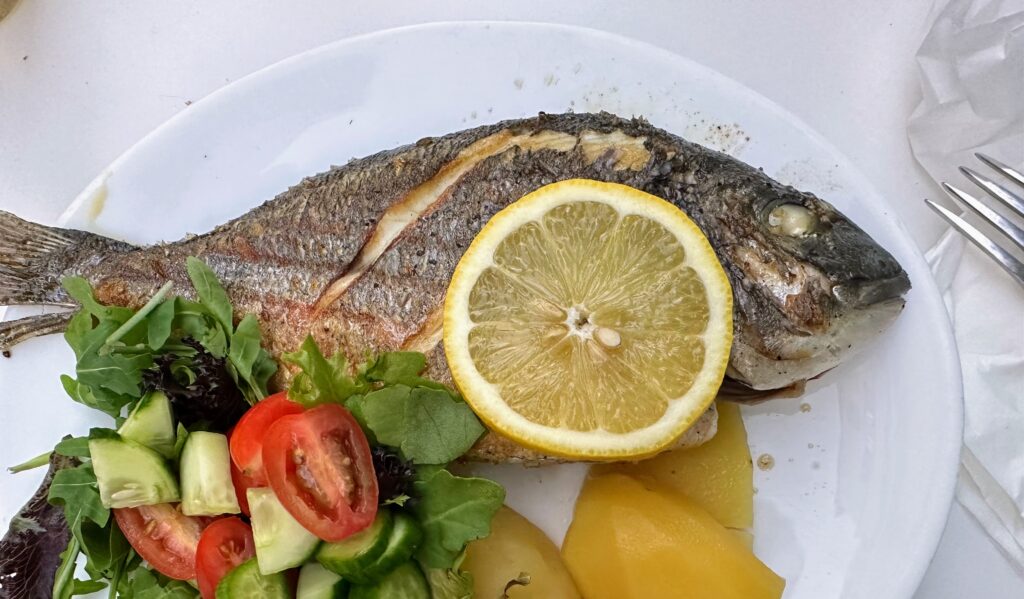
Look for dourada, robalo, sardines or the fish of the day cooked over charcoal.
Always ask how the fish is priced before ordering. Some restaurants list prices per kilogram rather than per portion.
Arroz de marisco
Portuguese seafood rice is wetter and more broth-like than Spanish paella.
A good version should taste intensely of shellfish rather than tomato sauce or stock powder.
Piri-piri chicken
Frango piri-piri is charcoal-grilled chicken served with a chilli sauce.
It is strongly associated with the Algarve, although quality varies. A busy churrascaria is usually a better choice than an international resort restaurant offering it as one item on an enormous menu.
Percebes
Percebes, or goose barnacles, have an intense salty flavour and are eaten with the fingers.
They are not always available and can be expensive. Confirm the price before ordering.
How to Find Better Restaurants in the Algarve
- Walk away from the main beachfront promenade
- Avoid restaurants relying heavily on menu photographs
- Look for shorter, more focused menus
- Choose places with local repeat customers
- Ask about the fish of the day
- Confirm fish and shellfish prices before ordering
- Research restaurants instead of choosing solely by location
- Do not assume a sea view guarantees good seafood
The marina in Vilamoura, the busiest streets in Albufeira and the Praia da Rocha strip all charge a substantial location premium.
In many cases, walking five or ten minutes away from the most obvious tourist area improves both quality and value.
What are the Best Things to Do in the Algarve?
Kayak around Ponta da Piedade
This is the strongest experience in the western Algarve.
From the water, you can properly see the arches, channels and grottoes that make the coastline distinctive.
Walk the Seven Hanging Valleys Trail
The trail connects some of the central Algarve’s most famous cliff scenery.
Start early, carry water and avoid the hottest hours of the day.
Visit Sagres and Cabo de São Vicente
The far west feels different from the sheltered resort coast.
Visit for wind, cliffs and Atlantic scale rather than resort facilities.
Explore Silves
Silves adds history and an inland landscape to an otherwise beach-focused trip.
Take a Ria Formosa boat trip
A lagoon excursion reveals a quieter and more ecologically distinctive part of the eastern Algarve.
Spend the day on an island beach
The barrier islands near Faro, Olhão and Tavira offer long sandy beaches that contrast with the small cliff coves around Lagos.
Go surfing
Sagres and the western Atlantic coast provide some of the region’s best surfing, with schools available for beginners.
Play golf
The Algarve is one of Europe’s most established golf destinations, particularly around Vilamoura, Quinta do Lago and Vale do Lobo.
For golfers, the region’s international reputation makes much more sense. The facilities are a central part of what the Algarve has deliberately built for overseas tourism.
Algarve Experiences We Would Skip
Large and crowded cave tours
Cave tours can be worthwhile, but large vessels moving quickly between crowded photo stops rarely provide the best experience. Choose a small-group tour where possible or skip the caves.
Generic jeep safaris
Some rural tours visit worthwhile villages and landscapes. Others package an ordinary drive through dry countryside as an encounter with the “authentic Algarve.” Research the actual itinerary before booking. Or skip it.
Tourist folk shows
Performances created primarily for resort groups rarely offer meaningful cultural context. Spend the evening in a functioning Portuguese town instead.
Restaurants selected only for the view
A sea view may justify the experience, but it does not guarantee good food. Decide whether the location or the meal is your priority.
When Is the Best Time to Visit the Algarve?
We were sure that the best time to visit the Algarve were May, June, September or early October. They’re not simply because the weather is generally good and this means tourists flock all year round, making every month an unsuitable one. But if you’ve to choose, these are the best among the worst months since they generally provide warm weather and lower crowd levels than July and August.
March and April
Spring is good for walking, cycling and exploring towns. Temperatures can be pleasant, but the sea remains cold and the weather is not consistently suitable for a beach holiday.
May and June
May and June offer one of the best balances of warm weather, long days and manageable crowds. By June, popular areas are becoming busy, but they have not yet reached peak-season intensity.
July and August
July and August bring the largest crowds, highest accommodation prices and busiest roads. Popular beaches fill early, parking becomes difficult and resort towns operate at maximum capacity.
This is also when the Algarve’s commercial character is most visible. Visit during these months if school schedules require it or if you actively enjoy a lively peak-season atmosphere. Otherwise, choose another period.
September and October
September is arguably the best month to visit the Algarve. The weather remains warm, the sea has had the summer to heat up and crowd levels begin to fall after the school holidays.
Early October can also be excellent, although the probability of unsettled weather gradually increases.
November to February
Winter works for walking, golf, cycling and long stays. It is not a reliable beach season, and many tourism businesses reduce their hours or close temporarily.
How Many Days Do You Need in the Algarve?
Four or five days are enough for a focused western Algarve trip. Seven days allow you to combine Lagos, the central coastline and part of the eastern Algarve without rushing.
Four-day Algarve itinerary
Day one: Lagos and its historic centre
Day two: Ponta da Piedade and the Lagos beaches
Day three: Sagres and Cabo de São Vicente
Day four: Silves or Praia da Marinha and the central coast
Seven-day Algarve itinerary
Days one to three: Lagos, Ponta da Piedade and nearby beaches
Day four: Sagres and the western coast
Day five: Silves, Carvoeiro and Praia da Marinha
Day six: Faro and the Ria Formosa
Day seven: Tavira and Ilha de Tavira
Trying to explore the entire Algarve from one base creates unnecessary driving.
For a week-long trip, consider dividing your stay between Lagos and Tavira or Faro.
How to Get to the Algarve
Faro Airport is the main airport serving the Algarve.
It receives flights from many European cities and is the most convenient arrival point for a dedicated trip to the region.
Lisbon is another possible entry point. From Lisbon, you can continue south by train, coach or car.
Arriving through Lisbon works well when combining the Algarve with the capital or the Alentejo. For a beach-focused holiday, flying directly to Faro is generally easier.
Do You Need a Car in the Algarve?
We recommend renting a car if you want to explore several Algarve beaches, trails and towns. It is not strictly necessary if your goal is to remain in one town or resort.
The railway connects some of the region’s principal towns, and regional buses do exist. However, many beaches, viewpoints and cliff walks are inconvenient to reach using public transport.
Driving distances are generally manageable, but traffic and parking become difficult near popular beaches during July and August.
Is the Algarve Expensive?
The Algarve is more expensive than many other parts of Portugal, particularly during summer. Its reputation as a cheap destination is largely based on comparisons with northern European prices. Visitors arriving from the UK, Ireland, Scandinavia or major northern European cities may find accommodation, beer and restaurant meals affordable compared with home.
That does not mean those prices are low within Portugal. Restaurants in Vilamoura, Albufeira and Praia da Rocha can charge considerably more than restaurants of similar or better quality elsewhere in the country. Summer accommodation prices also rise sharply in Lagos and around the most popular beaches.
Vilamoura, Quinta do Lago and Vale do Lobo are among the most expensive parts of the region. Lagos offers a wider price range but is no longer a particularly cheap destination during peak season.
The important thing to remember is this:
The Algarve can be inexpensive for an international tourist without being inexpensive by Portuguese standards.
Is the Algarve Authentic Portugal?
The Algarve is part of Portugal, but its busiest coastal destinations are not the best places to experience contemporary Portuguese culture. Decades of international tourism and international investments have reshaped towns, restaurants and local economies around the expectations of visitors.
English is widely spoken. International food is easy to find. British pubs, Irish bars, golf resorts and package-holiday infrastructure dominate parts of the central coast.
This makes the region accessible and convenient. It also reduces the sense that you are encountering somewhere culturally distinct.
Places such as Silves, Tavira, Faro and parts of the western coast retain more local character. Even there, tourism plays a major role.
For a deeper introduction to Portugal, Lisbon, Porto, the Alentejo, central Portugal and the country’s less-developed coastal areas are generally more rewarding.
Visit Algarve: hit or miss?
The Algarve is not the Portugal we would recommend to someone primarily searching for local culture, exceptional food and towns that still revolve around everyday Portuguese life.
It is a region whose most famous natural assets have been surrounded by an enormous international tourism industry. In some places, that infrastructure makes travelling easy. In others, it removes the very sense of place visitors thought they were coming to experience.
Its reputation also depends heavily on perspective. For a British or northern European visitor, the Algarve may combine sunshine, inexpensive alcohol, English-speaking service, food and convenient resorts at prices that feel reasonable compared with home.
For someone comparing it with the rest of Portugal, or living in Portugal, the same experience may feel expensive, generic and culturally thin.
This does not mean the Algarve has nothing to offer. The cliffs around Lagos are extraordinary. Ponta da Piedade is worth seeing from the water. Sagres provides genuine drama, and the Ria Formosa reveals a completely different coastal ecosystem in the east. The strongest beaches justify the journey, particularly outside the busiest summer weeks.
So, is the Algarve worth visiting? Yes, if you visit for the coast rather than for an idealised version of authentic Portugal. Stay in Lagos, explore beyond the largest resorts, travel outside July and August when possible, and treat good food as something to research rather than something guaranteed.
The Algarve may not be as extraordinary, affordable or authentically Portuguese as its international reputation suggests. But for cliffs, beaches and days spent outdoors beside the Atlantic, parts of it can still be great.