

Let’s be honest about Phuket from the start: it is Thailand’s most commercially developed island by a wide margin, and it shows. Parts of it feel less like a Thai destination and more like an international resort zone that happens to be located in Thailand — the signage is in five languages, the menus are laminated and photo-illustrated, and the infrastructure is built entirely around absorbing the six million tourists who pass through the island every year.
And yet. The water off Phuket’s west coast, particularly in the calmer months of dry season, is beautiful. The beaches at Kata and Kata Noi hold up against almost anywhere in Thailand. The island’s south and north ends hide pockets of real calm. The question is not whether Phuket is worth visiting — it can be — but whether you understand what you are visiting and make decisions accordingly.
The single most important decision you will make in Phuket is not which temple to visit or which tour to book. It is where you sleep. That choice will shape every hour of your trip.
| Location | Andaman Sea, southern Thailand — Thailand’s largest island, connected to mainland by two bridges |
| Best season | November to April (Andaman dry season). Peak: December–February. Sweet spot: November and March. |
| Getting there | Phuket International Airport (HKT) — direct flights from Bangkok (1h20), Singapore, KL, many European hubs |
| Where to stay | This decision is everything. Kata/Kata Noi for couples and calm; Karon for families; Kamala/Surin for quiet upscale; Nai Harn for local feel. Patong only if you are going to party. |
| Best beaches | Kata, Kata Noi, Karon, Freedom Beach. Not Patong for beach quality. |
| Biggest mistake | Booking Patong accommodation without understanding what Patong is — it will define your entire trip |
| Honest verdict | Phuket is over-developed and can feel artificial. The beaches are real; the experience around them often is not. Go in knowing that and you will find the good parts. |
Where to Stay in Phuket? The Decision That Shapes Everything
Phuket is large — roughly 50km north to south — and each coastal strip operates almost as a separate destination. The area you book into is the area you will spend most of your time in, because moving between beaches requires either a vehicle or an expensive tuk-tuk. There is no walkable centre and no public transport system.
Do not book Phuket accommodation based on price alone without checking which area it is in. A cheap room in Patong and a cheap room in Nai Harn are completely different holidays. Read this section before you book anything.
Patong — The Party Zone. Only If That’s What You Want.
Patong is the largest, most famous, and most visited beach in Phuket. Its main street, Bangla Road, is one of the most concentrated strips of bars, clubs, and entertainment venues in Southeast Asia. On peak-season evenings it is loud, crowded, neon-lit, and relentless — it operates until 4 or 5am. This is not a criticism; it is a description. For a certain type of traveller — mid-20s, solo or in groups, specifically looking for nightlife and a social atmosphere — Patong does exactly what it promises.
For everyone else — couples on a romantic holiday, families with children, people who need to sleep before midnight, anyone seeking an authentic Thai experience or simply a quiet beach — Patong will ruin your trip. Not disappoint it. Ruin it. The noise carries into the accommodation. The beach itself is heaving with sunbeds and vendors by 9am. The streets are a gauntlet of bars and massage parlours at all hours.
If you are like us and not specifically coming to Phuket for the nightlife and the party scene, do not stay in Patong. There is no ‘quiet side’ of Patong. It is loud, all of it, all the time during high season.
The beach at Patong is long and the water is swimmable, but the sand is packed with vendor infrastructure and the beach itself reflects the area: functional, crowded, not particularly pleasant.
Kata Beach — The Best All-Round Base
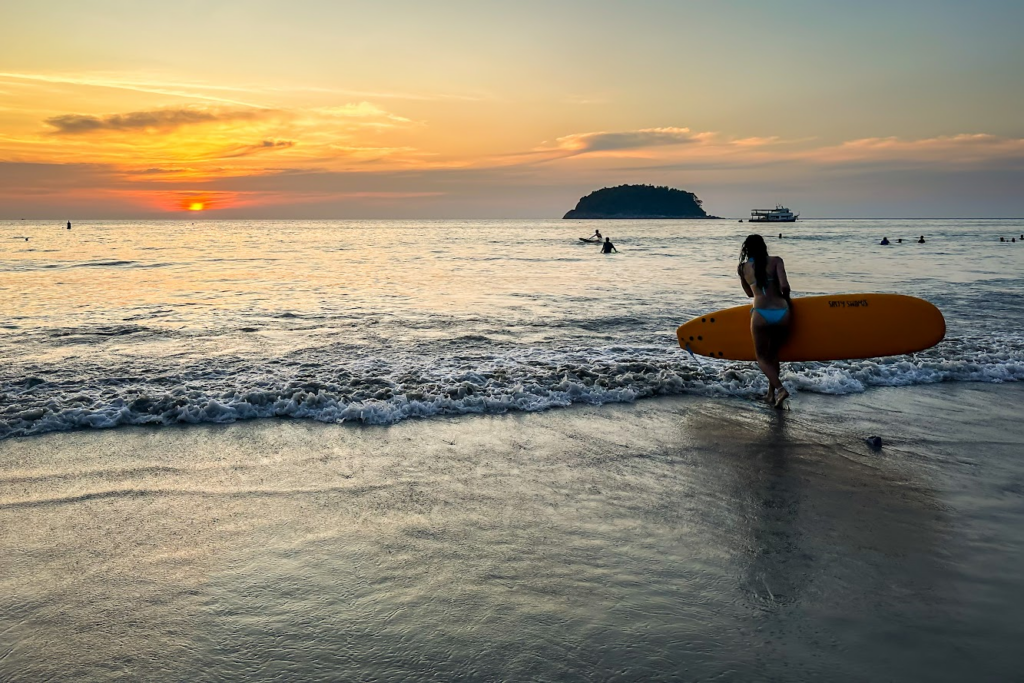
Kata Beach, on the southwestern coast, is where the balance tips in Phuket’s favour. The beach is wide, the sand is good quality, the water is clear and swimmable through most of dry season, and the area behind it — while undeniably touristy — is on a human scale. There are proper restaurants, surf schools (Kata has the best beginner surf in Phuket, with consistent small waves from April to October), and accommodation options from budget guesthouses to mid-range resorts.
There is nightlife in Kata — a few bars, some live music — but it operates at a volume and duration that does not penetrate your sleep. By midnight, Kata is quiet. Families, couples, and older travellers consistently rate it as Phuket’s most liveable beach area for exactly this reason.
Kata Beach is the default recommendation for first-time Phuket visitors who are not specifically there for the party scene. It is the island’s sweet spot between convenience and quality.
Kata Noi — The Quieter, Prettier Sister
Kata Noi is a smaller bay just south of Kata, separated by a headland. The beach is shorter, the water is often calmer (the headland provides more shelter), and the density of tourists is noticeably lower — partly because there is less accommodation, partly because fewer people know it, and partly because the slightly longer tuk-tuk ride from the main tourist strip filters the casual day-tripper.
Accommodation options are more limited and skew towards resort-level properties (the Katathani Phuket Beach Resort occupies much of the bay). But if you are prioritising beach quality and calm over having restaurants within walking distance, Kata Noi delivers a materially better experience than any beach further north.
Karon Beach — Family-Friendly, Understated
Karon is the next beach north of Kata — long, wide, and significantly less developed than Patong despite being closer to it. The sand is coarser than Kata but the beach is spacious and the water is good. Karon attracts a slightly older, more family-oriented crowd than Kata and considerably more than Patong.
The area behind the beach has the full range of Thai resort services — restaurants, massage shops, tour operators — but the commercial strip is milder and there is no meaningful nightlife. It is a good option for families wanting a larger beach with more space and lower prices than Kata.
Kamala and Surin — The Quiet Upscale Strip
North of Patong (which sits centrally on the west coast), Kamala and Surin offer a completely different version of Phuket. Kamala is a residential beach village that has absorbed some tourism infrastructure without losing its shape entirely — there is a mosque, local shops, a community that predates the tourist economy. The beach is long and largely uncrowded.
Surin, just north of Kamala, is Phuket’s upscale beach. Twin Palms and the Catch Beach Club define the end of the strip — expensive sunbeds, cocktails, international clientele. The beach itself is beautiful and significantly quieter than Kata or Karon. There are seasonal water safety concerns (Surin has a strong undertow and beach flag rules are enforced) — check flags before swimming.
Nai Harn — The Expat Favourite, the Island at Its Most Real
At the southern tip of Phuket, Nai Harn is consistently rated the best beach on the island by the expat community and returning visitors who have graduated beyond the tourist circuit. The beach is wide and sheltered, backed by a lake that separates it from the village. There is a yacht club, a handful of genuinely good restaurants that serve Thais and expats rather than tourists, and an atmosphere that feels less manufactured than anything north of Kata.
The trade-off is distance — Nai Harn is far from the airport, far from Patong, and far from most of the island’s tour departure points. If you are using Phuket as a base for island day trips (Phi Phi, Similan), the logistics from Nai Harn are less convenient. If you want to actually relax on Phuket’s best beach with minimal tourist infrastructure around you, Nai Harn is the answer.
Nai Harn is the choice for people who have been to Phuket before and are coming back specifically because they know what they want — and that thing is not Patong.
Phuket Town — For Culture and Character, Not Beach
The island’s capital and the only part of Phuket that reads as an actual Thai city. Sino-Portuguese shophouses line the old town streets — narrow facades in faded pastels, Chinese shrines, coffee shops, proper local markets. The Sunday Walking Street market on Thalang Road is one of the best in southern Thailand: local food, local vendors, a fraction of the tourist density of the beach areas.
Staying in Phuket Town means no direct beach access (it is 15km from the nearest west coast beach), but it is the only accommodation option on the island with any cultural texture. For travellers who will spend most of their time on day trips and want a base that is not a resort zone, it is worth serious consideration.
Phuket Area Comparison: Which Part of Phuket Is Right for You?
| Area | Beach Quality | Crowd Level | Nightlife | Best For | Avoid If… |
| Patong | Average | Extremely high | Intense — all night | Party crowd, 20s, social scene | You want to sleep before midnight |
| Kata | Very good | Moderate | Mild — winds down by midnight | Couples, first-timers, surfers | You want total quiet |
| Kata Noi | Excellent | Low–moderate | Almost none | Couples, beach quality chasers | You need lots of restaurants nearby |
| Karon | Good | Moderate | Very little | Families, older travellers | You want vibrant atmosphere |
| Kamala | Good | Low | None | Quiet stays, local feel | You want nightlife or big resort infrastructure |
| Surin | Very good | Low | Beach clubs only | Upscale stays, sunbed days | You have a limited budget |
| Nai Harn | Excellent | Low | None | Repeat visitors, expat-adjacent | You want easy access to tours or airport |
| Phuket Town | No beach | Low tourists | Local bars, quiet | Culture, Old Town, local food | You prioritise beach access |
The Best Beaches in Phuket: our Honest Assessments
Kata Beach
The most consistent beach on the island for overall quality. The sand is fine and pale, the bay is shaped in a gentle curve with good visual proportions, and the water clears to excellent visibility in December through March. Kata has the best surfable waves in Phuket — small but consistent from April to October, making it the only Phuket beach where a surf lesson is genuinely worthwhile. In high season it fills up but never reaches the wall-to-wall density of Patong.
Kata Noi
Smaller, calmer, and more beautiful than Kata proper. The headland to the north creates a natural shelter that keeps the water gentler than the main Kata bay. At low tide the beach widens considerably and the coral at the southern end of the bay is accessible to snorkellers from the beach. In peak season, the early mornings here are among the best beach experiences available anywhere on the island’s west coast — by 7am you have the bay to yourself.
Karon Beach
Karon is Phuket’s second longest beach (after Patong) and its least appreciated. The extra length means the crowd density is lower per square metre even on busy days. The sand is slightly coarser than Kata but the water is comparable and the swimming is good through dry season. The northern end of the beach, furthest from the resort strip, is consistently the quietest section.
Freedom Beach
Freedom Beach sits directly south of Patong — separated from it by a headland and accessible only by longtail boat from the Patong Beach area (around 200–300 THB return, takes 10 minutes). There is no road access. That physical separation does most of the work: while Patong’s beach is packed, Freedom Beach on the same morning can have a few dozen people on it at most.
The beach is small — perhaps 200 metres of white sand backed by dense jungle — and the water is a different quality to anything on the main tourist strip. There is a simple restaurant on the beach selling cold drinks and fresh fruit. The whole thing is, by Phuket standards, remarkably unspoiled. Longtail boats run from the southern end of Patong Beach; the first ones depart around 8am.
Freedom Beach is the most underused good beach in Phuket. It requires only a short longtail ride from Patong and delivers a completely different experience from anything on the main strip. Go in the morning before 10am when the boats start bringing larger groups.
Nai Harn Beach
Wide, photogenic, and almost entirely free of the vendor and sunbed infrastructure that dominates the more northerly beaches. Nai Harn is backed by the Nai Harn Lake and a public park, which means development behind the beach is limited. The Royal Phuket Yacht Club sits at the northern end; beyond it the beach is largely open. The water can have stronger currents here than at Kata — flag warnings should be taken seriously.
Beaches to Skip
Patong beach: perfectly swimmable but the density of parasols, jet ski operators, and persistent vendors removes most pleasure from the experience. Rawai, on the south coast, is a working fishing beach — great for fresh seafood restaurants and hiring longtails to nearby islands, but not for swimming. Bang Tao is long and quiet at its northern end but the southern section, around the Laguna complex, has the manicured feel of a resort compound.
What to See and Do in Phuket
Phuket Old Town
The most genuine part of the island. The historic core of Phuket Town preserves a grid of Sino-Portuguese shophouses built during the tin-mining boom of the 19th century — two-storey facades with covered walkways (five-foot ways), shuttered windows, and peeling paint in ochre, terracotta, and pale green. Many have been converted into cafes, boutique guesthouses, and restaurants without losing their architectural character.
Thalang Road and Dibuk Road are the best-preserved streets. The Blue Elephant Restaurant, in a restored 1903 mansion, is a landmark. The Sunday Walking Street market on Thalang Road runs from 4–10pm and is the one market in Phuket that feels like a genuine local event rather than a tourist production.
Big Buddha (Phra Puttamingmongkol Akenakkiri)
A 45-metre white marble-effect Buddha statue sitting on Nakkerd Hill in the centre of the island, visible from much of the west coast. The complex is an active religious site — not a tourist attraction — and the behaviour expected at the base (covered shoulders and knees, respectful conduct) is taken seriously. The views from the hilltop over both the west and east coasts are the best elevated perspective available in Phuket without a drone.
Go at early morning (7–8am) or late afternoon (4–5pm) — midday is the least rewarding time both for light and for crowd density. The drive up the hill passes through a rubber plantation that softens the transition from the resort zone below.
Wat Chalong
Phuket’s most important Buddhist temple and one of the largest in the province. The main building, Phra Viharn Luang, contains relics of two revered monks and is an active site of worship — merit-making, prayer, incense. The complex is large and includes a chedi (stupa) with a fragment of the Buddha’s bone. Less visually dramatic than some of Chiang Mai or Ayutthaya’s temples, but genuinely functioning and non-theatrical.
Dress code applies: covered shoulders and knees. The temple is free to enter. Most tours include it as a stop; it is worth visiting independently for 30–45 minutes.
Promthep Cape
The southernmost tip of Phuket — a rocky headland with a lighthouse and a panoramic view over the Andaman Sea and the small islands to the south. It is one of the most popular sunset viewpoints in Thailand and fills up in the late afternoon with hundreds of visitors. The view is genuine and the site earns its reputation for the quality of the light when conditions are right. Going slightly before sunset (arriving at 5pm for a 6:15pm sunset in peak season) positions you before the main crowd arrives.
Day Trips from Phuket
Phuket’s main value as a base is the day trip access it provides. Phi Phi Islands are 1.5 hours by speedboat. The Similan Islands, the best diving in Thailand, are 2 hours by speedboat from Chalong Pier and 1.5 hours from Khao Lak (the better base for Similan trips). Phang Nga Bay — the karst bay made famous by The Man with the Golden Gun — is 45 minutes to 1 hour from the north of the island.
For Similan Islands diving or snorkelling, base yourself in Khao Lak (90 minutes north of Phuket) rather than doing the day trip from Phuket itself. The shorter journey means more time at the islands and the town is quieter and cheaper.
What Not to Do in Phuket: Rules and Ethical Red Lines
Tiger Kingdom
Tiger Kingdom has multiple locations in Thailand, including one near Kathu in central Phuket. Visitors pay to enter enclosures with tigers of different sizes — from cubs to adults — for photographs. The tigers are not sedated in the conventional sense, but the conditions required to make adult tigers docile enough for tourist handling are incompatible with normal tiger behaviour. Training methods documented at facilities of this type involve physical intervention and confinement from birth.
Tiger Kingdom is not an ethical wildlife experience. A tiger that allows strangers to sit on it and take photographs has been conditioned into that compliance in ways that cause harm. Do not visit.
Elephant Riding
Elephant trekking operations persist across Phuket despite years of pressure from welfare organisations. The crushing (phajaan) process used to break elephants for riding — confinement, sleep deprivation, physical pain — is well documented and is the precondition for any elephant being rideable. The ‘it looks fine because the elephant seems calm’ argument misses the point entirely: that apparent calm is the result of the process.
Do not ride elephants in Phuket or anywhere in Thailand. This applies regardless of how the operation describes itself or what certifications it displays.
Jet Ski Scams
The jet ski scam is Phuket’s most notorious tourist trap and operates primarily on Patong Beach. The format: you rent a jet ski, return it, and the operator claims you have damaged it — producing scratches or dents that were pre-existing. The demand is for cash, typically 10,000–30,000 THB, and the operators sometimes have associates positioned nearby to make refusal difficult. Police have historically been unsympathetic to tourist complaints in these situations.
Do not rent jet skis on Patong Beach. If you rent one anywhere in Phuket, photograph every scratch on the vehicle in the presence of the operator before departing and get a written receipt. The scam is systematic and well-documented.
Unmarked Taxis and Tuk-Tuks Without Agreed Prices
Phuket has no ride-hailing app coverage equivalent to Bangkok’s Grab (Grab operates on the island but coverage and driver availability are inconsistent). Official metered taxis exist but are rare. The default is tuk-tuk or songthaew, and both require price negotiation before departure. Fares without prior agreement almost always result in disputes. Agree the price before getting in, state your destination clearly, and have the price confirmed.
Animal Shows and Performances
Monkey shows, crocodile shows, and snake performances operate near the main tourist areas. The same welfare considerations that apply across Thailand apply here — trained animal performances require conditioning methods incompatible with animal wellbeing. Avoid all of them.
Buying Coral, Shells, and Marine Souvenirs
It is illegal to remove coral or protected marine life from Thai waters, and importing many shell or coral products into European countries is restricted under CITES regulations. The souvenir shops selling dried starfish, large shells, and coral pieces near the beach areas are selling products that are either illegally sourced or contributing to destructive collection practices. Do not buy them.
Best Time to Visit Phuket
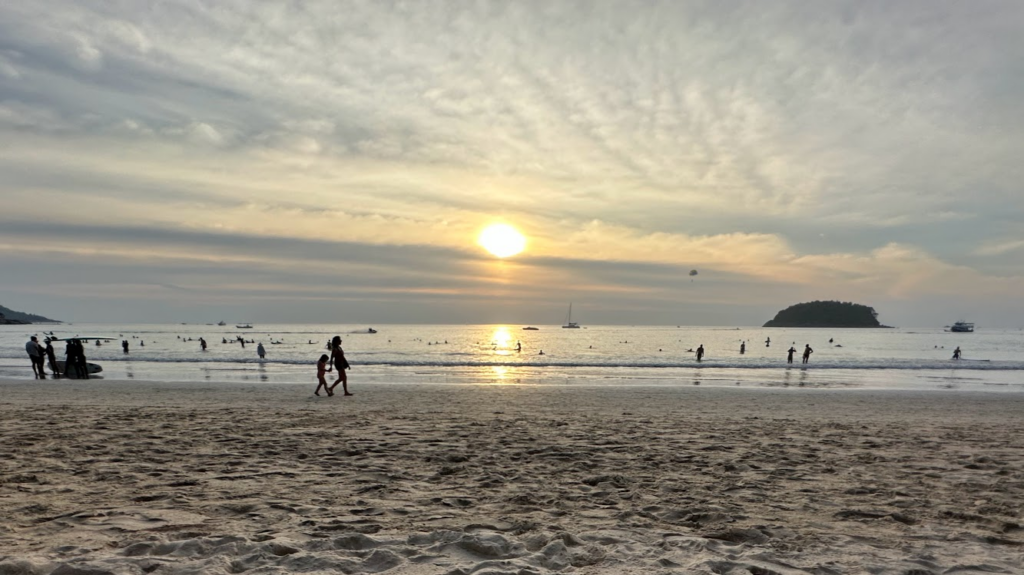
Phuket sits on the Andaman Sea and follows the Andaman monsoon pattern — dry and calm from November through April, wet and sometimes rough from May through October. The distinction matters: in monsoon season, the west coast beaches face the full force of the southwest swell, making swimming dangerous on red flag days and boat trips to Phi Phi or the Similan Islands frequently cancelled.
| Month | Weather | Crowds | Prices | Honest Assessment |
| November | Dry season begins. Occasional early showers. Seas calming. | Low–medium | Low–medium | Best time to visit. Weather is good, prices are down, beaches are quiet. |
| December | Peak dry season. Hot, sunny, calm seas. | Very high | Peak | Great weather, worst crowds and prices. Christmas–New Year is absolute peak. |
| January | Best weather of the year. Dry, clear. | Very high | Peak | Stunning conditions but fully tourist-operational. Book months ahead. |
| February | Excellent. Hot, clear, best visibility for diving. | High | High | Strong choice — slightly past the Christmas rush, weather at its best. |
| March | Still dry, seas calm, haze building. | Medium | Medium | Underrated. Good weather, manageable crowds, prices dropping. |
| April | Hot. Seas still calm. End of dry season. | Medium | Medium | Good option. Some haze but beach and water conditions still strong. |
| May–October | Southwest monsoon. Rain, rough seas, some daily sun. | Low | Low | Significantly different experience. Beaches usable on calm days; island trips frequently cancelled. Best for budget travellers who can be flexible. |
November and March are the two most underrated months in Phuket. Weather is good to excellent, prices are 20–40% lower than December–February peak, and the beaches are noticeably less crowded. If your dates are flexible, these are the windows to target.
Practical Information
| Detail | What You Need to Know |
| Getting around | No public transport. Options: rent a motorbike (from ~250 THB/day; international licence required), hire a driver for the day (~1,000–1,500 THB), tuk-tuk (negotiate price before departure), Grab app where coverage allows. |
| Airport | Phuket International Airport (HKT) is in the north of the island. Transfer to Kata or Nai Harn takes 45–60 minutes; to Patong around 40 minutes. Airport taxi: ~600–800 THB to most west coast beaches. |
| Money | ATMs are everywhere and charge a 220 THB foreign transaction fee. The best rates are from Superrich exchange booths (not airport ones). Credit cards accepted widely in hotels and larger restaurants; cash needed for markets and street food. |
| SIM card | Buy at the airport on arrival — AIS and DTAC both offer tourist SIMs with good data packages for around 299 THB for 30 days. Easiest logistical decision you will make. |
| Dress code | Temples require covered shoulders and knees. Beach-to-restaurant transitions: most restaurants in tourist areas accept beach cover-ups; Phuket Town restaurants expect slightly more than a swimsuit. |
| Safety | Rip currents on west coast beaches are real — obey beach flags. Red flag = do not enter water. Yellow = swim with caution. Ignore at real risk. |
| High season | Book accommodation for December–February at least 2–3 months ahead, particularly in Kata, Kata Noi, and Nai Harn. |
Is Phuket the Right Choice?
Phuket is the right choice if you want: easy international flight connections, a full range of accommodation from budget to ultra-luxury, reliable tour departure infrastructure for day trips to Phi Phi and the Similan Islands, a mix of beach and cultural options (Old Town), and good food options including high-quality international restaurants.
Phuket is the wrong choice if you want: an authentic Thai experience, quiet beaches without infrastructure, an island that does not feel over-touristed, or value for money relative to quality. Koh Lanta, Koh Lipe, or the Krabi coast deliver a meaningfully better experience for any of those priorities.
The honest version of the Phuket proposition: it is a convenient, well-developed destination with genuinely beautiful beaches in the right areas, which rewards visitors who research where to stay and are willing to do a short longtail ride to find the good bits. It does not reward visitors who book Patong because it was the cheapest option and expected a tropical paradise.
Phuket Frequently Asked Questions
It depends entirely on where you stay and what you expect. Kata, Kata Noi, and Nai Harn offer genuinely beautiful beaches that hold up against anywhere in Thailand. Patong and the central tourist strip are overdeveloped and feel artificial. Phuket Town has real character. The island is worth visiting with managed expectations and a base away from Patong.
Three to four days is enough to see the island’s highlights — a day on Kata and Kata Noi, a trip to Freedom Beach, Old Town, a day trip to Phi Phi or Phang Nga Bay, and a sunset at Promthep Cape. Five to six days allows you to also do the Similan Islands properly. More than a week and you are likely using Phuket as a base for regional day trips rather than exploring the island itself.
Kata Beach. It has the best balance of beach quality, accommodation range, accessibility, and atmosphere without the extremes of Patong’s noise or Nai Harn’s distance from everything. It is the default recommendation for first-time visitors who have not yet figured out what kind of Phuket visitor they are.
The beach itself is safe for swimming in dry season. The area around it has the standard safety considerations of any very busy tourist zone — be aware of your belongings in crowds, do not engage with jet ski operators, do not accept rides without agreeing prices, and do not drink so much on Bangla Road that your judgment is impaired. It is not dangerous in a meaningful sense; it is just relentlessly commercial and loud.
Yes, with the right area choice. Kata is good for families — calm water at the right tides, surf lessons for older children, good restaurants, and a manageable scale. Karon is also family-friendly. Avoid Patong with children. Kamala is quiet and works well for families wanting a lower-key experience. Nai Harn can have stronger currents — check flags carefully if swimming with children.