

You can make eating in Seoul surprisingly complicated. Search for the best food in the city and within minutes you will have fifty restaurants saved: a Netflix-famous market stall, the barbecue restaurant everybody saw on TikTok, a Michelin-listed soup shop, three bakeries in Seongsu and a café where the queue appears to be longer than the actual meal.
We don’t think this is the best way to eat in Seoul. Some restaurants are absolutely worth planning around. Some dishes make more sense in particular parts of the city. And there are food traditions in Seoul that deserve to be deliberately sought out.
But many of our favourite meals here have happened because we walked into somewhere that looked busy, ordered what everybody else was eating and stayed.
This guide is therefore not another list of Korean foods. We already have a guide to the South Korean dishes you should know and try.
This one answers a different question:
How do you eat well in Seoul?
That means what to eat, where to eat it, which markets and neighbourhoods we would prioritise, how we find restaurants, what we think is overhyped and which meals are worth leaving space for rather than booking before you have even arrived.
What should you eat in Seoul on your first trip?
If it is your first time in Seoul, we would make room for:
- one Korean barbecue meal
- one proper soup or stew
- naengmyeon or kalguksu
- fried chicken, preferably as an evening meal
- jeon with makgeolli
- one traditional market
- a casual Korean-Chinese meal such as jjajangmyeon or jjamppong
- at least one meal you did not research beforehand
That is enough. You do not need to work through a checklist of X number Korean dishes, and you certainly do not need to eat every famous food in Seoul. Korea has strong regional food traditions, so travelling around the country only to insist on eating everything in the capital makes little sense.
Our broader Korean food guide explains the individual dishes. In Seoul, we are more interested in where and how they fit into the city.
| If you want… | Prioritise |
|---|---|
| A classic first Seoul meal | Korean barbecue |
| Everyday Korean food | Soup or stew |
| A Seoul-specific food tradition | Naengmyeon, kalguksu or an established food alley |
| A market meal | Namdaemun, Mangwon or Gwangjang |
| A casual evening meal | Fried chicken |
| Food + drinking culture | Jeon and makgeolli |
| Something travellers often overlook | Korean-Chinese food |
| Our favourite approach | Leave at least one meal completely unplanned |
What food should you try in Seoul?
Korean barbecue
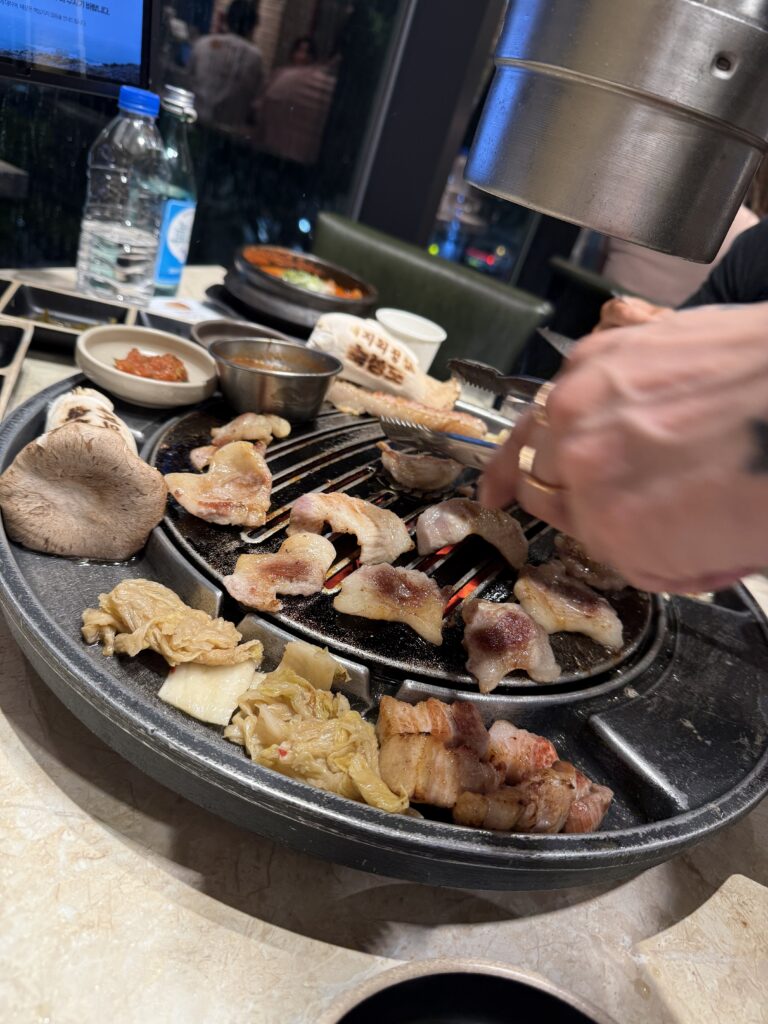
Korean barbecue is one of the meals we would prioritise on a first trip to Seoul, but you do not need to cross the city for a famous restaurant.
Samgyeopsal, galbi and other cuts grilled directly at the table are not only about meat; the meal is social, built around sharing, side dishes, sauces and repeatedly putting another piece on the grill while promising yourself that this is definitely the last one.
What we would not do is spend an hour travelling and another hour queueing for a barbecue restaurant simply because it became famous among international visitors.
For a normal barbecue meal, look for somewhere busy around dinner time with a focused menu.
If you want to spend more, Hanwoo is where restaurant research becomes more worthwhile because meat grade, cut, sourcing and preparation genuinely change the experience.
That’s a different meal from casual samgyeopsal and should be treated as such.
Korean soups and stews
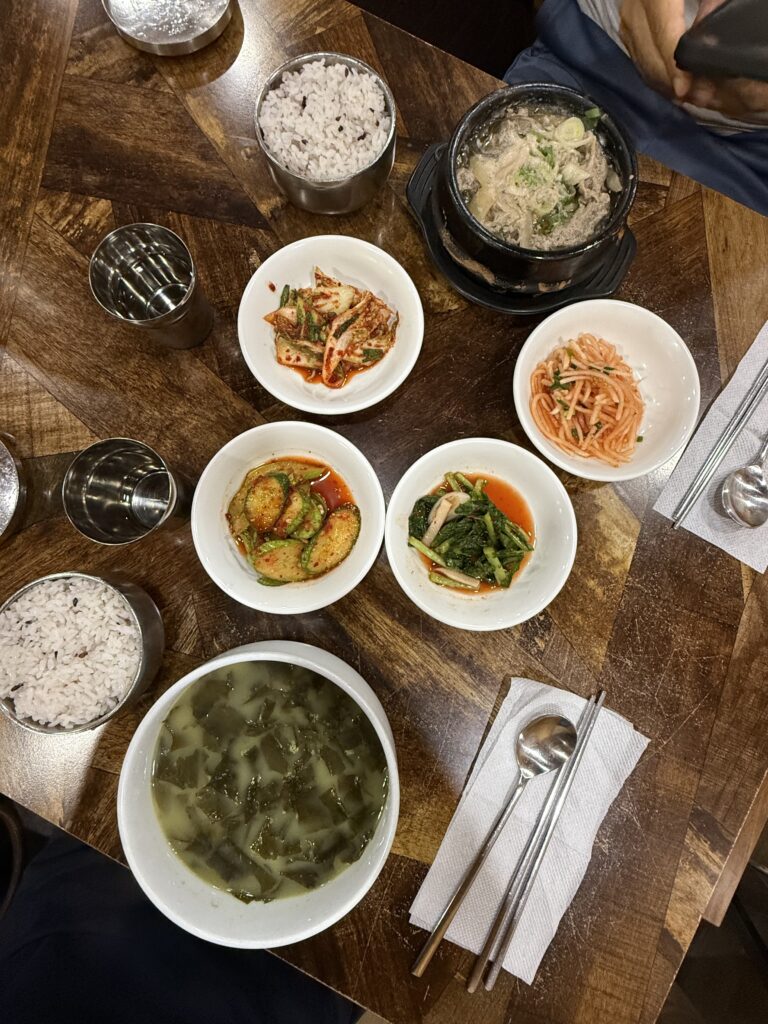
Seolleongtang, gomtang, sundubu-jjigae, kimchi-jjigae and gamjatang are some of the best choices if you want food closer to everyday Korean eating.
Korean soups and stews receive far less international attention than barbecue, probably because a bubbling bowl of brown broth is harder to turn into aspirational travel content. Ignore that.
They are also particularly good on cold, wet or exhausted Seoul days.
Our broader Korean food guide explains the dishes themselves. Here, the important thing is simply:
don’t spend an entire trip eating only foods that photograph well.
Naengmyeon
Cold noodles can be strange on first encounter if you are expecting something intensely seasoned.
That is partly the point.
Ojang-dong in central Seoul is known specifically for Hamheung-style naengmyeon, developed by people displaced from Hamhung after the Korean War.
That’s a good example of a food being worth travelling for because its history belongs to a particular part of Seoul.
Kalguksu
Knife-cut noodles are comforting, inexpensive and easy to find. Namdaemun’s Kalguksu Alley gives you both the dish and a particularly Seoul market experience.
You don’t need to make every bowl a culinary expedition.
Korean-Chinese food
Jjajangmyeon, jjamppong and tangsuyuk sometimes disappear from international lists because they don’t fit neatly into outsiders’ idea of “traditional Korean food”.
That makes no sense once you spend time in Korea.
Korean-Chinese food is thoroughly embedded in everyday eating culture. Jjajangmyeon in particular is one of those meals people order casually, including for delivery, rather than something that needs an elaborate culinary explanation.
Have it because people in Korea actually eat it, not because it has to qualify as ancient heritage before it deserves one of your meals.
Fried chicken
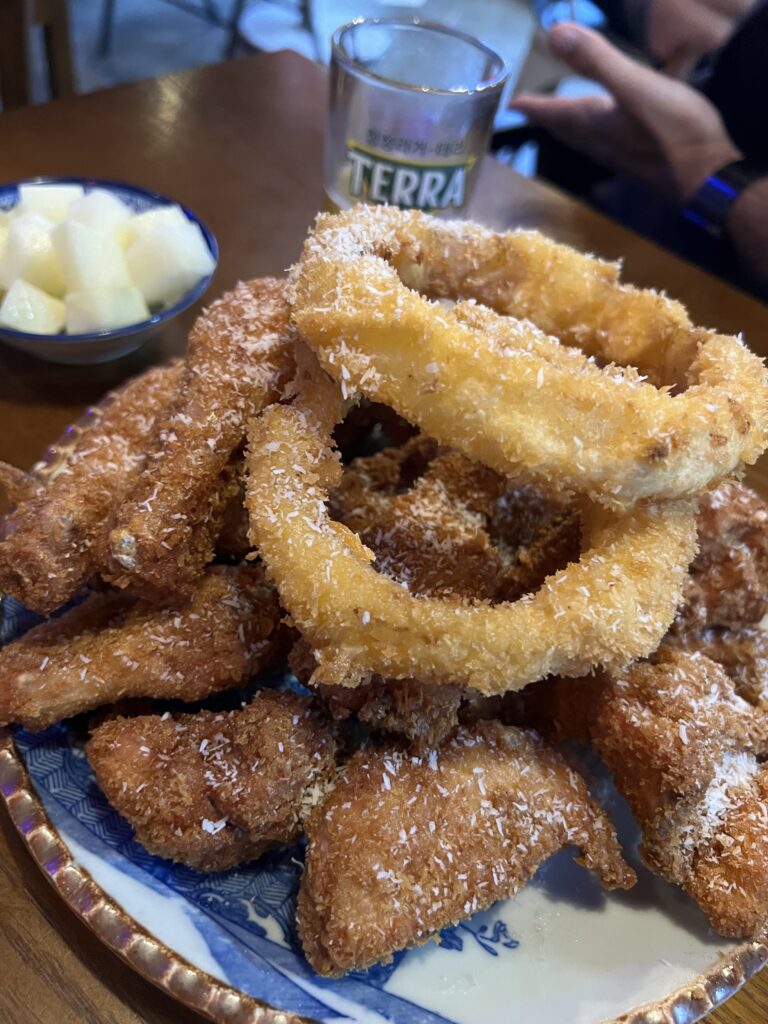
Korean fried chicken is another food we wouldn’t over-research. Find a good place. Order chicken. Have beer if you drink it.
Chimaek — chicken and maekju — works because it is casual.
It also fits particularly well with an evening beside the Han River, where delivery and takeaway food have become part of the social experience.
We would rather do that than schedule fried chicken at 3 p.m. because a restaurant appeared on a “best chicken in Seoul” list.
Jeon and makgeolli
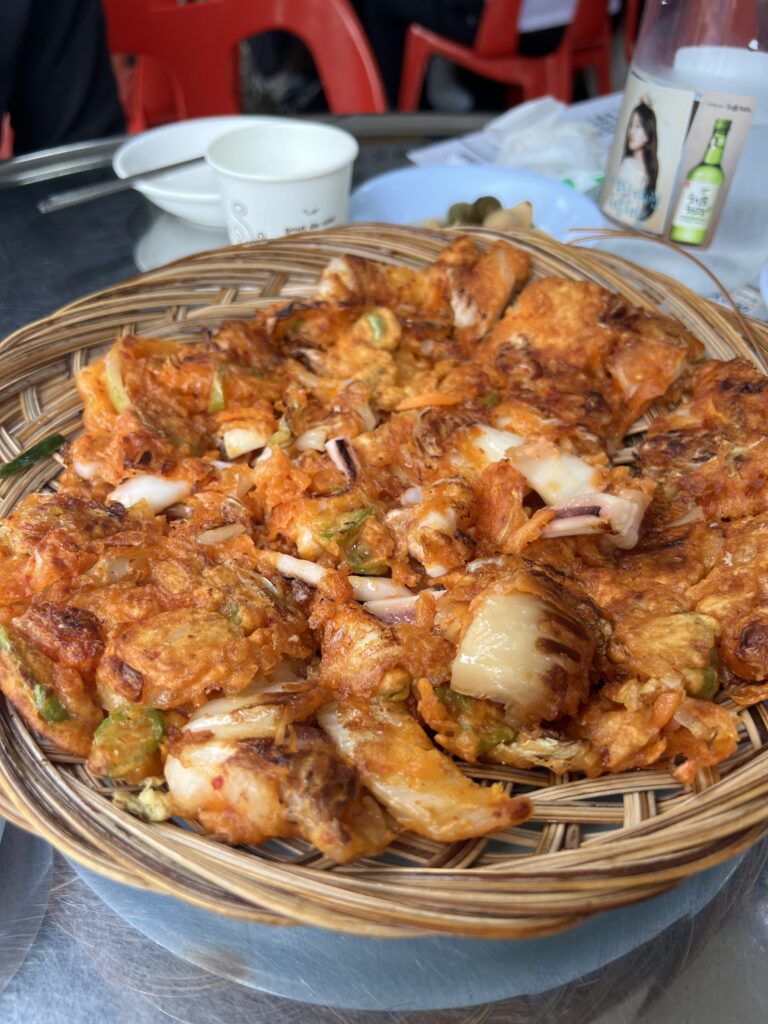
We hike Bukhansan every time we return to Seoul. And almost every time, we finish at one of the restaurants near the foot of the mountain with jeon and makgeolli.
We are usually surrounded by local hikers who never miss the opportunity to tell us what to order, show us how to drink makgeolli properly or simply watch with amusement as we enjoy exactly the same ritual again.
You can eat Korean pancakes elsewhere. You can drink makgeolli in a bar.
But putting them together after a mountain hike tells you something about Seoul that a list of “best restaurants” never will.
Food is often most interesting when it belongs to what people are doing around it.
How to eat well in Seoul
The best way to eat well in Seoul is to plan the meals where the restaurant or neighbourhood genuinely matters and leave the rest flexible.
Research the meals where research matters. Reserve somewhere exceptional if you want to. Know which neighbourhoods have particular food traditions. Then stop.
One of the problems with contemporary travel is that every meal now feels as though it needs to justify itself before you have eaten it. It needs 4.8 stars, a viral reel, hundreds of saves and preferably someone announcing that it is a “hidden gem” despite a two-hour queue outside.
Seoul does not require this level of optimisation.
Some of our most memorable meals have been in small cafeterias and neighbourhood restaurants that we would never have discovered through an English-language list. On several occasions, people have been so curious about who we were and why we had walked into that particular place that lunch turned into an exchange of stories: theirs and ours.
A small BBQ place near Naksan is still one of our fondest food memories in Seoul. The owners were so determined to help us cook the meat properly that, after a while, we simply stopped trying to intervene and let them take over completely even though we knew perfectly well what we were doing. The care they put into it made the meal far more memorable than the food alone.
That doesn’t make those restaurants “more authentic” than somewhere famous. It simply means that leaving room for discovery still matters.
Best areas to eat in Seoul
There is no single food district you need to stay near. Good food exists all over Seoul.
But different parts of the city make sense for different kinds of meals.
| Area | Best for |
|---|---|
| Jongno / Euljiro | Older restaurants, BBQ, drinking food |
| Mapo | Korean barbecue |
| Mangwon | Market food + neighbourhood eating |
| Namdaemun | Kalguksu and galchi food alleys |
| Hongdae / Sinchon | Casual meals and late nights |
| Seongsu | Contemporary dining and cafés |
| Gangnam | Premium dining and Hanwoo |
| Myeongdong | Convenience |
Jongno and Euljiro for older restaurants, evening food and drinking culture
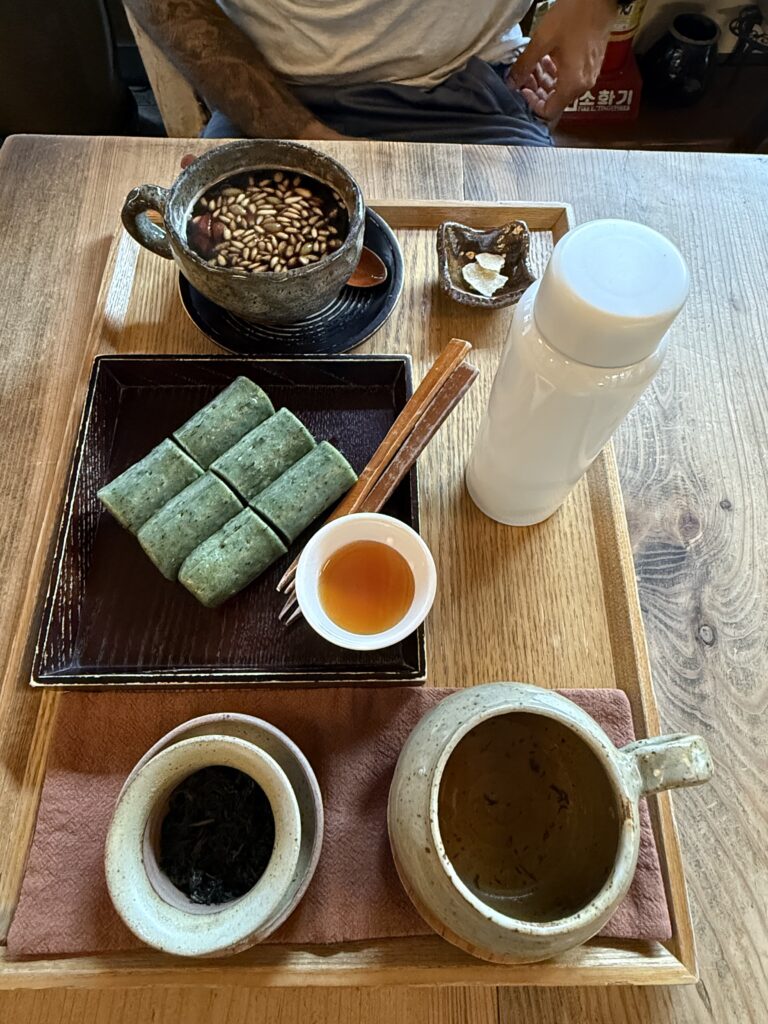
If you want an evening that felt particularly connected to older central Seoul, you should start around Jongno or Euljiro. This is where barbecue restaurants, pubs, specialist restaurants and places serving food designed to accompany alcohol sit alongside offices and increasingly fashionable new businesses.
Euljiro even has a long-established golbaengi alley, known for spicy seasoned whelk eaten with drinks. You do not need to eat golbaengi specifically.
The wider point is that Jongno and Euljiro work particularly well when you want dinner to become an evening rather than another restaurant reservation followed immediately by the subway home.
Mapo for Korean barbecue
Mapo has a long association with grilled meat and remains an easy area to consider if barbecue is a priority. But we would not recommend to cross the entire city because somebody declared one Mapo restaurant the definitive place for samgyeopsal.
A busy barbecue restaurant near wherever you are staying can give you an equally enjoyable meal. Travel for something distinctive, not simply because the internet has crowned a particular grill.
Mangwon for a market that still belongs to its neighbourhood
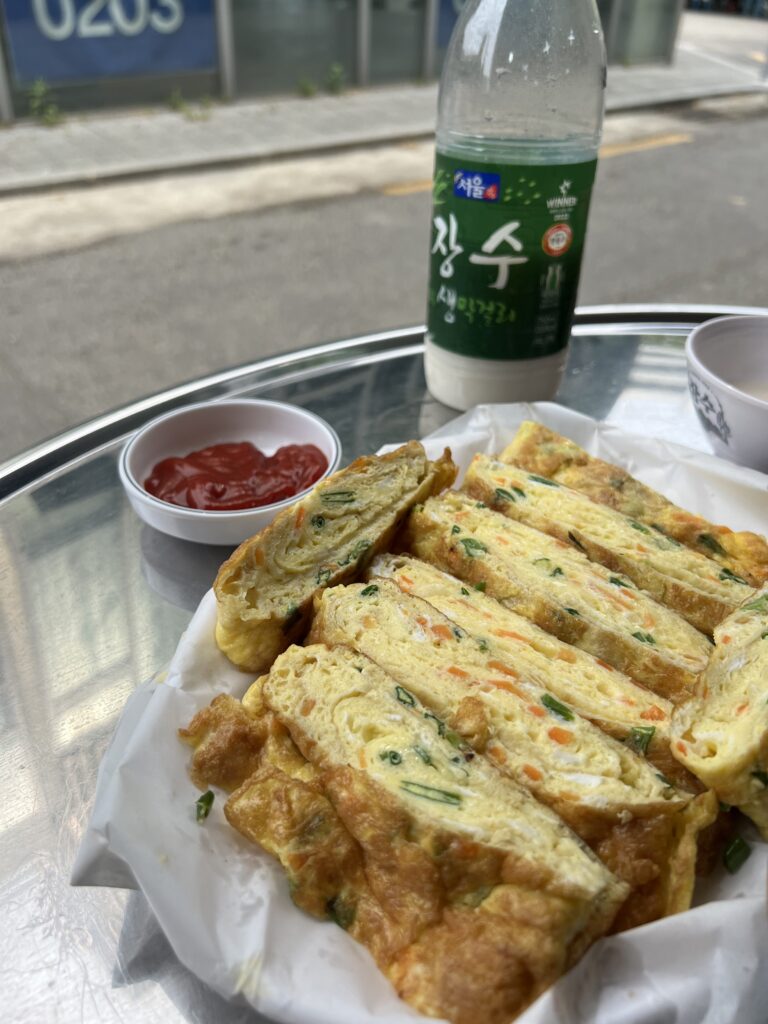
Mangwon Market is one of our favourite market choices in Seoul. It is compact, easy to understand and still functions as somewhere people buy produce, seafood, prepared dishes and everyday food.
Buy a few things. Look around the neighbourhood. Continue towards the river if the weather is good. You do not need a list of seven mandatory stalls.
Namdaemun for food alleys with an actual reason to exist
Namdaemun is much more interesting to us as a food destination than it sometimes gets credit for.
Its Kalguksu Alley developed after the Korean War and remains packed with small stalls serving knife-cut noodles, barley rice and often a small serving of naengmyeon alongside them.
There is also Galchi Jorim Alley, specialising in braised cutlassfish.
These are the sorts of places we are more willing to travel for because there is a relationship between the food and the place.
If we had to choose between travelling across Seoul for a viral snack and travelling for an established food alley, we know which one we would choose.
Hongdae, Yeonnam and Sinchon for casual eating and late nights
Hongdae, Yeonnam and Sinchon are useful when you want choice without much planning.
Chicken, barbecue, noodles, Korean-Chinese food, bars, casual restaurants and cafés are everywhere, and many places stay lively later than quieter parts of Seoul.
We do not travel here for one specific Korean dish. We come because the neighbourhood gives you lots of good options when you don’t yet know what you want to eat.
We once found an incredible fried-chicken place simply by wandering, without checking maps, reviews or recommendations. It was tiny, deeply local and completely empty of foreigners, which was exactly why we couldn’t resist going in. The owner battered and fried the chicken right in front of us while we watched, completely fascinated by the whole process. It was one of those meals that reminded us why leaving parts of Seoul unplanned can be so rewarding.
Seongsu for contemporary Seoul
Seongsu makes sense if you want to see where Seoul’s current food, fashion and café culture collide. Go for the neighbourhood. Try something interesting while you are there. But we would not send someone across the city to Seongsu because they asked where to experience “traditional Korean food”.
That isn’t really its role.
Gangnam for polished and higher-end dining
Gangnam makes more sense if you are looking for premium meat, contemporary restaurants, department-store food halls or a more polished dining experience.
There is excellent food south of the river. It simply isn’t where we would go to eat and to understand Seoul through food.
Myeongdong for convenience
You can eat perfectly well in Myeongdong. You can also eat badly.
Its central location and enormous visitor numbers mean there are restaurants aimed squarely at tourists alongside perfectly legitimate Korean restaurants and long-running businesses.
Use it when it is convenient.
We just wouldn’t make “eat everything in Myeongdong because we are staying there” the food strategy for an entire Seoul trip.
Best food markets in Seoul
Seoul markets are an easy way to experience several foods at once, but they are not interchangeable.
| Market | Best for | What we would look for | Our verdict |
|---|---|---|---|
| Gwangjang Market | Famous market atmosphere | Bindaetteok, yukhoe, gimbap, noodles, kkwabaegi | Go, but don’t mistake it for all of Seoul’s food culture |
| Mangwon Market | Neighbourhood market experience | Prepared foods, chicken, snacks, side dishes | One of our favourites |
| Namdaemun Market | Established food alleys | Kalguksu, barley rice, galchi jorim | Strong recommendation |
| Tongin Market | Small traditional market near historic Seoul | Snacks and simple market food | Worth it if it fits your route |
| Noryangjin Fish Market | Seafood | Fish and shellfish selected at the market | Go if seafood is genuinely a priority |
Is Gwangjang Market worth visiting?
Yes, Gwangjang Market is worth visiting but you need to go there aware of what it is today.
Gwangjang is one of Seoul’s most famous markets and has been operating since the early twentieth century. It is strongly associated with foods including bindaetteok, yukhoe and small gimbap. It is also extremely famous internationally.
Those two facts can coexist.
Popularity does not automatically make a place bad, just as seeing mostly Korean customers does not automatically make somewhere good.
What we would avoid is going to Gwangjang, queueing only for the stalls already famous on television and social media, eating three things somebody told us were mandatory and deciding that we had now understood Seoul’s market culture.
Walk around. Eat something you actually want. Look beyond the most photographed intersection. Then visit another market during your trip.
Mangwon or Gwangjang Market?
If you only have time for one and want the iconic Seoul market experience, choose Gwangjang. If you are more interested in seeing a market embedded in an ordinary residential neighbourhood, we prefer Mangwon.
Mangwon also works beautifully as part of a larger afternoon because the market sits close to Mangwon-dong and the Han River.
Seoul food alleys worth knowing
Seoul has several long-established food alleys where particular dishes are closely tied to a specific neighbourhood, including naengmyeon in Ojang-dong, kalguksu and galchi jorim in Namdaemun, jokbal in Jangchung-dong and tteokbokki in Sindang-dong.
| Seoul food alley | Known for | Would we go? |
|---|---|---|
| Ojang-dong | Hamheung naengmyeon | Yes, if you like naengmyeon |
| Namdaemun | Kalguksu and galchi jorim | Strong recommendation |
| Euljiro | Golbaengi | More interesting as part of an evening out |
| Jangchung-dong | Jokbal | Worth it if jokbal is a priority |
| Sindang-dong | Tteokbokki | Fun, but not essential |
| Wangsimni | Gopchang | Worth seeking out if you like offal |
Where to find street food in Seoul
The easiest places to find street food in Seoul are traditional markets and busy commercial areas such as Gwangjang, Namdaemun, Myeongdong and Hongdae; Seoul is not one continuous street-food market.
Tteokbokki, hotteok, eomuk, fried snacks and market foods are fun and inexpensive. But the idea that Seoul is one endless street-food market is largely a travel-content fantasy.
You will find concentrated street food around markets and some commercial districts. Elsewhere, you may barely notice it.
Eat street food when you encounter something appealing. Then sit down and have actual meals too.
Where do locals eat in Seoul?
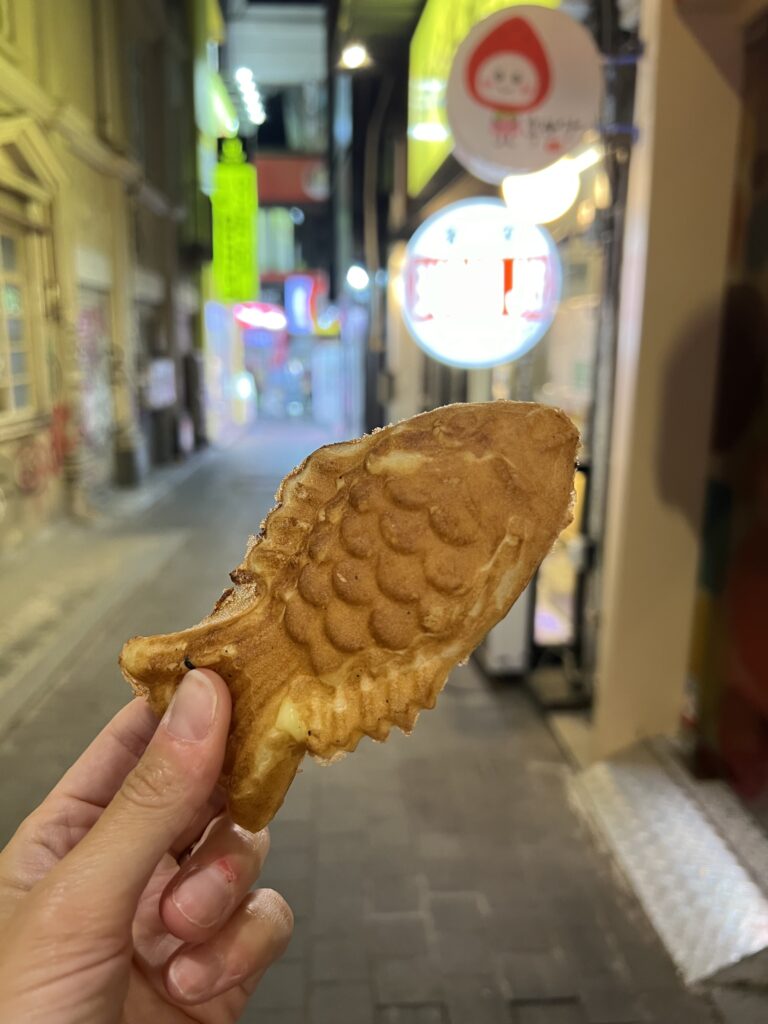
Seoul locals eat everywhere. There isn’t another, secret Seoul where residents eat behind an invisible door tourists have failed to discover.
People eat in neighbourhood restaurants, chains, department stores, shopping malls, markets, delivery restaurants, office-district cafeterias, trendy openings and places that have served the same dish for decades.
The better question is:
Does this restaurant have a reason to exist beyond attracting visitors?
After years traveling to Seoul and Korea, we pay attention to places that:
- specialise in a small number of dishes;
- are busy during normal local meal times;
- attract office workers or neighbourhood residents;
- have recent Korean-language reviews;
- make sense in the area where they are located;
- or simply look and smell good when we walk past.
That can be a more useful discovery method than trying to hunt down somewhere supposedly unknown to tourists.
And don’t make the opposite mistake of assuming that a restaurant needs to look traditionally Korean to tell you something about how people eat in Seoul.
A restaurant underneath an office tower can be as relevant to everyday Seoul as a decades-old restaurant in Jongno. So can a department-store food hall, a busy chain or a contemporary restaurant working with Korean ingredients in completely modern ways.
The obsession with finding the “real” place to eat can produce a strangely narrow version of Korean life.
Modern Seoul is also Seoul.
What matters to us is not whether a restaurant looks traditional, but whether it has a reason to exist beyond performing an idea of Korea for visitors.
How to find good local restaurants in Seoul
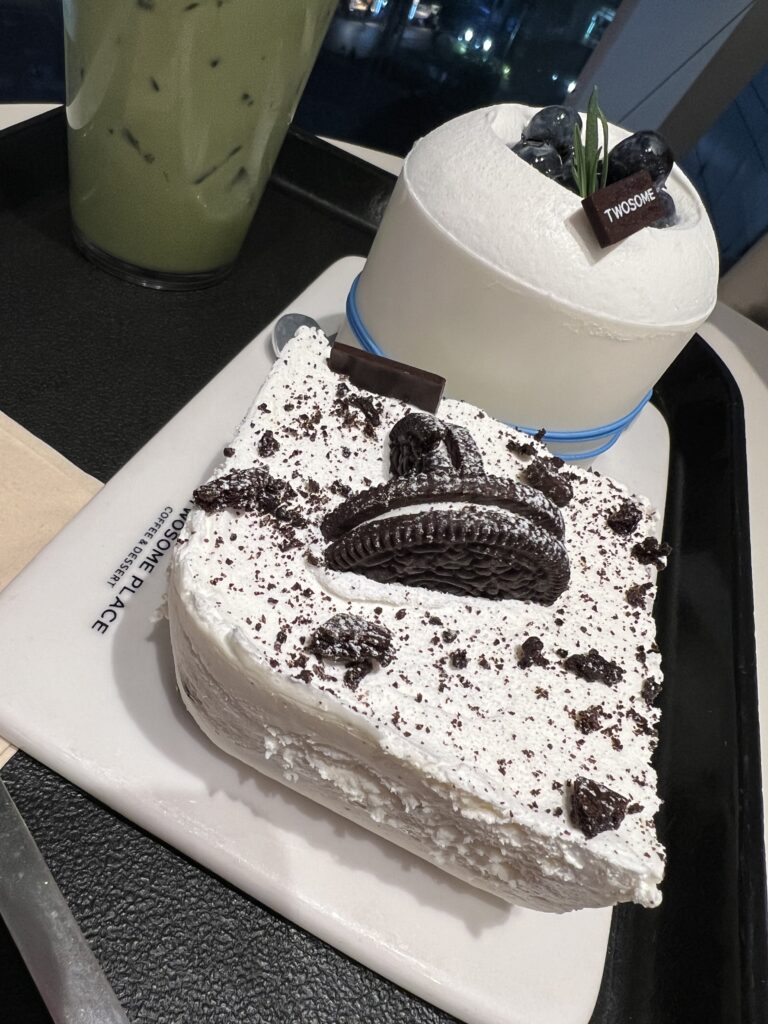
Our preferred way to find local restaurants in Seoul is to discover them while walking and use Naver Map afterwards to check recent Korean reviews, opening hours and photographs.
We rarely choose a restaurant in Seoul because we saw it on a list, saved it on social media or found it while scrolling through a map. Most of the time, discovery happens once we are already there.
We walk. We look at what is busy. We notice what people are eating, what is being cooked, whether a place feels like it belongs to the neighbourhood rather than existing primarily to attract visitors. If something catches our attention, we might quickly check Naver Map to see recent reviews or confirm opening hours. Then we decide for ourselves.
That approach has led us to some of our favourite meals in Seoul: tiny restaurants that barely register on international travel guides, places where the food is cooked the way it might be at home, and where the familiarity between owners and regular customers becomes part of the experience.
We have walked into small barbecue restaurants because the smell stopped us outside. We have found fried chicken places by accident and ended up watching the owner batter and fry every piece in front of us. None of these meals started with a saved pin.
That does not mean we ignore recommendations. Michelin, Netflix, food programmes, Instagram and TikTok can all point you towards places worth knowing about. We just do not treat any of them as instructions.
A Michelin restaurant can be excellent without representing everything that makes Seoul a great food city. A place featured on Netflix may genuinely be worth visiting, but fame can also mean queues and a very different experience from the one that made it interesting in the first place. Social media is particularly good at showing you what something looks like and much less useful at telling you whether travelling 45 minutes across Seoul for it is actually worth your time.
We use Naver Map much more than Google Maps when we need practical information, and CatchTable can be useful for restaurants that genuinely require reservations.
But for us, all of these are tools for confirming or refining a decision, not making it.
We usually find the place first and research it second.
What should you know before eating at a restaurant in Seoul?
During our very first trip to Korea, we walked into a small local restaurant in Seoul and ordered soup. When the food arrived, we spent several minutes looking around for the chopsticks and spoons, increasingly convinced that we had somehow been forgotten.
Eventually, we discovered them in a small drawer built into the side of the table.
Nobody had forgotten anything. We simply had no idea where to look.
It is a tiny detail, but Seoul restaurants are full of little conventions like this that become completely normal once you know them:
- Don’t be surprised if water is self-service.
- Check under or beside the table for the utensil drawer before assuming nobody gave you chopsticks and spoons.
- Some restaurants use tablets or kiosks for ordering. At others, you order at the table and pay at the counter when you leave.
- Side dishes are commonly included with Korean meals, and some can be refilled, but don’t assume everything placed on the table is unlimited.
- Tipping is not normally expected.
- At barbecue restaurants, minimum orders can apply, particularly if you are eating alone.
- And if Google Maps says somewhere is open but Naver says otherwise, we would trust Naver first.
How we recommend eating in Seoul
There is no single restaurant, market or neighbourhood that will give you the definitive Seoul food experience.
If it is your first trip, start with a few meals that are genuinely worth planning: Korean barbecue, a proper soup or stew, naengmyeon or kalguksu, fried chicken, jeon with makgeolli and at least one traditional market. Gwangjang is worth seeing for the famous market experience; Mangwon gives you a better sense of a neighbourhood market; and Namdaemun is where we would go specifically for established food traditions such as Kalguksu Alley and Galchi Jorim Alley.
Where you eat matters too. Jongno and Euljiro work particularly well for older restaurants and evening eating, Mapo for barbecue, Hongdae and Sinchon for casual food and late nights, Seongsu for contemporary Seoul and Gangnam for more polished dining.
But we would not build every day around restaurant reservations or cross the city every time somebody online declares that one place serves the “best” version of a dish.
Seoul is too large, and too good for food, for that.
Research the meals where the place itself matters. Use Naver Map to check what you find. Book ahead when a restaurant genuinely requires it.
And leave enough meals unplanned to notice what is happening around you.
Some of the restaurants we remember most were never on our itinerary: the tiny barbecue place where the owners decided they were going to cook every piece of meat for us whether we needed help or not; the fried-chicken shop we walked into simply because we saw the owner battering and frying the chicken in front of us; the small cafeterias where lunch unexpectedly became a conversation.
That is ultimately how we recommend eating in Seoul: know what is worth seeking out, but don’t become so busy searching for Seoul’s best food that you stop noticing the food directly in front of you.
Convenience-store food is worth trying in Seoul We like Korean convenience stores. A lot. They are useful. They are everywhere. They can rescue you after a late arrival, supply drinks for a walk and occasionally produce surprisingly enjoyable snacks.
The Han River ramyeon experience can also be fun.
What we don’t think you need is a scheduled two-hour “convenience-store food experience” involving sixteen products assembled because a TikTok told you which combination to make.
Sometimes CU is simply where you bought water. That is the best approach.
Yes. Seoul’s café culture is extraordinary partly because cafés here are often about far more than coffee.
Architecture, fashion, pastry, design and social media all collide in places such as Seongsu and Yeonnam.
Visit some. But don’t spend your entire trip queueing for visually ambitious pastries while telling yourself that this is culinary research.
A viral café is still occupying stomach space that could have gone to lunch.
Vegetarian and vegan dining is relatively easy in Seoul if you plan a little. Gluten-free dining is harder.
Seoul now has a growing number of dedicated vegan and vegetarian restaurants, particularly in areas such as Itaewon, Mapo and central Seoul. Official tourism listings include fully vegan restaurants such as PLANT and Vegan Kitchen, as well as temple-food restaurants such as Sanchon.
The difficulty starts when you move away from dedicated restaurants.
A dish that looks vegetarian may still contain anchovy broth, meat stock, fish sauce or seafood-based seasoning. Kimchi is not automatically vegetarian either. VISITKOREA explicitly warns that many Korean dishes use meat or fish broth and that restaurants may not have a standard procedure for dietary requests.
For vegans, the safest strategy is usually to choose restaurants that are explicitly vegan rather than trying to modify traditional dishes one ingredient at a time.
Gluten-free is more complicated. Soy sauce, gochujang, marinades, noodles, fried coatings and processed sauces can all contain wheat, and cross-contamination can be difficult to establish in small restaurants. Some vegan restaurants do offer gluten-free dishes, but vegan does not automatically mean gluten-free.
If you have a strict allergy or coeliac disease, we would not rely on simply saying “gluten-free” or “vegetarian”. Carry a clear Korean explanation of exactly what you cannot eat and, where possible, choose restaurants that explicitly cater to the restriction.
Eating in Seoul can still be relatively affordable, but prices vary enormously depending on what and where you eat.
For everyday Korean food, a useful 2026 benchmark is roughly ₩8,000–₩13,000 per person for a simple sit-down meal. Current Seoul averages put kimchi-jjigae at about ₩8,654, kalguksu at around ₩10,038, bibimbap at roughly ₩11,769 and naengmyeon at around ₩12,615. Korean barbecue costs more: the current average for a 200 g portion of samgyeopsal in Seoul is about ₩21,321 before you add extra meat, rice, alcohol or other dishes.
In practice, we would budget around ₩10,000–₩15,000 for an ordinary lunch, ₩20,000–₩40,000+ per person for barbecue or a longer evening meal, and considerably more for premium Hanwoo or contemporary fine dining. Market food, kimbap shops and simple cafeterias can cost less.
Seoul is also one of those cities where spending more does not necessarily give you a more memorable meal. Some of our favourite food experiences have cost very little, while premium meat or a restaurant doing something genuinely distinctive are the occasions when we think spending more can make sense.
So we would not set a strict daily food budget and try to make every meal fit it. Save on everyday soups, noodles and casual restaurants, then spend more when the food or experience actually justifies it.
Most everyday restaurants in Seoul do not require reservations. For neighbourhood restaurants, soup shops, noodle places, casual Korean barbecue and market eating, we usually just turn up.
Reservations become more relevant for very popular restaurants, premium Korean barbecue or Hanwoo restaurants, tasting menus, Michelin-listed restaurants and fashionable places that attract heavy demand.
For these, CatchTable is one of the most useful platforms.
The other thing to understand is that not having a reservation does not always mean simply standing in a physical queue. Some popular Seoul restaurants use digital waiting systems, so checking how a restaurant handles queues before travelling across the city can save a lot of wasted time.
Our approach is simple: we reserve when the restaurant itself is part of the reason we are going. For ordinary meals, we prefer the freedom to decide once we are already in the neighbourhood.
Also check opening hours and break times. Many restaurants close between lunch and dinner, and holiday schedules can change;
No. Tipping is not normally required or expected in restaurants in Seoul or elsewhere in South Korea.
Korea Tourism Organization explicitly states that tipping is not expected in Korean restaurants. Water and standard side dishes are also generally provided without an additional charge, although increasingly you may be expected to refill them yourself from a self-service station.
That applies to the kinds of places most travellers will use: neighbourhood restaurants, Korean barbecue restaurants, cafés, noodle shops and casual dining.
So you do not need to calculate 10%, 15% or 20% on top of the bill. Pay the amount charged and do not feel that you are being impolite by leaving without adding a tip.
What can confuse first-time visitors is that service works differently in other ways too. You may find a call button on the table rather than having staff constantly check on you, water and side-dish refills may be self-service, and the chopsticks and spoons may be hidden in a drawer built into the table. These are normal restaurant conventions, not signs that service is poor.